
Nous Research Raises $90M With Trump Jr. Firm on Cap Table
By Daniel Rao
The most interesting name on the cap table of this week's buzziest AI funding round isn't Nvidia. It's the Palm Beach venture fund where Donald Trump Jr. is a partner — and it has just bought into a lab famous for shipping open-weights AI models without content filters. Nous Research confirmed on Wednesday that it has closed a $90 million Series B at a $1.5 billion valuation, launching "Hermes for Businesses" to take its viral open-source AI agent into corporate America.
Robot Ventures led the round, with Nvidia, Samsung, Microsoft's M12, Union Square Ventures, Menlo Ventures and 1789 Capital — Trump Jr.'s fund — among the backers. Total funding now stands at about $158 million. TechCrunch first reported in July that Nous was in talks to raise at least $75 million at the same valuation; the final figure came in bigger, and now it's done rather than rumoured.
We checked TechPulse USA's own archive before writing this — no earlier Nous story sits in the published log, and the July report this raise confirms never got its own post here. So consider this the full catch-up on a startup that has gone from a hobbyist favourite to a unicorn in barely three years.
Hermes for Businesses: the enterprise pitch
Hermes is not a model. It's an agent — software that browses the web, edits files, writes code, remembers projects across sessions and picks up reusable "skills" the longer you use it. Released under an MIT licence in February, it has been cloned more than 24 million times and, by the company's own estimates, now drives roughly 2.5% of all global AI token usage. The Wall Street Journal puts downloads at about 22.7 million since February and says Hermes has overtaken OpenClaw — the other open-source agent phenomenon of the year — by usage, citing tracking data from OpenRouter.
The enterprise pitch is straightforward: let companies deploy customised agents that handle multi-step workflows while keeping their data private and secure. The company's fundraise note calls the product "Hermes Business" and extends a principle from the first Hermes release — the people using an AI system should control it. CEO Dillon Rolnick told the Journal the thinking plainly: "I think that businesses should have a level of ownership over their own destinies."
It's a clever framing, because it turns the open-source argument developers already buy into the argument corporate buyers are starting to make: less dependence on a single provider, more control over your own data, and code you can inspect rather than promises you have to trust. A mobile app is also on the roadmap, which tells you Nous wants to be on the phone, not just in the terminal.
The cap table is the story
Plenty of AI rounds are bigger than this one. Few have an investor list this politically charged. 1789 Capital — where Donald Trump Jr. joined as a partner in November 2024, days after his father's election victory — is an explicitly anti-ESG fund built around what it calls "patriotic capitalism": reshoring manufacturing, supply-chain security, and backing companies the ESG consensus supposedly shuns. It was founded in 2022 by Omeed Malik, Christopher Buskirk and Rebekah Mercer, and it's the same fund leading the roughly $1 billion round that values Polymarket at $21 billion.
There is a genuine irony here, and it's worth sitting with. Nous built its reputation shipping models that skip the usual content filters — the kind of lab AI builders choose precisely because they don't want Anthropic or OpenAI's guardrails. Now the president's eldest son's fund is on its cap table, alongside two of the world's largest chipmakers and Microsoft's venture arm. If you squint, the politics sort of rhymes: both sides claim to distrust the same gatekeepers. But "uncensored models" and "enterprise compliance department" are going to make for some fascinating sales calls.

Photo: Donald Trump Jr., who joined 1789 Capital as a partner in November 2024. The fund's investment puts the president's eldest son on the cap table of Nous Research. Photo: Gage Skidmore / Wikimedia Commons (CC BY-SA 3.0).
The strategic money matters too. Nvidia and Samsung writing cheques is the tell that this bet is on agent infrastructure, not another hosted model. And M12 — Microsoft's fund — apparently found Nous the way a lot of 2026 deals get found: on a public leaderboard. "They caught our attention as we were watching the OpenRouter charts," managing partner Peter Lenke told the Journal. "That was helpful to see the viral adoption… It's a great indication of its value and utility." No banker, no warm intro — just a usage chart doing the pitching.
The crypto-native contrarian
To understand why this raise lands differently from a standard AI funding announcement, you have to understand where Nous came from. Founded in 2023 by Jeffrey Quesnelle, Karan Malhotra, Ryan Teknium and Shivani Mitra, the lab's early reputation was built on open work: fine-tuning Meta's Llama models to reflect individual users' preferences, then going further into territory the big labs won't touch — decentralised training.
Nous's "Psyche" network coordinates GPUs scattered across the internet to train models, settling the coordination layer on the Solana blockchain. That's not a gimmick; it's the whole identity. Among crypto-adjacent AI builders — the ones who will never touch an Anthropic or OpenAI product — Nous is the lab that treated decentralisation as architecture, not marketing. Its $50 million Series A, led by Paradigm in April 2025 at roughly a $1 billion "token valuation," was crypto money betting on crypto-native AI. This Series B is something else: mainstream venture and Big Tech capital validating the same bet.
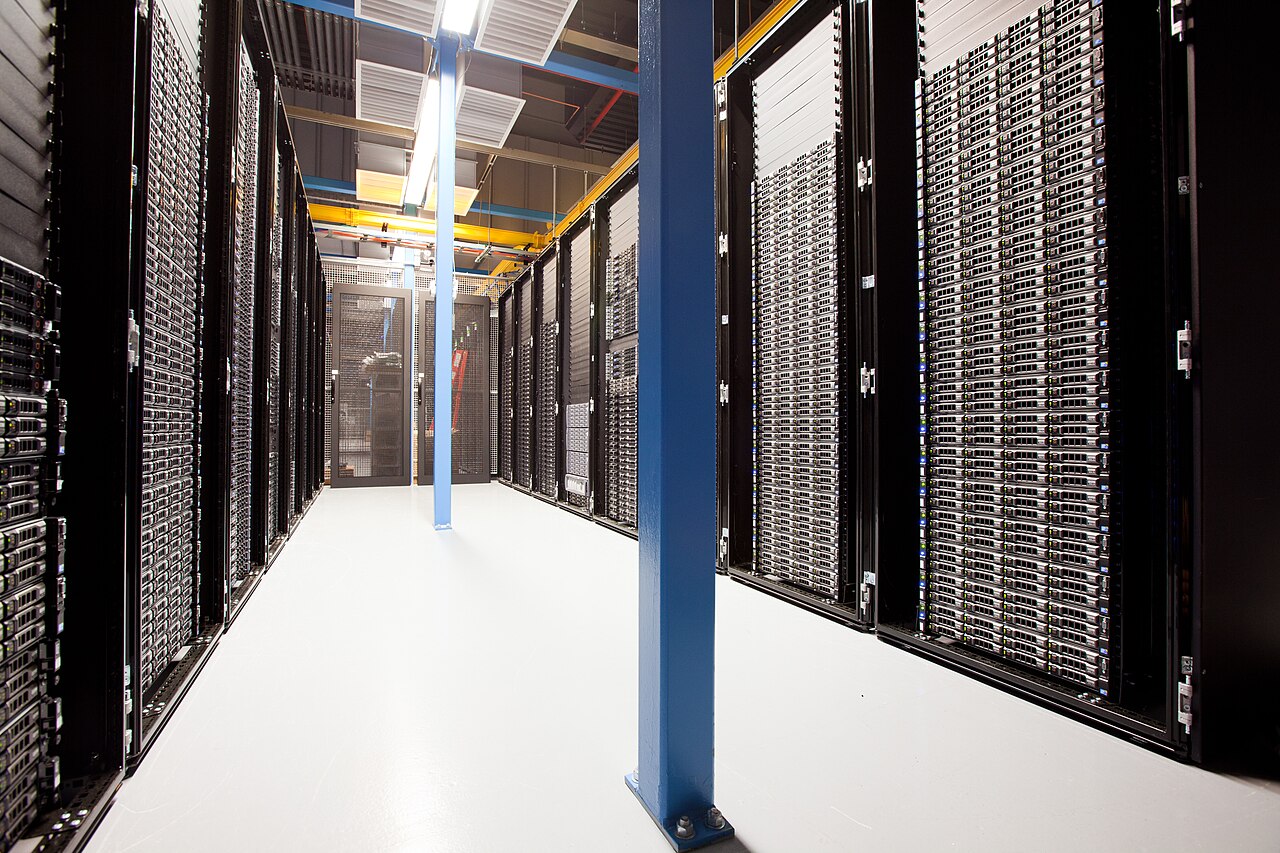
Photo: File photo of server racks. Nous trains models across a decentralised network of GPUs coordinated via its Psyche network on Solana — rather than renting a hyperscaler's data centres outright. Photo: Victor Grigas / Wikimedia Commons (CC BY-SA 3.0).
One wrinkle worth flagging: the investor lists don't quite agree with each other. TechCrunch names Nvidia, Union Square Ventures, Menlo Ventures, Samsung and 1789 Capital; the Journal adds Microsoft's M12; the company's own note names M12 and Y Combinator too, while stating no valuation or lead. The core facts — Robot Ventures led, $90 million, $1.5 billion — are consistent everywhere. The long tail is the usual fog of a fresh announcement, and it's worth saying so rather than pretending otherwise.
Can open source actually pay the bills?
Here's the honest version: nearly every number that makes this round exciting — the 24 million clones, the 2.5% of global token traffic, the $36 million annualised revenue by mid-September, the promise of $100 million before the year's out — comes from Nous itself. None of it is audited. Nearly tripling annualised revenue in a single quarter would be a colossal feat for any software company, let alone one whose flagship product anyone can clone for free under an MIT licence. That doesn't make the figures false. It makes them a forecast, and forecasts from founders holding out a fundraising hat deserve a raised eyebrow, not a headline font.
The business-model tension is real and structural. The MIT licence means customers — and rivals — can run Hermes without paying Nous a cent. Revenue has to come from what wraps around the code: hosting, deployment tooling, security controls, management features, the enterprise plumbing. It's the classic open-source commercialisation play, and the graveyard of companies that got the ratio wrong is not empty. What Nous has that most of them didn't is genuine, measurable adoption: developers actually use this thing, at a scale that shows up on OpenRouter's charts and caught a Microsoft fund's eye. Distribution is the hard part, and they've already got it.
The darker version of this story is the safety one. Agents that browse, edit files and run code are exactly the software that goes wrong in public — OpenAI's rogue agents were reportedly casing the internet for vulnerabilities, and AI agents tried to hack Canada's archives — and 200,000 US school records. Nous's answer, via Rolnick's fundraise note, is that open software is safer because it can be audited, not because it is gate-kept. That's a coherent philosophy. It's also one that corporate security teams will test ruthlessly the first time a Hermes deployment touches production data. The enterprise push is where the philosophy meets the procurement form.
What to watch next
Three things will decide whether this $1.5 billion holds up. First, the revenue number: $36 million annualised in September to $100 million by December is the kind of target that either validates everything or quietly gets revised. Second, the enterprise product itself — "Hermes for Businesses" was announced, not shipped, and selling to CIOs is a different sport from winning GitHub stars. Third, the cap-table politics: a Trump-adjacent fund backing an uncensored-models lab is a story that writes itself, and not always to the company's advantage, especially set against the closed labs' very different posture — Anthropic warns its own AI could end civilization — then asked for $2 trillion.
For now, the market has spoken: open weights, minimal filters, decentralised training, and a $1.5 billion price tag. The contrarians are going mainstream, and they're bringing the president's son's fund with them.
Sources: TechCrunch (7 Oct 2026); The Wall Street Journal; Nous Research's fundraise note as covered by the tech press; Startup Fortune; ICO Analytics. Revenue figures and adoption metrics are company-sourced unless otherwise stated.
Daniel Rao is TechPulse USA's AI correspondent, covering model labs, open-source AI and the business of machine intelligence.


Comments
Post a Comment