
Jefferies: America Is Planning More AI Datacenters Than Its Chip Supply Can Fill
America's AI Datacenter Pipeline Is Now Running Into a Hard Ceiling: Its Own Chip Supply
The United States is planning far more AI datacenter capacity than its chip supply can fill. That is the blunt conclusion of a new Jefferies analysis of SynMax satellite imagery, reported by The Register on September 30 — and it reframes the AI buildout debate entirely. The binding constraint on America's AI infrastructure is no longer just land, power, or community opposition. It is now showing up in orbit: there may simply not be enough advanced chips — and enough advanced packaging for those chips — to fill the shells everyone is building.
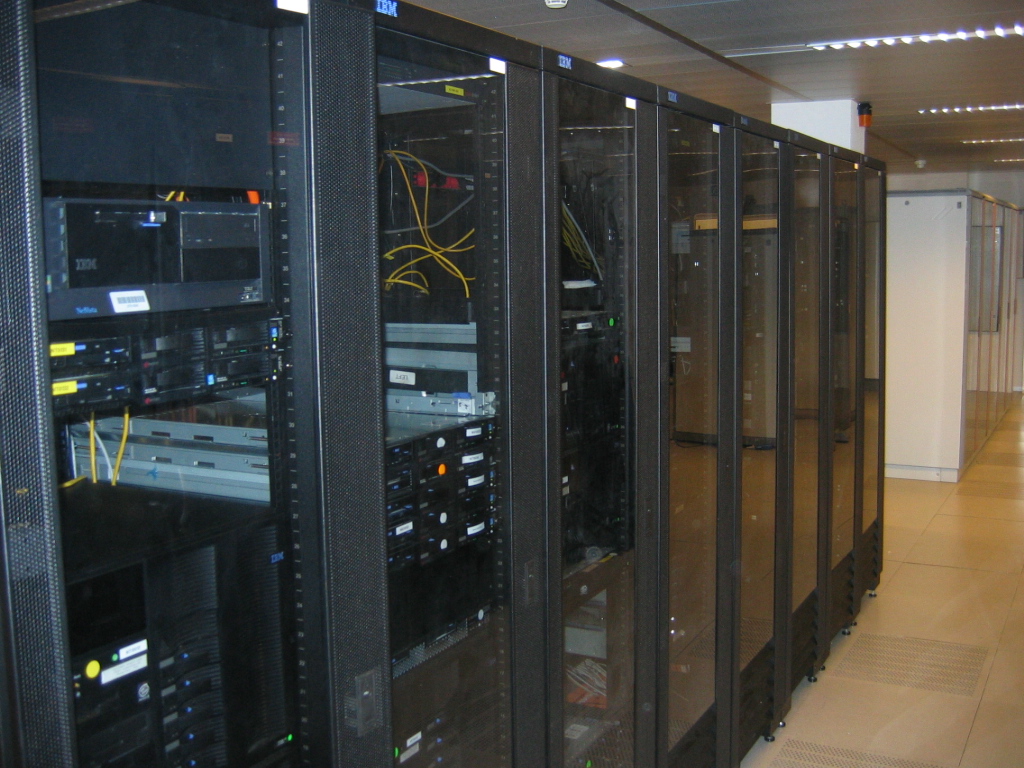
File photo: server racks inside a datacenter. As SynMax satellite data shows, US construction is accelerating — but the chip supply to fill new halls is now the binding constraint. Photo: Wil Weterings, public domain, via Wikimedia Commons.
SynMax, which tracks datacenter construction from satellite imagery, estimates that U.S. deployments will rise from roughly 11 gigawatts of gross capacity in 2025 to 16–18 GW in 2026 — above its own previous forecast of 14–16 GW. But the trajectory then hits a wall: the practical upper limit for 2027 sits in the low 20s of gigawatts, and once CPUs, memory, cooling, and other non-accelerator loads are accounted for, that converts to approximately 17.5 GW of total datacenter power. Construction is accelerating; deliverable compute is plateauing.
What the satellites are seeing
The methodology is what gives the finding its weight. SynMax does not rely on press releases, county permits, or hyperscaler roadmaps — it watches dirt move. Its analysts track land clearing, foundation work, and shell construction across the country, producing a ground-truth inventory of what is actually being built rather than what has been announced.
What the imagery shows is a two-part picture. On the ground, construction is genuinely accelerating: the 2026 deployment figures have been revised upward. But the land-clearing phase — the earliest, most reliable indicator of the future pipeline — has plateaued. Developers are finishing what they started faster, while starting less that is genuinely new. The result is a surge in 2026 deliveries with diminishing follow-through behind them.
This is where the numbers stop adding up. The 2028 pipeline implies roughly 80 GW of planned capacity. SynMax's satellite-derived reality puts the deliverable envelope for 2027 at about 17.5 GW of total datacenter power. The gap between announcement and atmosphere is no longer a rounding error — it is a multiple.
The ceiling: low 20s gigawatts
The 17.5 GW figure deserves unpacking, because it is not really about datacenters at all — it is about semiconductors. A datacenter's headline "gross capacity" is a building number. The constraint that matters is how many of those gigawatts can be filled with the accelerators that make a facility an AI datacenter: the GPUs and custom AI chips from Nvidia, AMD, and the hyperscalers' own silicon programs, surrounded by HBM memory, networked, powered, and cooled.
Jefferies' analysis converts the low-20s GW gross figure down to ~17.5 GW of total datacenter power precisely because a large share of any facility's draw goes to CPUs, memory, cooling, and electrical infrastructure rather than the accelerators themselves. And even that number is a practical ceiling — what can actually be delivered — not a demand number. Demand, by every measure, wants more.
The implication is a structural shift in who holds pricing power. For years the AI economy's scarcest resource was the GPU. Then, briefly, it was power — grid interconnections, turbines, transformers. Now the satellite data suggests the bottleneck is circling back to silicon: not the famous shortage of the last generation, but a subtler, harder-to-fix constraint in the chip supply chain itself.
Packaging: the new bottleneck nobody planned for
The most technically interesting finding in the reporting is the emerging constraint in advanced chip packaging — and specifically HBM packaging. This is a layer of the supply chain that has received far less attention than the fabs that print the dies.
A modern AI accelerator is not really one chip. It is a complex stack: logic dies paired with multiple generations of high-bandwidth memory (HBM), joined by advanced packaging technologies like TSMC's CoWoS that mount memory and compute on a shared silicon interposer. Every GPU Nvidia or AMD ships consumes not just a logic wafer's worth of leading-edge capacity, but a matching tranche of packaging capacity and HBM supply — and packaging capacity has become the tail that wags the accelerator.
Packaging matters for a second reason: it is far less fungible than most observers assume. You cannot simply substitute a packaging house the way you might substitute a board vendor. Advanced packaging requires specialized tooling, co-location with test operations, and process integration with the foundry that made the dies — which is why TSMC's CoWoS capacity in particular has been one of the industry's tightest chokepoints since the AI boom began. The Jefferies/SynMax finding suggests this constraint is now binding at a national level: America can pour concrete faster than the packaging ecosystem can fill it with working accelerators.
Consider how this connects to the parallel buildout of U.S. chip manufacturing. TSMC's reported evaluation of a second American hub near Dallas — a campus that could exceed its $265 billion Arizona commitment — is ultimately a response to exactly this kind of demand. But fabs take years to build, and packaging capacity is even slower to scale, because the economics of a packaging plant are thinner and the customer commitments harder to secure. The chips that would fill the 2028 pipeline's 80 GW would need to be in packaging now.
The 80-gigawatt mirage
The gulf between 80 GW of announced 2028 pipeline and a ~17.5 GW deliverable ceiling is the story's sharpest number — and it is not new. A previous Jefferies analysis had already found that only about half of 2026's capacity was under construction, with work not yet begun on roughly 80 percent of the 2028 pipeline. The satellite data is now confirming the earlier warning: the pipeline is a wish list, and the wishes are increasingly unfunded by physical supply.
This pattern is familiar from earlier in the cycle. Jefferies' June analysis, reported by The Economic Times, estimated that global AI datacenter power demand could reach around 30 GW in 2026 — nearly 19 GW of it in North America alone — and documented the bottlenecks already throttling delivery: engineering and construction labor, cooling equipment, power infrastructure, transformers, electrical components, and backup generators. That report put the cumulative deficit of undelivered datacenter capacity from 2021 to 2025 at 20.4 GW, with cloud-service backlogs around $2 trillion. The new SynMax-backed finding adds the decisive piece: even where buildings get built, the silicon to fill them is now the constraint.
For investors, this is the part that cuts two ways. Jefferies has previously argued that the persistent demand-supply gap benefits datacenter operators, infrastructure developers, and equipment suppliers — vacancy rates stay low, rents rise. But the same dynamic is what another Jefferies note this summer warned about from the opposite direction: a potential "massive wealth transfer" from hyperscaler balance sheets to North Asian chipmakers, and the risk of "massive capital destruction, or malinvestment" if returns never materialize. A pipeline that cannot be filled is both an inflationary and a deflationary signal at once — it pushes up the price of the capacity that exists while raising the odds that the capacity that was promised never pays for itself.
What this means for the AI buildout
Three consequences follow, and all three matter for a U.S. audience watching the boom reshape its economy.
First, expect the construction slowdown to arrive in the data before it arrives in the press releases. Land-clearing plateauing is the earliest signal; announcements will keep coming for quarters after the satellites go quiet. Watch what developers start, not what they announce.
Second, the locus of competition shifts upstream. If packaging and HBM are the binding constraints, then the companies and countries that control them — overwhelmingly in Taiwan and South Korea — gain leverage over the entire American AI buildout. Washington's push to onshore advanced packaging, alongside logic fabs, is no longer just industrial policy theater; it is the precondition for the 2028 pipeline to exist at all.
Third, the economics of existing AI datacenters keep improving even as the pipeline disappoints. Scarcity of deliverable compute supports pricing for operators with live capacity — and punishes anyone who borrowed against capacity that may never materialize. The market has spent two years asking whether AI demand is real. The satellite data suggests a stranger answer: demand is real, but supply has a ceiling that no amount of capital can drill through in eighteen months.
The farmland fight, the turbine protests, the grid interconnection queues — TechPulse USA recently covered the data centers' footprint on US farmland — remain real political frictions. But the Jefferies/SynMax analysis adds the harder, physical fact underneath them: even if every permit were granted and every community persuaded, America's AI ambitions are now gated by chips it does not yet have the capacity to finish.
Sources: The Register (Dan Robinson, Sept. 30, 2026) reporting on the Jefferies/SynMax analysis; The Economic Times/ANI on Jefferies' earlier datacenter-supply reporting (June 2026). SynMax and Jefferies figures are cited as reported; the 80 GW 2028-pipeline figure is the pipeline-implied capacity per the reporting, not a deliverable forecast.


Comments
Post a Comment