
1Komma5Grad Eyes US Comeback After Trump Tariffs Killed IPO
Eighteen months ago, Donald Trump's tariff barrage scared a Hamburg startup into shelving its Nasdaq dream. This morning, that same startup slapped a $1.35 billion valuation on itself, committed more than €100 million to its energy AI, and told Reuters it is coming for America anyway. The only thing standing between 1Komma5Grad and Wall Street now is one year.
The news, first reported by Reuters on Monday, is the latest chapter in one of Europe's more interesting energy plays: a company that installs solar panels and heat pumps on German roofs by day and runs what it calls Europe's largest residential virtual power plant by night. Its chief executive, Philipp Schroeder, told the news agency the company plans to expand into the United States from next year — and that how 2027 goes will decide whether the IPO shelved in April 2025 finally gets revived.
We checked the dates, and the timing is not accidental. The April 2025 postponement landed between the company's €150 million pre-IPO round in December 2024 and a pre-IPO extension in July 2025 that brought in Sabanci Climate Ventures. In other words, the tariff scare didn't starve the company of capital — it just rerouted it through private markets, again.
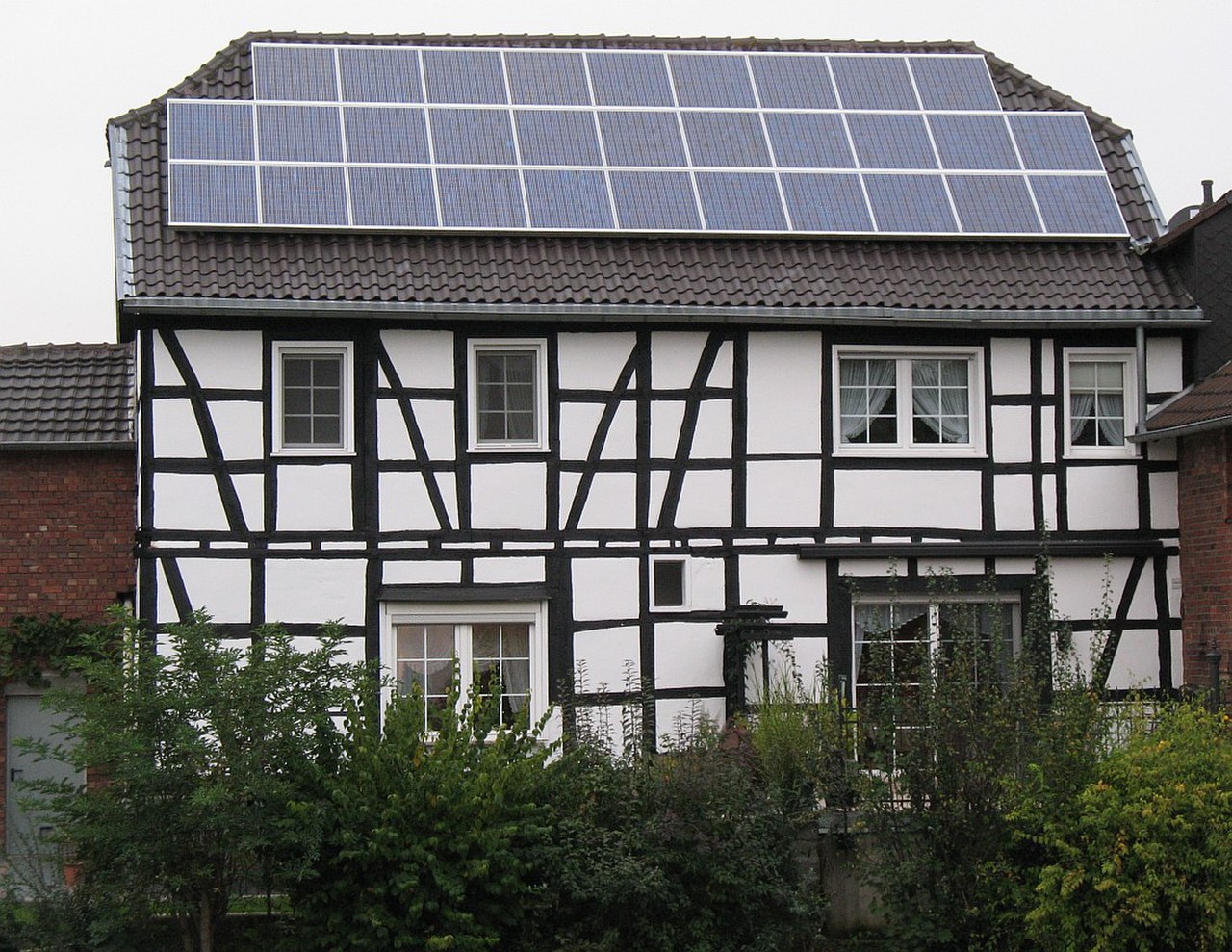
Photo: A timber-framed house with rooftop solar panels in Buschhoven near Bonn, Germany. Residential solar is the bread and butter of 1Komma5Grad's business. Túrelio / Wikimedia Commons (CC BY-SA 3.0 de).
A $1.35 billion valuation — with the round itself undisclosed
Reuters reported the $1.35 billion valuation on October 12, citing the company's latest financing round. The round's size and its investors were not disclosed — neither by the company nor by the agency — so treat that nine-digit figure as the only hard number on offer. Still, the headline matters: 1Komma5Grad became a unicorn back in June 2023 on the back of a €430 million round (half equity, half buyback options, led by California-based G2VP with Porsche and Norrsken in the mix), and it has now held above that mark through two years of a brutal European home-solar market.
The company is targeting roughly $750 million in revenue for the 2026 financial year, a figure Reuters says 1Komma5Grad confirmed in September — though the exact wording of that statement hasn't been independently verified. If that target holds, it would be a striking acceleration: turnover rose to nearly €520 million in 2024, up from €450 million in 2023, according to TechFundingNews — achieved while the European solar and heat-pump market around it was shrinking. The company's core hardware business, it told investors, was profitable.
That growth came from an unglamorous but effective model: buying up regional craft businesses — photovoltaic installers, electricians, heat-pump firms — and turning them into a continental sales and installation network. The acquisitions roll on: Arkana Energy, Solaray Energy, ZEWO Energy and Zonduurzaam are among the names folded in. The company now counts some 2,500 employees and more than 120,000 customers, with operations stretching from Germany across Europe to Australia.
Heartbeat is the real asset — the panels are the delivery van
Here is the part that justifies the valuation's energy-AI premium. Heartbeat, the company's software, is a virtual power plant: it buys electricity on the spot market when prices are lowest and sells surplus power back to the grid when prices peak, stabilising the grid in the process. Customers pay a flat software fee rather than a margin on the electricity itself, which the company says allows real-time, individual electricity pricing. A companion app shows live energy flows, and the company claims households save around €1,550 a year — a company figure, worth treating as marketing until independently audited.
The scale is not marketing, though: more than 500 megawatts of flexible capacity under management, described as Europe's largest integrated residential virtual power plant, with upwards of 300,000 decentralised, controllable household systems connected, per TechFundingNews. That's a lot of water heaters and car chargers to orchestrate.
And the company is doubling down. Schroeder confirmed the plan to invest more than €100 million — about $112 million — in Heartbeat in 2027. Readers of the trade press will recognise this: Tech.eu reported back in July 2025 that the company aimed to invest more than €100 million between 2025 and 2027 to scale the software business with Heartbeat as the focus. Monday's number is, in effect, the 2027 tranche of that plan, now stated with conviction rather than as an ambition.
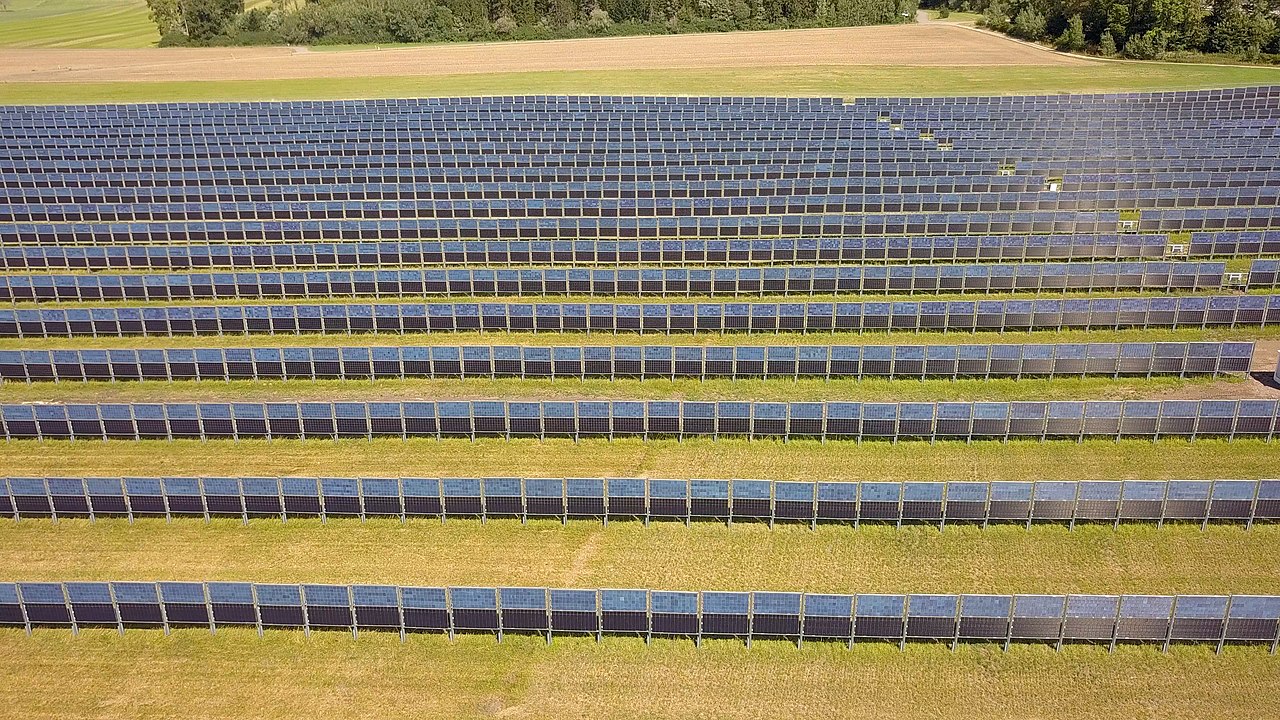
Photo: Aerial view of an agrivoltaics solar plant near Aasen, Donaueschingen, Germany — the kind of flexible, grid-connected solar capacity that virtual power plants like Heartbeat aggregate and trade. Tobi Kellner / Wikimedia Commons (CC BY-SA 4.0).
America in 2027 — then, maybe, an IPO
The US entry is the headline Schroeder clearly wanted Monday. "We're considering entering the US, because we've seen how much drive and how much interest from investors is actually behind that," he told Reuters in an interview published October 12. He confirmed that 2027 performance would be key to deciding when — and whether — the company launches a US IPO, reviving the plans shelved in 2025 as Trump's renewable-energy and trade policies roiled markets.
Context matters here. A US listing "makes strategic sense" for reasons beyond prestige: Schroeder told Sifted back in a 2023 interview that "If we are listed, it's much easier for us to do asset deals" — a public currency being, for an acquisition rollup, the difference between buying installers with paper and buying them with cash raised at a premium. The exact mechanics of the 2027 US entry — full business expansion, listing, partnership, or some mix — remain ambiguous; Schroeder said only that the company was "considering entering the US."
And America is a different beast from Germany or Australia. US residential solar has been whipsawed by interest rates and, more recently, by Trump's hostility to renewable subsidies — the very hostility that froze the IPO in the first place. Heartbeat's pitch would need a grid that rewards the kind of real-time price arbitrage it runs; in parts of Texas and California, that grid exists. Whether it exists at the scale to justify a Nasdaq valuation is the $1.35 billion question.
April 2025: the tariffs that froze everything
Rewind to April 9, 2025. Trump's tariffs were rattling global markets, and 1Komma5Grad — which had been aiming for a Nasdaq listing that year — pulled the ripcord. It did so alongside Klarna, making for one of the spring's more symbolic tech-finance double-acts: Europe's IPO pipeline, frozen by an American trade war. "Due to recent tariffs and market reaction we have postponed IPO plans to review the timeline," founder and CEO Philipp Schroeder told Reuters at the time.
The company behind the decision is worth a sketch. Schroeder founded 1Komma5Grad in the summer of 2021 with co-founders, naming it for the 1.5°C Paris climate target and its mission of making buildings CO2-neutral. He had previously run Tesla's German and Austrian operations as Country Director and served as Managing Director of Sonnen, the German battery-storage maker — so the man selling AI-optimised rooftops has spent his career selling batteries and cars. His co-founder and CFO Micha Grüber was crowing early: "Less than 4 years after our foundation, this round is the next building block on our way to the capital market and a huge success for the entire team, especially in the current market environment," he said of the December 2024 round, quoted by Tech.eu.
One caution before the euphoria: funding totals for this company are a swamp. Tech.eu reported "over €450 million" raised by late 2024; startuprise.co.uk said "over €650 million"; TechFundingNews put it at "nearly €400 million," debt-free, with an unused €100 million credit line. The honest answer is that nobody's public numbers reconcile — so don't believe a tidy total when you read one.
The hard question: is this an AI company or an installer network?
Here is our read. The €100 million bet on Heartbeat is the smartest money this company can spend, because software is the only part of 1Komma5Grad that scales without buying more vans. Five hundred megawatts of orchestrated residential flexibility is a genuinely interesting asset — the kind of distributed grid infrastructure that gets more valuable as grids get more volatile. That volatility is everywhere now: in the US, the fight is already on about who pays for grid strain, as we reported in our piece on why AI data centres may soon have to pay for the grid themselves.
But don't let the AI gloss distract you: this is still a 2,500-person rollup of regional installers in a cyclical hardware market, and the acquisition treadmill is colossally capital-hungry. The private-market money has been generous — G2 Venture Partners, Norrsken, Eurazeo, Hamilton Lane, CalSTRS — but private generosity ends the day it has to be priced by the public. Whether the market eventually pays a software multiple or an installer multiple for 1Komma5Grad will decide whether $1.35 billion was a bargain or a top. The tariff scare of 2025 was an excuse the market understood; a botched 2027 would be an execution story, and those get no sympathy.
The one thing working in Schroeder's favour: he has done this dance before. The December 2024 pre-IPO round was co-led by G2 Venture Partners with 2150, Norrsken, Hamilton Lane, b2venture, Eurazeo and eCAPITAL, and its largest new investor was a US pension fund, CalSTRS — American money, betting on a European energy company, even then. The road to the Nasdaq has been under construction for years. Now 2027 has to carry the traffic.
The capital backdrop doesn't hurt either — though it's getting expensive. For the wider story of how Wall Street is pricing AI-linked risk right now, see AI's $113B debt machine and the wall it hit in September.
Sources
Reuters ("German startup 1Komma5Grad secures $1.35 billion valuation in new financing round," Oct 12, 2026; April 2025 IPO-postponement reporting syndicated via SRN News and GlobalBankingAndFinance); Tech.eu (Dec 2024 pre-IPO coverage; July 2025 extension coverage); Sifted (2023 interview with Philipp Schroeder); TechStartups (June 2023 funding coverage); TechFundingNews (2024 revenue and Heartbeat scale reporting); Energy Central (interview with Philipp Schroeder); startuprise.co.uk.
— TechPulse USA newsroom
TechPulse USA is an independent technology news publication covering the people, companies and machines building the AI era. Every story is researched from multiple sources and every fact verified before publication.
Related: tariffs were the reason this company's US IPO died on the vine — and they remain the single biggest variable in its revival plans. For the full picture of where trade policy is biting tech, see our tariff scorecard of every major economy.
Related: For Europe's tech-sovereignty fight on another front, see how Brussels' own officials called their Microsoft Teams replacement 'absolute shit' — and for the grid strain shaping energy-linked bets, Ofgem's alarm over 315 data centres straining the grid.


Comments
Post a Comment