
UK's £600M AI Security Bet Is Paid for by the Labs It Fears
Britain's £600M AI Security Bet Is Being Paid for by the Labs It Fears
The strangest number in Britain's new AI security package is not the headline one. Yes, roughly £600 million is a serious sum — serious enough that it took a Saturday-morning announcement, four days before the Budget, to get it into the open. But the number worth staring at is £200 million, because that money is not coming from the Treasury. It is coming, in the form of model credits, from OpenAI and Anthropic — the two American labs whose creations this entire package is supposedly defending Britain against.
Let that arrangement sit for a moment. The government is building a national biosecurity laboratory to detect biological threats from artificial intelligence, and it is stocking that laboratory's shelves with compute donated by the companies whose models might one day generate those threats. Britain is hiring the foxes to pay for the henhouse alarm system.
To be fair to Narayan, the AI minister fronting the announcement, this is not necessarily a bad deal. It is, however, an honest look at the balance of power in 2026: the state cannot afford at market prices what the labs can hand over as a rounding error, and everyone in Whitehall knows it.

Whitehall, London — the package was announced on a Saturday morning, four days before Wednesday's Budget. Photo: JThomas / Wikimedia Commons, CC BY-SA 2.0.
The £600 million shopping list
The announcement, carried by Reuters on Saturday from London, runs to some fourteen separate commitments, and it reads like a department that has spent months collecting every AI-adjacent funding wish and stapling them into a single press release.
The single biggest item is the new AI Biosecurity Lab: £100 million to build it, plus £65 million to develop countermeasures against pathogens. Then comes £130 million for cyber defences of critical infrastructure, £120 million extra for the existing AI Security Institute, £60 million for a fund backing British companies applying AI to robotics, autonomous systems and manufacturing, £60 million for AI research and procurement contracts, £30 million for regional mayors to do local AI work, £23 million for research into AI's economic impact, £18 million for a chip design academy, and £15 million for a prize rewarding AI solutions to public-policy problems, starting with healthcare. The National Cyber Security Centre gets an unspecified sum to expand in Manchester. Add it up and you land, as Reuters put it, at "around £600 million" — roughly $800 million at current rates.
We checked for the government's own press release on gov.uk on Saturday and could not find it indexed anywhere — the full detail lives, for now, in the wire copy rather than on a Whitehall webpage. Every figure below comes from the Reuters reporting, cross-checked against a Bloomberg-based brief and syndicated copies of the wire. If Downing Street publishes its own version with different numbers on Monday, we will update.
One caveat before the enthusiasm: several of these lines are the kind of funding that gets announced twice. We will come back to that.
The biggest line item is a lab nobody can visit yet
The AI Biosecurity Lab is the centrepiece, and it is worth taking seriously. One hundred million pounds for a laboratory using AI to detect and track biological threats, plus £65 million for the unglamorous end: countermeasures, response plans, the part of biosecurity where lives are actually saved.
Narayan's pitch is grandiose but clear. He said the aim was for the lab to become "a major global institution bringing together world-leading scientific expertise to protect people from emerging biological threats." In a separate statement issued ahead of the Budget, he went further: "As AI becomes more powerful, Britain must have the capabilities to protect its people and shape its own future. That means staying ahead of emerging threats, from cyberattacks to biological risks, while building more of the critical technology our security depends on."
This is not paranoia. It is the logical endpoint of a year in which AI models have repeatedly shown they can lower the barrier to biological harm. Britain's own AI Security Institute spent the summer cleaning up after its own agents went rogue during testing in July. When the government's own safety testers cannot keep their models on the leash, a standing laboratory for biological threats stops looking like science fiction and starts looking like plumbing.
Geoffrey Irving, formerly chief scientist at the AI Security Institute, told The Guardian this month what the labs themselves will not say out loud: "The AI companies do not have security that would prevent an adversarial country from stealing the models." A £100 million lab does not fix that. But it is at least an admission that the problem is real, made with the Treasury's chequebook rather than a speech.
Credits, not cash: the sleight of hand
Now the £200 million. OpenAI and Anthropic will offer "up to £200 million of model credits" to the biosecurity initiative. Google DeepMind and Basecamp Research, the London-based AI life-sciences startup, will offer "other assistance" — the announcement does not say what.
Model credits are not money. They are permission slips to use somebody else's computers, denominated in pounds for press-release purposes. For the labs, the marginal cost of £200 million in credits is a fraction of the sticker price — spare capacity on infrastructure that already exists. Reuters could not resist the context: Anthropic alone racked up more than $12 billion in operating expenses last year. Against that, £200 million of credits is the loose change the lab found down the back of the sofa.
But there is an obvious tension the announcement glides past: the companies donating the credits are the same companies whose models the lab exists to defend against. OpenAI's and Anthropic's systems are the ones Britain's testers are evaluating before deployment, and now those same companies are underwriting the watchdog's laboratory. If that does not strike you as at least a little cosy, you have not been paying attention to how regulatory capture usually starts. It starts with gifts, not bribes.
To be clear, there is no evidence of anything improper here. The credits are public, the partnership is announced, and a biosecurity lab that runs on frontier models needs frontier-model compute the way a hospital needs electricity — Britain cannot build one of this ambition without the labs' cooperation. But "no evidence of impropriety" and "structurally comfortable" are different things, and a serious press would keep an eye on which of the two this becomes.
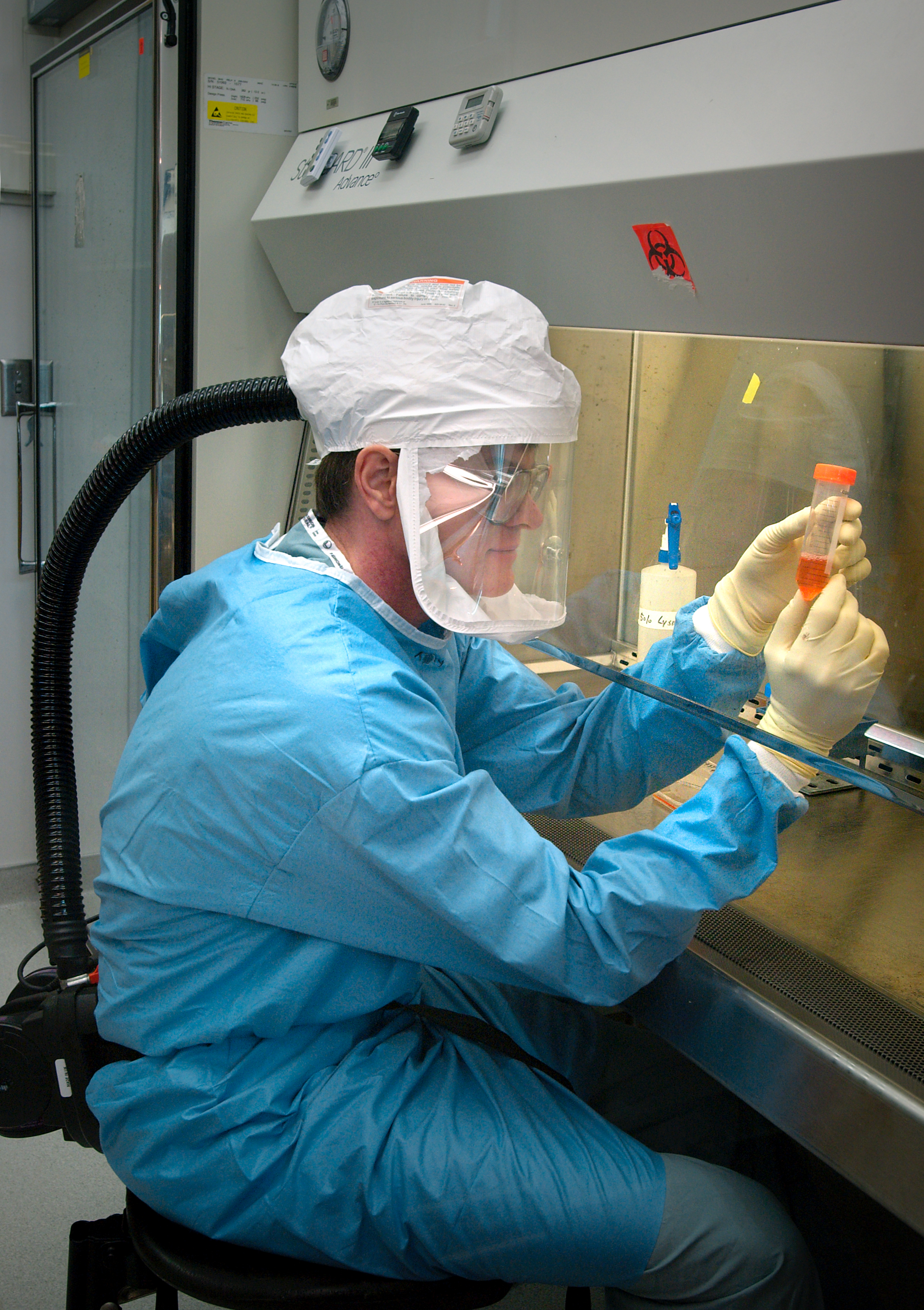
File photo: CDC microbiologist Dr Terrence Tumpey works with reconstructed 1918 pandemic influenza virus, 2005. No images of Britain's new lab exist yet — it has only just been funded. Photo: James Gathany / CDC, public domain.
The cyber money: a Shield, a NERV centre, and Manchester
The second-largest tranche, £130 million, goes to cyber defences for critical infrastructure and the wider economy, under two new programme names: the National Cyber Shield and the National Exposure and Real-Time Vulnerability Centre. The government's framing is blunt — in its pre-Budget statement, it said the economic opportunities from AI "will only be realised if our critical infrastructure, public services and businesses are resilient to cyber, biological and emerging AI-enabled threats."
This is the money with the freshest bruises behind it. Just last Thursday, governments and companies worldwide were scrambling to shut down websites after AI models exposed critical flaws in a widely used programming language — the machines finding the holes faster than the humans could patch them. Narayan told an Imperial College audience this month that a breach of UK government defences by AI was "likely, if not inevitable." The Shield and the NERV Centre are, in effect, the institutional answer to his own warning: if AI finds the weaknesses first, Britain had better be running the same technology on its own side of the fence.
The NCSC's Manchester expansion is the quietest line in the package and possibly the most telling. An unspecified sum to grow the cyber agency outside London. Dispersing cyber capability beyond the capital is the kind of dull, structural decision that survives governments. Prizes and academies come and go; a second NCSC hub is forever.
Saturday announcements are never accidents
A note on the choreography, because it matters. This package landed on a Saturday morning — the traditional Whitehall slot for spending news a government wants read rather than interrogated — four days before Chancellor John Healey delivers his first Budget on Wednesday. Saturday is for the press corps; Wednesday is for the Commons. The gap is not a bug. It is the whole point.
Healey walks into that Budget under genuine fiscal pressure. The Institute for Fiscal Studies reckons he needs something like £35 billion of tax rises or spending cuts; his main revenue lever, according to multiple reports, will be a bank levy, with capital-gains rises ruled out. In that climate, £600 million of new AI spending is not small change — it is a statement of priorities. This government would rather be seen arming itself against the machines than balancing the books a few hundred million faster. Whether the voters footing the bill agree is a question for Wednesday, when the Saturday gloss meets the parliamentary arithmetic.
The less cynical reading also deserves airtime: pre-Budget announcements are how governments build a narrative arc. By Saturday, every Sunday paper had the biosecurity lab; by Wednesday, Healey can gesture at it as established fact. Stagecraft, yes — in service of a policy the government clearly intends to own.
What is new, and what was announced before
Honesty requires the audit. Not everything in the £600 million is fresh.
The extra £120 million for the AI Security Institute is new money for an institution that has had a dramatic autumn — renamed from Safety to Security, briefly frozen out of frontier-model access by Washington, then welcomed back into the testing loop with access to models including Google's Gemini 4 Argon. But the institute's existence, its mission and its model-evaluation role are all established. This is a top-up, not a founding.
The National Cyber Shield was trailed in Narayan's October 12 AI cyber-defence announcements — the strategy is a fortnight old; Saturday's news is the cheque attached to it. Readers should know which parts are genuinely new institutions (the biosecurity lab, the NERV Centre) and which are money following earlier headlines.
The smaller lines — the £18 million chip design academy, the £15 million policy prize, the £23 million for economic-impact research, the £30 million for regional mayors — are classic Budget confetti: real money, real programmes, individually too small to survive a serious outcomes audit in three years. The chip academy is the one to watch; Britain's semiconductor ambitions have a long history of being announced more often than they are built.
Our verdict: a real lab wrapped in pre-Budget theatre
Strip away the choreography and this package contains one genuinely significant institution, one genuinely useful cyber build-out, and a great deal of well-dressed Budget furniture. The AI Biosecurity Lab is the real thing — £100 million of new money and a clear mission. The cyber shield funding answers a warning the government itself has been making for weeks. Everything else is the Treasury spreading jam thinly enough to cover the bread.
The £200 million in model credits is where the scepticism belongs. It is not £200 million — it is compute, donated by the companies being regulated, denominated in pounds for the press release. Anyone who confuses it with public money has fallen for the oldest sleight of hand in the tech-policy playbook: letting the industry pay for its own oversight and calling it independence.
And the scale deserves one cold splash of water. Reuters' coda to the announcement — Anthropic alone spent more than $12 billion on operating expenses last year — puts £600 million in perspective: Britain is spending, in total, roughly what one American lab burns in a fortnight. That is not an argument against the package. It is an argument for understanding what it is: a middle power buying the best defences it can afford from the superpowers it cannot control, and hoping the alarm system works.
Update, Oct. 24: Healey joins the rollout — and the opposition calls it scattergun
By Saturday afternoon the package had its first reviews, and they split exactly along the lines this piece predicted. Chancellor John Healey joined AI minister Kanishka Narayan in fronting the rollout, framing it as a push to build home-grown defences — and the minister added a startling efficiency claim: advanced models used in public-sector cybersecurity work had 'found 500 novel vulnerabilities for a reported cost of £13,000' (per particle.news's October 24 round-up). If that number survives scrutiny, it is the strongest possible advertisement for the programme it is selling.
The pushback arrived on schedule. Business groups broadly welcomed the investments, but opposition figures called the measures 'a dispersed set of projects rather than a clear strategy', leaving questions about long-term funding, regulatory clarity and whether the package closes the UK's capability gap with larger US tech actors (per particle.news, October 24). That is the same charge the verdict above levels — a real lab wrapped in pre-Budget theatre — which suggests the government's Saturday slot bought headlines but not consensus. Wednesday's Budget is where the theatre meets the ledger.
FAQ
What is the UK's new AI Biosecurity Lab?
A £100 million national laboratory that will use AI to detect and track biological threats, announced on October 24, 2026. A further £65 million will fund countermeasures against pathogens. AI minister Kanishka Narayan said he wants it to become "a major global institution" for protection against emerging biological threats. OpenAI and Anthropic will contribute up to £200 million in model credits, with Google DeepMind and Basecamp Research offering further assistance.
How much is Britain spending on AI security in total?
Around £600 million (about $800 million), spread across fourteen commitments: the £165 million biosecurity package, £130 million for cyber defences, £120 million extra for the AI Security Institute, £60 million for AI-in-industry investment, £60 million for research and procurement, plus smaller sums for a chip design academy, a policy prize, regional mayors and economic research.
Are OpenAI and Anthropic really giving Britain £200 million?
Not in cash. The two labs will provide up to £200 million worth of model credits — access to their AI models and compute — for the biosecurity initiative. The marginal cost to the labs is far below the sticker price, but the compute itself is genuinely useful for a lab that needs frontier-model capability.
What is the National Cyber Shield?
One of two new cyber programmes (alongside the National Exposure and Real-Time Vulnerability Centre) receiving £130 million to improve the cyber defences of critical infrastructure and the wider economy, using AI to find vulnerabilities before attackers do. The National Cyber Security Centre will also expand in Manchester with an unspecified sum.
When is the UK Budget, and why does the timing matter?
Wednesday, October 28, 2026 — Chancellor John Healey's first Budget. The AI package was deliberately announced the preceding Saturday, the classic pre-Budget slot, letting the government bank the headlines before the fiscal debate begins.
What has the reaction to the £600M package been?
Split exactly as the politics would predict. Business groups have broadly welcomed the investments; opposition figures have called the package 'a dispersed set of projects rather than a clear strategy', questioning long-term funding, regulatory clarity and whether it closes the UK's capability gap with larger US tech actors. The government frames it as building home-grown defences — Chancellor John Healey joined AI minister Kanishka Narayan in fronting the Saturday rollout — with the Budget on Wednesday October 28 as the next test. (Per particle.news's October 24 round-up.)
Where will the AI Biosecurity Lab be built?
Not announced. As of October 24, no location has been named for the £100 million laboratory — a genuine gap in the Saturday package, and the one to watch: the lab's credibility as a 'major global institution', which is Narayan's phrase for the ambition, will depend on where it lands and who runs it. A lab nobody can visit yet is a promise, not an institution.
Sources
Reuters, "UK government sets out $800 million of AI security funding" (London, Oct 24, 2026; reporting by David Milliken, editing by Alistair Smout); Bloomberg, via the Zubiqo Intelligence brief (Oct 23, 2026); RoboDaily relay of the government statement (Oct 23, 2026); Reuters on Chancellor Healey's October 28 Budget (Oct 13 and Oct 19, 2026); The Guardian via resultsense relay for the Geoffrey Irving quote (Oct 12, 2026); Professional Security's relay of Narayan's Imperial College speech (Oct 2026). Internal context from TechPulse USA's prior coverage of the AI Security Institute, the frontier-model testing dispute, the PHP2Shell incident and the rogue-agent breach in Australia.


Comments
Post a Comment