
California Bans AI-Only Firings — Newsom Slams Trump's Plan
California Bans AI-Only Firings — Newsom Slams Trump's Plan
By Daniel Rao, TechPulse USA
Gavin Newsom killed this exact bill last October. He called it "overly broad." Then, on the last bill-signing day of his governorship, he signed it anyway — and used the occasion to declare the Trump administration's AI stance "bullshit" on social media. Welcome to the No Robo Bosses Act: the first law in America that makes it illegal for a machine to fire you.
September 30, 2026 — Newsom's last day to sign or veto anything — and he signed SB 947, the bill that tells California employers they can no longer lean primarily on automated decision-making systems to fire, discipline, or demote people. From here on, a human reviewer has to genuinely corroborate every AI-flagged termination — personnel files, manager evaluations, peer reviews, the works — not just rubber-stamp whatever the dashboard spits out. Workers get it in writing that AI was in the loop, what data it chewed on, and the name of an actual human being they can demand an explanation from. Get caught violating it and it's $500 a pop, per violation — workers can sue directly, and punitive damages are on the table. The law kicks in July 1, 2027.
Don't mistake this for a symbolic resolution. It's enforceable, with real penalties attached — and it's the first law of its kind anywhere in America. I read the full text so you don't have to, and the interesting parts aren't the ones in the press releases.
The veto he reversed
The backstory is the story. State Senator Jerry McNerney, a Democrat, wrote the bill. An earlier version, SB 7, sailed through both chambers of the legislature in 2025 — and Newsom vetoed it that October, writing that it "proposes overly broad restrictions" on how employers use these tools. His objection centered on a provision requiring employers to notify workers in advance whenever any AI system that could affect working conditions was in use. Unfocused, he said.
McNerney brought it back this February with the pre-notification duty stripped out and, more controversially, the protections for gig workers deleted — a concession that defused opposition from Uber and Lyft. The revised bill passed the Assembly 53–14 and the Senate 28–10, and this time Newsom put his name on it.
The veto was defensible; the signature, eleven months later, is timed theater. Strip away the timing, though, and you've got a genuinely good law sitting underneath — cynical calendar or not.
What SB 947 actually does
The mechanics are where this bill gets interesting — and where every HR department in California is about to spend a lot of money, because this is the part they all have to rebuild by next summer. I've read enough HR-vendor pitch decks to know that "rebuild" is going to mean a flood of expensive consulting calls.
Start with the ban itself. No employer gets to lean primarily on an automated decision-making system — the statute defines the term wide enough to catch machine-learning models, statistical scoring, and every AI tool that spits out scores, classifications, or recommendations — when it fires, disciplines, or demotes someone. And where the machine's output is the main basis for the call, a human reviewer has to corroborate it with genuinely independent evidence. The bill spells out what counts, and it's not subtle: personnel records. Supervisory evaluations. Peer reviews. Actual work product. A manager clicking "approve" on a dashboard? That's not compliance. That's a violation — the law says so in so many words.
Then the transparency half, which is honestly the part I'd want if I worked in a California warehouse. Anyone hit with one of these decisions gets a standalone written notice that AI was primarily used, a description of the employee data the system analysed, and contact details for a human reviewer who can explain the decision. Workers can also pull a copy of their own data that the system used over the past 12 months — one such request a year. Not generous. But it's there, and it's enforceable.
The enforcement side is where my eyebrows went up. The state labor commissioner or public prosecutors can bring cases. Workers can sue directly. Each violation carries a $500 civil penalty, with punitive damages and attorney's fees available. Run the maths on a company that auto-fires an entire warehouse shift through a black-box model and — well. I'll let you do that arithmetic yourself. It's frightening.
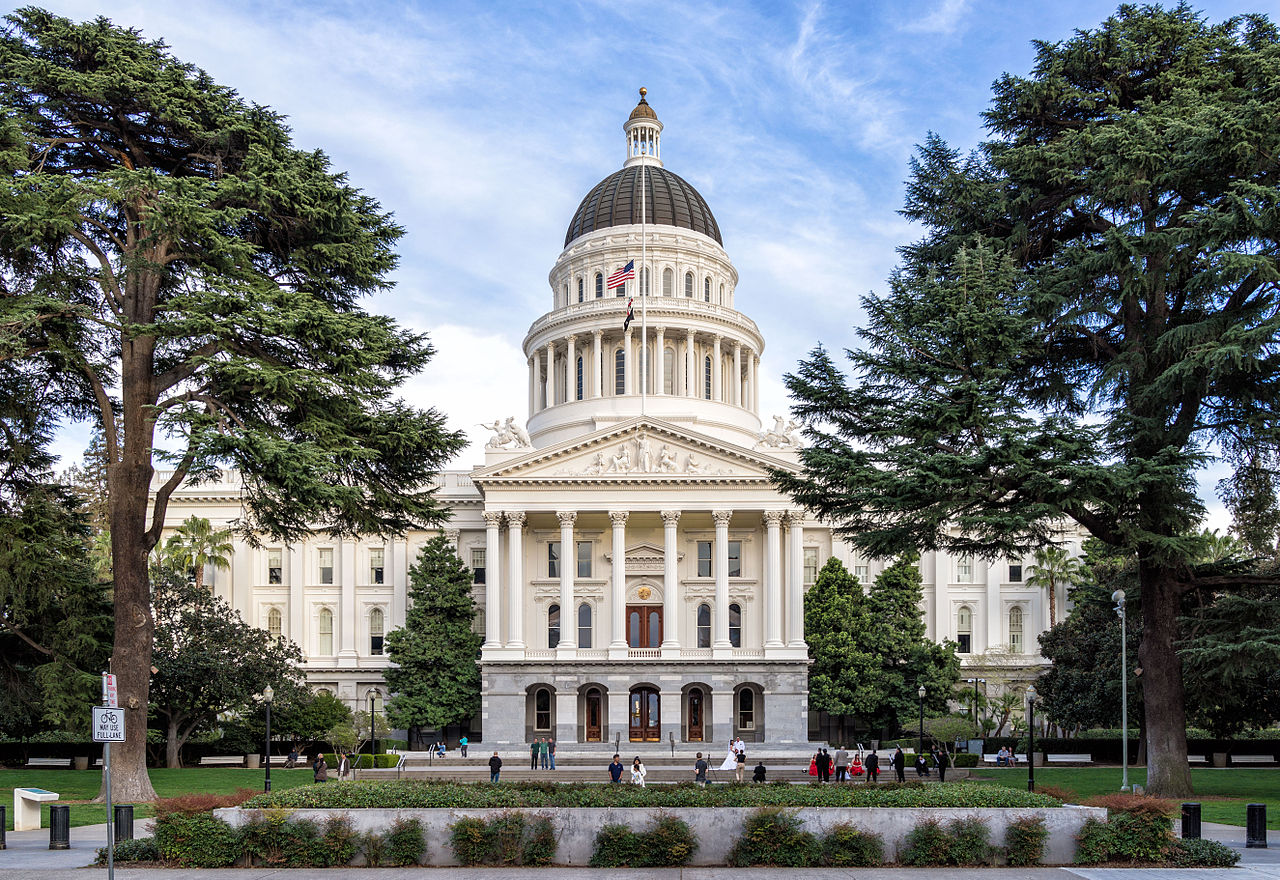
Photo: The California State Capitol in Sacramento, where Newsom signed SB 947 on his final bill-signing day as governor. Credit: Andre m, Wikimedia Commons, CC BY-SA 3.0.
The provisions nobody is talking about
The "robo boss" framing undersells this bill, frankly. There's a whole second half of SB 947 that barely got a mention in the signing-day coverage, and some of it is wilder than the headline ban. Employers can't deploy automated systems to infer a worker's protected characteristics. They can't use them to predict beliefs, emotions, or future behavior, or to run predictive behavior analysis that drives employment decisions. Biometric data? Off-limits for reading anybody's emotional state. And nobody can be punished for exercising their rights under the statute.
It landed as part of a package — Newsom signed 11 workplace bills that day — and the companions are worth your time. SB 951, effective January 1, 2027, forces mass-layoff WARN notices to declare right at the top: "This notice is for a technology displacement." Number of positions. Job functions being automated. Category of technology responsible. The state will publish quarterly summaries, which means AI-driven layoffs become public, union-visible data. There are also rules making AI chatbot operators run risk assessments before rollout, an order directing the state to consult experts on stronger oversight, and — my favorite detail, because it tells you how granular Sacramento got — provisions restricting AI-powered surveillance of employee bathrooms and barring lawyers from handing core legal work like drafting briefs entirely to AI.
The "bullshit" press conference
The signing was a showdown, not a ceremony, and Newsom made sure of it. Before the ink was dry he'd shared the White House's "Accord on Super Intelligence" announcement on X with a caption so dry it could start a fire: "The Golden Age of Super Intelligence."
That was the warm-up. The main event was his answer to the administration's position that the AI industry can regulate itself — Trump had announced the day before that top tech leaders signed a voluntary accord to "self-police" AI development. Newsom's reply, posted for everyone: "What we saw from the White House yesterday was bullshit. It's like Big Pharma saying we don't need the FDA. Donald Trump's 'let it rip' approach to AI is RECKLESS." Subtle, he is not. He added that California has to accelerate its own timelines: "We have to do a lot more in the absence of federal leadership."
And the terminology fight is real, not just vibes. The same day, Newsom signed an executive order requiring state agencies to keep calling the technology "artificial intelligence" — because, as the Associated Press reported, President Trump recently ordered U.S. diplomats to say "super intelligence" instead. A whole executive order about a noun. Welcome to 2026.

Photo: California Governor Gavin Newsom. Official 2026 portrait, public domain. Newsom signed SB 947 on September 30, 2026, his final day to act on bills before leaving office in January.
Who pushed it, who fought it
The bill's lead sponsor was the California Federation of Labor Unions, AFL-CIO. Its president, Lorena Gonzalez, called the signing a turning point: "When working people organize, we get results. Today, California's workers and our unions have changed the national narrative on how Americans can fight back and win against AI taking over our jobs and workplaces."
McNerney, the bill's author, told CNBC the measure addresses documented failures of automated systems: "No worker should ever be fired or disciplined by a machine, AI or not. Artificial intelligence systems have the potential to boost productivity, but they've also made errors and misjudgments and exhibited bias. AI must remain a tool controlled by humans, not the other way around."
The bill's path was rocky in the usual California way. Beyond the Newsom veto, the fight centered on the gig-worker carve-out: Uber and Lyft pushed hard against extending protections to rideshare drivers, and the revised bill dropped them. That concession got the bill signed, but it means the workers most exposed to algorithmic management — drivers deactivated by opaque app ratings — are precisely the ones this law does not cover. A driver deactivated by an algorithm at 4 a.m. has no human reviewer under SB 947. That is a gaping hole, and labor knows it.
The anxieties feeding this law are not abstract. Meta is currently facing a lawsuit alleging its AI systems targeted employees on medical or family leave for layoffs — a claim Meta denies. A July Gallup poll found 39% of Americans believe AI does more harm than good, up from 31% in 2025, while Pew found 71% expect AI to cost people their jobs. The context is a public that increasingly doesn't trust AI companies — and a federal government that, under Trump, has chosen self-policing over regulation.
My take: good law, shoddy edges
Let's be honest about what this is and isn't. SB 947 will not stop AI from transforming work. It will not save the warehouse worker whose whole job is automated away — that's a WARN-notice and retraining conversation, not a corroboration one. What it does is narrower and more valuable than most tech legislation: it outlaws the specific, humiliating experience of being fired by a dashboard. A human being must now be able to look you in the eye and say they checked the machine's homework. That matters, colossally, for dignity if nothing else.
But the carve-outs deserve scrutiny. The gig-worker exclusion is the big one — the bill regulates the algorithmic boss while exempting the industry that invented the algorithmic boss. And nine months of implementation runway is generous to employers who have been automating HR decisions for years without telling anyone; the systems exist, the vendors exist, and "we need more time" is not a persuasive defense of a business that has already been grading humans by algorithm.
Newsom's veto-to-signature arc tells its own story. A year ago the bill was "overly broad." Today it's a national model. The bill changed at the margins; what changed colossally was Newsom's political position — last bill-signing day, a 2028-shaped shadow over everything, and a federal foil in Trump who keeps handing him the perfect contrast. The politics are theater. The law, though, is real. Sometimes theater produces good policy by accident.
California isn't alone: the other states moving on robo-bosses
California is first, but it is not alone. Connecticut's SB 26-189 took effect October 1, 2026: employers conducting WARN Act layoffs must now disclose in writing whether AI contributed to the decision (AutoNAI News) — a transparency rule that turns every large layoff into a potential AI audit.
The courts are testing companion liability theories. In Mobley v. Workday, plaintiffs argue AI vendors themselves can face discrimination claims for their hiring tools; in Kistler v. Eightfold AI, the question is whether AI scoring tools trigger federal consumer-reporting obligations (AutoNAI News). And courts are also redrawing AI's legal boundaries on the copyright side, where an appeals court just rejected AI's fair-use defense.
The collision to watch: 14 state attorneys general are now aligned against a federal disparate-impact memo, meaning employers face contradictory commands from different levels of government on what counts as lawful AI-driven employment decisions.
What happens next
For multistate employers, it's the familiar patchwork headache — California rules now, everyone else later. But California's economy is big enough that most national vendors will just build to the California standard and call it a day.
Expect copycat bills. California has a long history of exporting its regulations nationally — car emissions, privacy, and now AI workplace rules. It is no coincidence this arrives alongside Newsom's earlier AI kill-switch executive order and California's new disclosure rules for AI-generated performances: Sacramento is assembling, bill by bill, the regulatory architecture Washington refuses to build. Watch for lawsuits from the HR-tech industry testing whether the corroboration requirement survives a challenge. And watch whether the legislature ever gets around to closing the gig-worker hole it deliberately left open to secure Newsom's signature.
We verified the bill's passage tallies (53–14 in the Assembly, 28–10 in the Senate) against its legislative history, and checked both images' licences on their Wikimedia Commons file pages before publishing.
Update, Oct. 2: The bill's backers are framing it as a human-dignity floor, not a tech ban. "No worker should ever be fired or disciplined by a machine, AI or not. AI must remain a tool controlled by humans, not the other way around," said Sen. Jerry McNerney (D-Pleasanton), the bill's author (Techstrong.ai). Labor is blunter: "Employers are devastating workers' livelihoods and taking no responsibility for the callous decisions of this unchecked technology," said Lorena Gonzalez, president of the California Federation of Labor Unions (Techstrong.ai). And the litigation is already here — Meta faces a lawsuit alleging its AI algorithms targeted employees on medical or family leave for layoffs; Meta denies it (Techstrong.ai).
Sources
Reporting drew on the Associated Press (signing coverage, executive order), CNBC/Times of India (signing details, McNerney interview), Times Now (bill provisions), NDTV (package details), Fisher Phillips (employment-law analysis of all 11 bills), Techstrong.ai and Startup Fortune (legislative history, veto context), and the California Federation of Labor Unions (AFL-CIO) statement.
By Daniel Rao, TechPulse USA
Daniel Rao covers AI policy and tech regulation for TechPulse USA — which mostly means watching governments across the US, Europe, Canada and Australia scramble to write rules for a technology that's already running the show.


Comments
Post a Comment