
China Drafts 40-Tech Export Lock on AI, Biotech and Solar
China Drafts 40-Tech Export Lock on AI, Biotech and Solar
By Daniel Rao, TechPulse USA
Beijing has picked a Friday — the classic window for news it wants absorbed slowly — to put the three engines of its technology economy behind an export wall. On Friday, China's Ministry of Commerce proposed adding 40 technologies spanning artificial intelligence, biomedicine and photovoltaics to its catalogue of barred or restricted exports. The draft covers the crown jewels: AI models, the agents built on top of them, and the computing clusters that train them. China says this is routine housekeeping. It is not. It is the most aggressive move Beijing has made yet in the technology cold war, timed just weeks before Donald Trump and Xi Jinping meet again at the APEC leaders' summit in Shenzhen.

Solar panel fields spread across the Kubuqi Desert in Inner Mongolia, captured by the Landsat satellite. China makes roughly nine of every ten solar panels — and now wants the know-how behind them. Photo: NASA Earth Observatory (public domain).
The draft in one paragraph
The commerce and science ministries issued the notice jointly, according to Nikkei Asia and the South China Morning Post. Public comments are open from October 16 until November 15 — but Beijing is not waiting for the window to close: an interim pre-export registration regime takes effect immediately, applying to transfers of technology ownership, overseas licensing, and the movement of technology to foreign entities. Deals already in flight but not yet completed are caught in the net too, the Wall Street Journal reports.
The AI side of the draft is the deepest cut: 23 AI-related technologies, including large language models, AI agents, chip design and computing clusters. The SCMP reports the 40 items split into 14 outright export bans — including AI technology for generating malicious code, certain cell and gene therapy platforms, and some solar-cell module production technology — and 26 further technologies facing fresh restrictions.
What is actually being controlled
Start with the numbers that matter, because the ministry buried them in a consultation annex. The proposed AI controls would cover models containing at least two trillion parameters, or models ranking among the world's top ten on measures including performance, usage and safety — and they would sweep up the weights, checkpoints, source code and architecture, according to Bloomberg's reporting. That description captures this year's Chinese frontier models, like Moonshot AI's Kimi K3.
Technologies already in the public domain through open-source releases would be exempt, both Nikkei and the Journal report — which matters, because open weights are the business model of labs like DeepSeek. Overseas deployment of restricted AI technology would need approval, with a possible exception for company-owned overseas cloud infrastructure, per Nikkei.
On biomedicine, the controls would cover small interfering RNA molecules — the technology for silencing disease-causing genes — along with cell and gene therapies and research on disease-causing microorganisms. Notably, licensing deals would remain permitted under conditions, a carve-out that keeps the biotech industry's cross-border business model alive.
On solar, the draft targets the production technology for polysilicon, silicon wafers and solar cells — the upstream choke points where Chinese dominance is absolute. We cross-checked the accounts this morning: SCMP splits the 40 into 14 bans and 26 restrictions; Reuters presents them as a single package of prohibited-or-restricted items. Same draft, different slicing — the effect is identical either way.
Beijing insists this is routine. Do not believe that.
In a separate statement, the commerce ministry said the revision was prompted by the expanding use of the covered technologies in sensitive fields, and that the move was routine and "does not target any specific country, region or entity." That is Beijing's framing, and it is colossally thin.
Reuters identifies them as the three fundamental building blocks of China's AI industry — and a draft that touches all three is not administrative tidying. It is a strategic instrument, and the ministry's own language gives away the game.
A commerce ministry spokesperson said in a statement that the measures aim to ensure AI technology stays "safe and controllable," and warned of misuse for attacking critical infrastructure, defence industries and core government systems by non-state actors. The spokesperson added: "The Chinese government's necessary management of these technologies aims to solidify the security baseline, prevent misuse and abuse, ensure that AI remains under human control, and promote international governance of AI."
The wording is worth reading twice. "Safe and controllable" is the same language Beijing has used domestically to justify keeping model weights under party oversight. The Journal reported back in July that Chinese officials had already held discussions with the country's top AI labs about protecting their proprietary technology, worried that sharing it could help adversaries — and could ultimately be weaponised against China. Friday's draft is the export-control version of that anxiety, formalised in a catalogue that has been Beijing's favourite legal instrument for three years.
Who gets hurt
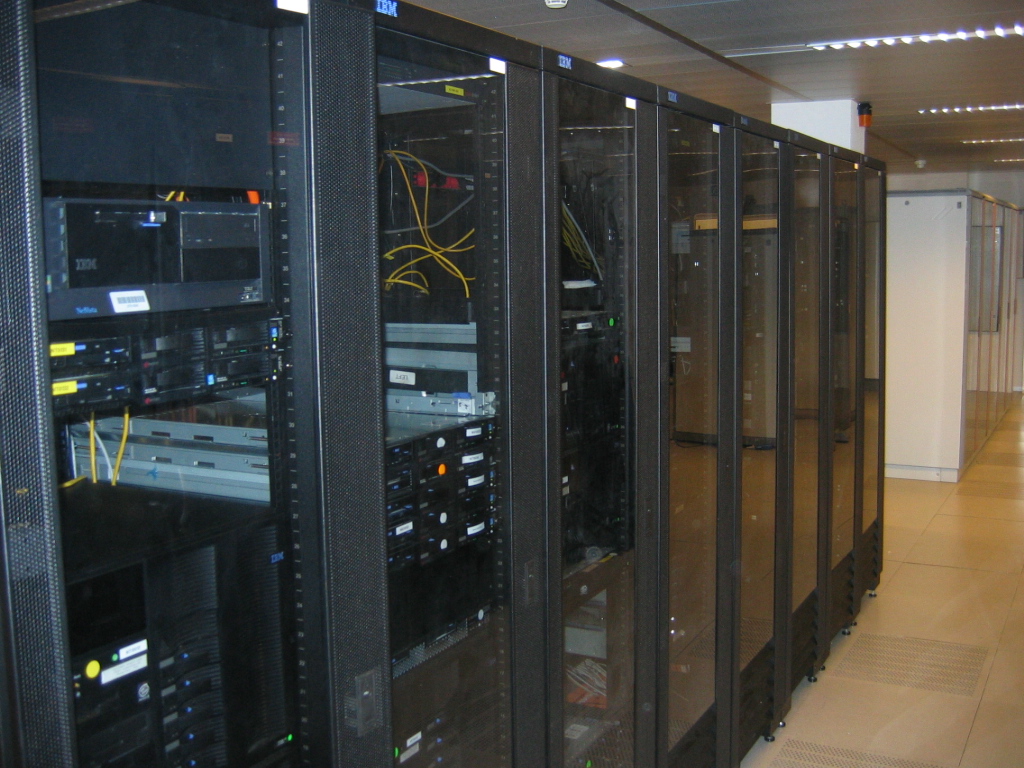
Server racks in a data centre — file photo, not a Chinese facility. The draft would require approval before "computing clusters" and model weights move across China's borders. Photo: Wil Weterings (public domain).
The pain radiates in three directions. First, China's own AI labs. Chinese startups closed the gap with US leaders this summer: Moonshot AI's Kimi K3 and DeepSeek's latest models compete on price and performance, and Chinese labs deliberately share model weights to pull developers into their orbit. Z.AI even made its products available through Amazon Web Services in the United States. The draft would force every one of those cross-border moves through a licensing queue — and the ministry says the deciding question will be "whether it involves the transfer of restricted technologies from within China to locations outside its borders." For labs built on open weights and global developer adoption, that is a problem with no quick fix.
Second, solar. This is where the draft has teeth the AI provisions can only dream of. China manufactures nearly 90% of the world's solar panels, Sumant Sinha — CEO of Nasdaq-listed renewables giant ReNew Energy Global — told the Bloomberg New Economy Forum in New Delhi this week, calling that concentration "not healthy." The International Energy Agency puts China's share of global production capacity at 60% to 85% across multiple green-energy supply chains. "We should all find ways of getting around that," Sinha said, adding: "What worries me is that the rest of the world is not thinking along those lines right now."
If Beijing locks up polysilicon and wafer know-how, the West's project to rebuild solar manufacturing anywhere else gets harder exactly where it is weakest. Polysilicon refining is among the most power-intensive industrial processes on earth, and China holds roughly 93% of global capacity, according to industry researchers — a share no subsidy programme closes quickly.
Third, US hyperscalers and anyone who needs Chinese compute. The controls cover chip design and computing clusters, which puts a licensing question mark over every joint AI-infrastructure venture touching Chinese soil. Taiwan has already moved to curb AI chip exports to mainland buyers; Beijing's draft is the mirror-image move, controlling what leaves China rather than what enters it.
This is a pattern, not an event
Friday's draft did not come out of nowhere — it is the latest turn of a screw Beijing has been tightening for three years, each rotation closing a loophole the last one left. In July 2023, the commerce ministry imposed controls on gallium and germanium, critical to semiconductors and defence radars.
December 2023 brought graphite controls and, more significantly, a ban on exporting the technology to extract and separate rare earths plus the know-how for making rare-earth permanent magnets — not a restriction on shipping material, but a lock on the knowledge needed to build a competing supply chain anywhere else.
Beijing then added antimony in August 2024, seven medium and heavy rare earths in April 2025, and — most pointedly of all — banned exports of gallium, germanium and antimony to the United States outright in December 2024, framed explicitly as retaliation for US chip-sector restrictions.
The direction of travel is consistent: from materials to the machines that process them, and now to the intangible crown jewels — model weights, algorithms, manufacturing recipes. Beijing has even imported an American legal idea, adding its own version of the US Foreign Direct Product Rule to extend its jurisdiction to foreign-made goods built on Chinese technology. Each step has been deniable as routine; the pattern is anything but.
Why now: weeks before Shenzhen
Timing is the part nobody in Beijing will discuss on the record. The draft landed just weeks before Trump and Xi are expected to meet again at the APEC Economic Leaders' Meeting in Shenzhen, after their September Washington summit produced a formal US–China AI dialogue and an AI incident channel. Our own coverage this morning noted both leaders are racing to build an AI incident hotline before that summit. A sweeping export-control draft is, in that context, negotiating ammunition: you do not arrive at a leaders' meeting empty-handed when the other side is holding a semiconductor export-control list.
There is also a quieter clock ticking. Key elements of the US–China trade truce — including China's suspensions of its October 2025 rare-earth and battery export controls — begin expiring in November, with industry groups warning a lapse would restart the 2024–2025 volatility. Alvin Wang Graylin, a senior fellow at the Asia Society Policy Institute's Center for China Analysis, said at a Quincy Institute panel this month that the follow-on APEC discussion "gives enough time for more offline discussions to happen" — which is analyst-speak for: the real deal-making happens before the photo opportunity. Beijing's draft ensures that when Trump sits down in Shenzhen, technology export controls will be one of the cards on the table — and one of them will be Chinese.
The bottom line
Strip away the ministry's "routine management" language and this is what remains: the country that dominates the physical supply chains of the 21st century — solar panels, batteries, rare earths, and now, increasingly, frontier AI models — has decided to start controlling the knowledge itself. For years, Washington treated export controls as its instrument and Beijing as the target. That era is over. The US built its controls around what goes into China; Beijing is building its own around what comes out. And where Washington's controls have been shoddy theatre at times — licences granted, rules riddled with exceptions, enforcement patchy — Beijing's record suggests it will implement this one with the discipline of a country that means it.
The open question is not whether the draft becomes final. Of course it will — the interim registration regime already in force makes the comment period something of a formality. The question is what Washington does with it. The US spent four years telling its allies that AI models are strategic assets worth protecting. Now China is making the same argument, with the same legal tools, pointed in the other direction. The frontier labs themselves have called for a slowdown in AI development — but neither government seems interested in slowing the other one down.
Meanwhile, US officials have accused China's AI giants of stealing American lab work — a charge Beijing will now find easier to answer with a single phrase: our models, our rules. When Trump lands in Shenzhen, he will discover that the leverage in the room has moved. Friday's draft made sure of that.
Sources: Reuters; Nikkei Asia; South China Morning Post; The Wall Street Journal; Bloomberg (via The Edge Singapore); International Energy Agency; US–China Business Council reporting on the trade truce.
Daniel Rao covers the US–China technology race for TechPulse USA. He writes about AI policy, export controls and the business of frontier models.


Comments
Post a Comment