
China's AI Bubble Burst First — and Wiped Out $480 Billion
By Daniel Rao
While Washington and Silicon Valley are still arguing about whether the AI boom is a bubble, China has already settled the question the hard way. Its AI stocks have not merely wobbled. They have crashed — 40% in under four months, roughly $480 billion vaporised — and the wreckage now stretches from Shanghai's STAR Market to the savings accounts of millions of small investors who believed, not unreasonably, that Beijing wanted them in.
That is the uncomfortable part. This was not a market accident. It was a market that did exactly what it was encouraged to do, faster and further than anyone in charge intended, and then discovered — as markets always do — that enthusiasm is not a business model. The United States is watching the same film. It is simply a few reels behind.
The numbers that ended the argument
Start with the scoreboard, because it leaves little room for spin. The mainland STAR50 index, which tracks the leading AI and semiconductor names on Shanghai's STAR Market, has fallen about 40% in less than four months, erasing roughly $480 billion in market value, according to Reuters. On Tuesday, October 27, it closed at 1,252.28, down 4.81% on the day and 30.74% lower than three months earlier. China's broad blue-chip CSI300 index finished the same session at 4,049.55, down 1.32% and roughly 20% below its June peak.
We compared the closing figures across two independent reports of Tuesday's session, and they matched to the decimal — the scale of the fall is not in dispute, even if what caused it is.
Now set that against the American picture. The Nasdaq is down about 6% from a record high set three weeks ago, dragged lower by the same worries about AI spending and returns. Six percent is a correction. Forty percent is a crash. Reuters itself drew the contrast in a single, brutal phrase: America's AI drawdown is "a mere prick" next to China's. The US debate about a bubble is theoretical. China's is historical.
And the exposure was enormous. AI-related stocks account for 42% of China's market capitalisation and 57% of trading value across mainland A-shares and Hong Kong H-shares, according to Goldman Sachs figures cited by Reuters. When nearly half the market is one trade, there is no such thing as a contained sell-off. In a market dominated by small investors, as Reuters notes, few have escaped the pain.
How a "slow bull" turned into a crazy bull
The rally that just died had been running for two years, ever since stimulus promises sent shares soaring. Beijing, for its part, had a plan for all this: break the old Chinese pattern of boom and bust and build what officials called a "slow bull" — a market that climbs steadily and delivers reliable performance, trustworthy enough to channel household savings into the companies building China's AI future.
It did not work out that way. "The stock market later evolved into a speculative crazy bull," said Beijing-based fund manager Dong Baozhen of Qianchuang Capital, in comments to Reuters. "And now we see the bubble bursting." It is a striking admission from inside the system: not that valuations got ahead of themselves, but that the market itself degenerated into speculation.
What made the frenzy possible was belief — specifically, the belief that government backing made the trade safe. Hainan investor and small business owner Chen Wensheng told Reuters that apparent government backing had encouraged him to buy into the rally, and that Unitree's state-backed investors had strengthened his confidence. He and his friends are now facing losses. That sentence, quietly reported, is the whole story in miniature: the state blessed the boom, the crowd followed, and the crowd is holding the losses.
Beijing's slow-bull ambition is now, at best, stalled. A market that was supposed to fund the AI boom has instead become a warning about it — and a dampener, as Reuters puts it, on the very effort to get Chinese savers into stocks to fund that boom.
Unitree: the robot that became the bubble's face

File photo: a Unitree G1 humanoid robot on display at a 2024 expo. This is not a photo of Unitree's share price or its listing ceremony. Photo: Sayanesy, via Wikimedia Commons, CC0.
No single company embodies the rise and fall better than Unitree, the humanoid robot maker. Its shares were 8,000 times oversubscribed by retail buyers at listing — a number so absurd it reads like a typo — and they have halved since trading began in August. The robot danced; the stock did not.
Unitree was not alone. Chipmaker CXMT has lost more than a quarter of its value in the past month. MetaX Integrated Circuits and Moore Threads Technology, which leapt 700% and 400% respectively on their market debuts last year, have also halved in value since July. The pattern is identical in every case: a debut that looked like a lottery win, followed by a long, grinding slide as the market asked the question it should have asked on day one — where is the revenue?
That question is now official policy. The Information reported on September 9, citing multiple sources, that the China Securities Regulatory Commission had sent informal "window guidance" raising the bar for humanoid robot listings: companies must demonstrate a capacity to generate sustained revenue, a path to narrowing losses, and substantive technological innovation — going beyond merely attracting large investments or unveiling robot prototypes. In other words, a dancing robot is no longer a listing prospectus. The regulator has, belatedly, joined the sceptics.
There is a lesson here that travels well beyond Shanghai. A listing standard that demands real revenue sounds obvious. That it had to be imposed after the crash, rather than before the boom, tells you how completely the frenzy had captured everyone — regulators included.
Why there was no single trigger
One of the strangest features of this crash is that nobody can point to the day it started. There has been no obvious selling trigger, Reuters reports, although traders cited high prices, tax bills, and the threat of the United States or other nations banning Chinese equipment in data centres as contributing factors.
That absence of a trigger is itself the diagnosis. Bubbles rarely pop because of one bad headline; they pop because the price has travelled so far from any plausible earnings that almost anything will do as an excuse. "This year, the profit margin is not as good as expected," Eurasia Group's China director Dan Wang told The Guardian. When profits disappoint after prices have tripled, gravity does the rest.
The rotation now under way is telling. Money is moving, in Reuters' account, toward companies showing actual AI profits — the unglamorous firms with customers and margins, rather than the ones with prototypes and promises. That is what a healthy market looks like. It is just an expensive way to get there.
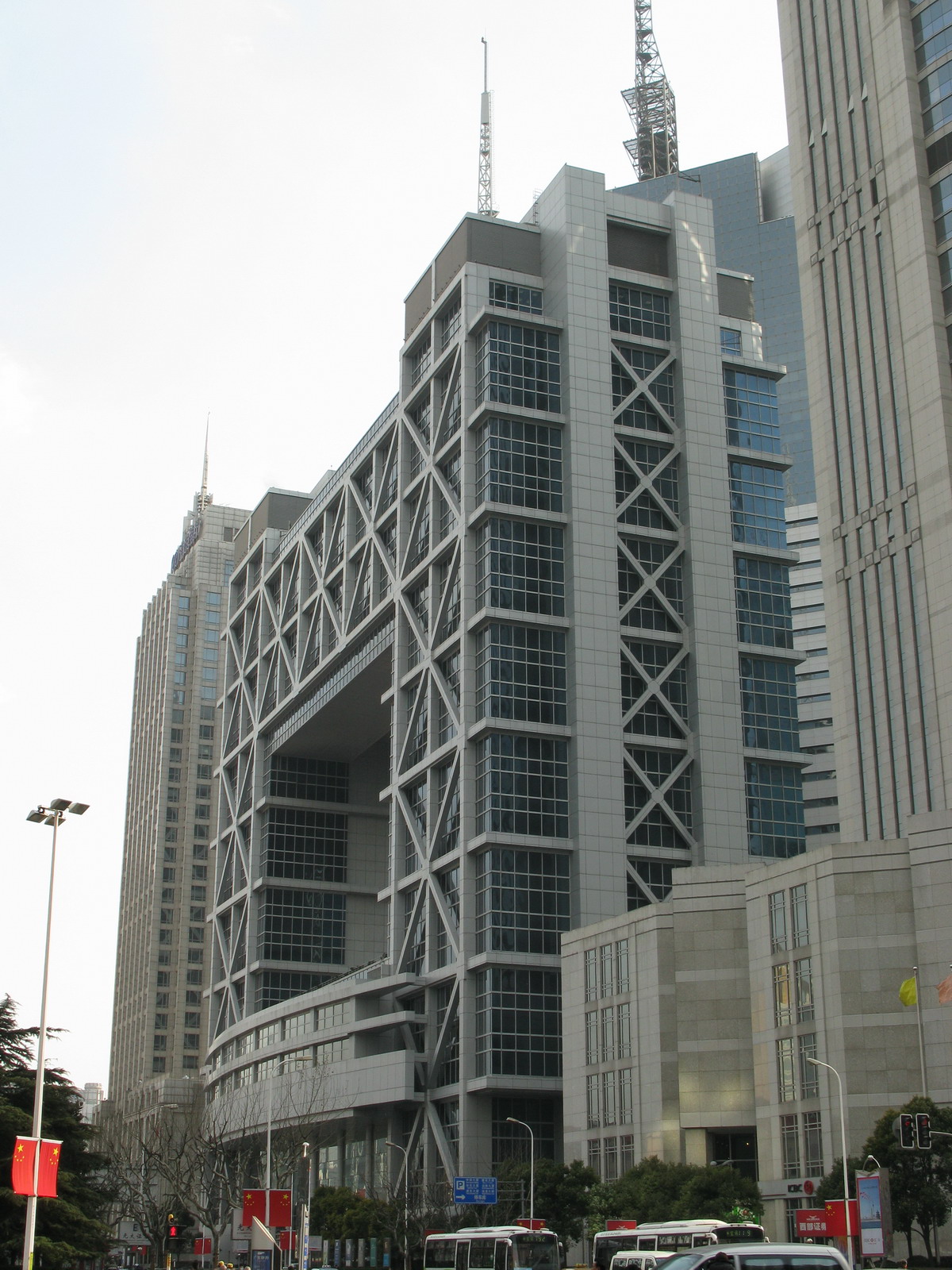
File photo: the Shanghai Stock Exchange building in Pudong. The STAR50 index of AI and semiconductor leaders trades on Shanghai's STAR Market. Photo: Baycrest, via Wikimedia Commons, CC BY-SA 2.5.
The retail wreckage nobody in Beijing wants to discuss
It is worth pausing on who actually pays for a burst bubble, because it is never the people who designed it. In China, the market is dominated by small investors — savers who were, in effect, invited in by a state that wanted their money funding the AI race. Goldman Sachs' figures make the scale plain: with AI stocks at 42% of market capitalisation and 57% of turnover, there was almost nowhere to hide once the selling started.
The political awkwardness of this cannot be overstated. Beijing wanted a slow bull to prove that Chinese capital markets had grown up. Instead it got a speculative blowout followed by a $480 billion wipeout, in the middle of a strategic technology race it cannot afford to look like it is losing. The crash does not just hurt portfolios; it embarrasses a strategy.
And the damage may not be finished. The STAR50 is down 40%, but the stocks that led the rally — the Unitrees, the MetaXs, the Moore Threads — are still priced on a future that has not arrived. Until these companies show the sustained revenue Beijing's own regulator now demands, every bounce is a chance for trapped investors to sell, not a reason to buy.
For readers who have followed our coverage of the bubble debate, this is the other half of the story: we have asked what happens when the AI bubble pops and who gets hurt, and who is warning about an AI bubble from inside the industry. China has now answered the first question in real time — and the answer is: ordinary savers, first and hardest. It is also worth remembering what the Nasdaq lost after 2000, because that crash also began with everyone agreeing the future was obvious and the prices were fine.
Our take: America is not immune — it is just later
Here is the position, stated plainly: the United States is not watching a foreign accident. It is watching its own future, running on a delay.
The differences are real and should not be dismissed. America's AI leaders have actual revenue, actual customers, and balance sheets that Chinese robot startups could only dream of. A 6% Nasdaq drawdown is not a 40% crash, and conflating the two would be lazy. But the structure of the argument is identical: prices that assume a flawless AI future, a retail crowd piling into the hottest names, and a growing gap between what companies spend on AI and what AI earns back. China's crash happened because that gap eventually mattered. There is no economic law exempting American stocks from the same arithmetic — only a longer runway.
The canary is not a metaphor here; it is a market. China ran the AI-bubble experiment first, at higher speed, with more leverage from retail enthusiasm and less discipline from listing standards, and it produced the result that sceptics predicted. The honest response from American investors is not relief that it happened over there. It is a question: what, exactly, is different enough here to change the ending?
Some of it is different. Much of it is not. The companies showing real AI profits will survive a repricing; the ones selling prototypes and promises will not, in Shanghai or in Silicon Valley. Beijing has learned that lesson at a cost of $480 billion. The rest of the world gets the lesson free. Whether it listens is another question entirely.
Daniel Rao covers technology and markets for TechPulse USA.
Sources: Reuters, "In China, the AI bubble has already burst" (October 26, 2026); Seoul Economic Daily, "Unitree Stock Halves in Two Months as China Robot Bubble Deflates" (October 27, 2026); Bastillepost, "China's STAR Composite Index closes lower Tuesday" (October 27, 2026); Telegraph India, "China's AI boom turns to bust" (October 27, 2026); Goldman Sachs figures and The Information's September 9 reporting on CSRC window guidance, as cited in the above.


Comments
Post a Comment