
DeepSeek Puts $400M on a Stealth Robot Startup That's Months Old
DeepSeek Puts $400M on a Stealth Robot Startup That's Months Old
DeepSeek, the lab that made frontier AI cheap, is suddenly paying seed-stage unicorn prices — and the paperwork isn't done.
DeepSeek, the Chinese AI lab that built its name on training world-class language models for a fraction of Silicon Valley's bills, has agreed to lead a seed financing round for a robot-brain startup at a valuation of roughly $400 million, according to Bloomberg. Here's the extraordinary part: Winverse AI was founded this year and is still operating in stealth, with no public product, no disclosed technology, and no website anyone has found. And here's the provisional part: the deal hasn't closed, and per Bloomberg the valuation and the investor line-up could both still change.
What Bloomberg does report is concrete enough to matter. The round is sized in the "tens of millions of dollars" — no exact figure has been disclosed, and you should treat any specific number you see elsewhere as invented. Meituan's Long-Z Investments has committed alongside DeepSeek. And all three parties — DeepSeek, founder Hu Han, and Long-Z — declined to comment, which, in a week when DeepSeek's fundraising has been the loudest story in Chinese tech, tells you something about how seriously the lab wants this one kept quiet.

Photo: A Unitree G1 humanoid robot at a 2024 expo. DeepSeek bought 2.31% of Unitree in its August Shanghai IPO — and now it wants its own robot brain. Credit: Sayanesy / Wikimedia Commons (CC0).
The Deal, Per Bloomberg
First, a point of precision, because the sloppy version of this story is already travelling. Some outlets are calling this a "$400 million round." It is not. Per Bloomberg, DeepSeek agreed to lead a round of tens of millions of dollars at a post-investment valuation of roughly $400 million. That is still a startling number for a company that has shown the world nothing — but it's a different kind of startling, and the difference matters when you're trying to understand how 2026's embodied-AI market actually prices talent.
Stealth is not a marketing word here. Bloomberg's sources describe Winverse as founded in 2026 by Hu Han and "months old," with nothing disclosed about what it is building — beyond, loosely, AI systems for robots. We could find no public filing, no website, and no product page for Winverse AI. One carrier suggested its focus may sit closer to underlying infrastructure and model acceleration than to embodied AI in the strictest sense; Bloomberg itself said nothing about the product. The honest reading: this is a bet on a person, not a company. Which makes the next section the most important one in this story.
Who Is Hu Han?
Hu Han's résumé is the kind that explains a $400 million post-money tag on a months-old startup. Per Bloomberg, he was a chief scientist at Tencent, where he led the vision-language and embodied foundation model teams, holds a PhD from Tsinghua University, and previously worked at Microsoft Research Asia and Baidu. That's a serious pedigree. But it's the one line on his record you can verify yourself that really lands: he is a co-author of the Swin Transformer paper.
We checked the ICCV 2021 open-access proceedings ourselves — Han Hu is listed as an author of the Swin Transformer paper, one of the most influential vision-architecture papers of the decade. The paper went on to win the ICCV 2021 Marr Award for best paper, given to a Microsoft Asia Research team. In other words, DeepSeek's new robot-brain bet is being founded by a man whose work helped reshape computer vision — and who then spent years at Tencent running the exact teams that turn vision models into systems that act in the physical world. You don't get a founder like that twice a year.
DeepSeek's $12 Billion War Chest
Context first: this seed bet isn't coming out of a thin treasury. DeepSeek is close to securing at least 80 billion yuan — about $12 billion — in a new funding round, per Bloomberg (Oct 6), after blowing past its own 50-billion-yuan target; the final tally could approach 100 billion yuan, roughly $15 billion. Tencent and CATL, the battery giant, are among the largest backers.
The round opened in July targeting a valuation of 500 billion yuan — around $74 billion — and follows DeepSeek's first external round in June, which raised roughly $7.4 billion at a valuation above $50 billion. The interest, per Bloomberg, was driven by the V4-Flash model release and its cost-versus-performance against Anthropic and OpenAI. After the round closes, the plan is a corporate restructuring toward an IPO in early 2027 — and according to The Standard, citing mainland media, the second round has already doubled to 100 billion yuan at an unchanged 500-billion-yuan pre-money valuation, taking the total raised to 150 billion yuan in six months: the largest primary-market financing in China this year, with CITIC Securities guiding toward a STAR Market listing.
Where's the money going? Mostly model training and data centres — DeepSeek plans to deploy at least 160,000 Huawei AI accelerators at an Inner Mongolia data centre, per Bloomberg. That tells you how serious the Huawei relationship has become (we've covered DeepSeek's open-source assault on Nvidia's CUDA moat before), and it frames the Winverse cheque for what it is: a rounding error on the balance sheet. As Hock Tan put it, capital, not chips, is now AI's binding constraint — and DeepSeek, right now, has capital to spare.
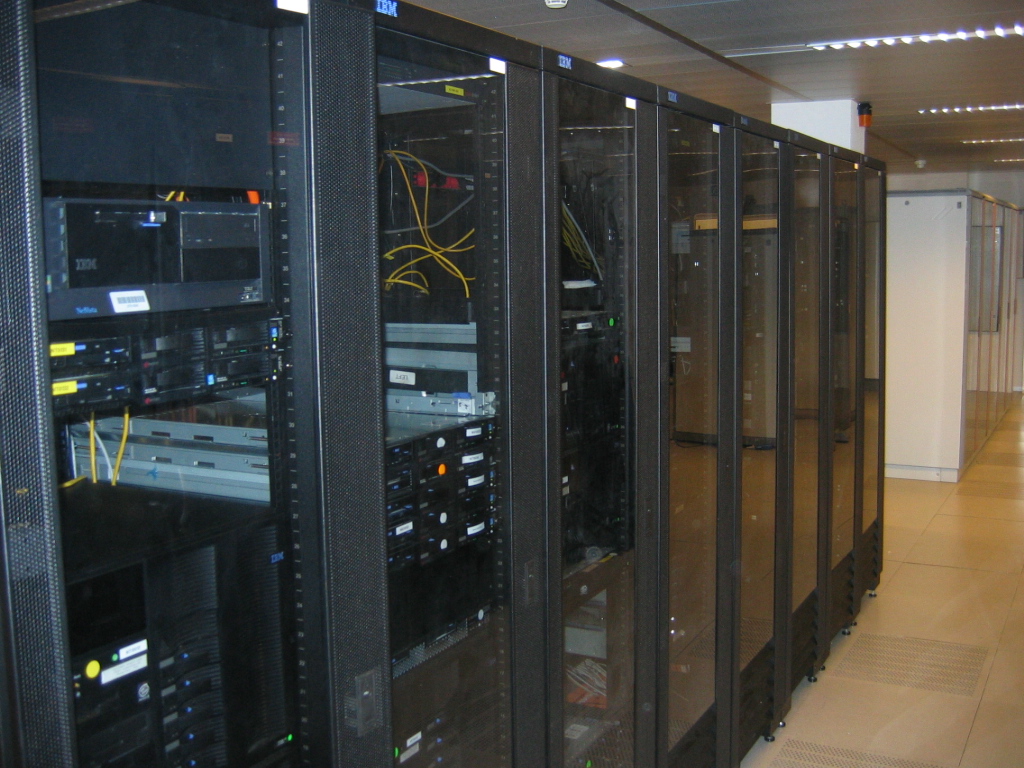
File photo: Server racks in a data centre. DeepSeek's latest raise — at least $12 billion — is earmarked mostly for training and data centres; a sliver of it is now flowing to robot-brain startups. Credit: Wil Weterings / Wikimedia Commons (public domain).
The Unitree Precedent
This is not DeepSeek's first move into embodied AI — and the earlier move makes this one easier to read. In August, DeepSeek invested 140.8 million yuan — about $20.8 million — in Unitree Robotics' Shanghai STAR Market IPO, picking up 933,399 shares, or 2.31% of the strategic placement, with a 36-month lock-up, per a stock-exchange filing cited by unite.ai. The IPO priced at 150.80 yuan a share, raised about 6.1 billion yuan at roughly a 61-billion-yuan valuation, and listed on August 19 — mainland China's first listed pure-play humanoid maker, ticker 688836.
The numbers since have been wild. Unitree's shares opened at 1,100 yuan — up 629% — and closed at 845 yuan, implying a valuation near $50 billion. The company shipped more than 5,500 humanoids and 33,000 quadrupeds in 2025, and Counterpoint credits it with over 7,000 humanoid shipments in the first half of 2026 — 31.1% of the global market, second only to AGIBOT's 9,700. Meituan-affiliated vehicles are the largest external bloc at about 9.65%, which makes Meituan's Long-Z presence in the Winverse round look less like coincidence and more like a pattern.
The more interesting detail is the procurement pact buried in the exchange filing: Unitree gives DeepSeek priority on model-training services, while DeepSeek favours Unitree when buying robots or pursuing embodied-AI applications. That's not a venture cheque; that's a supply-chain alliance wearing venture clothing. And it explains why DeepSeek's founder, Liang Wenfeng, who has said nothing publicly about the Winverse deal, might want a captive robot brain alongside an allied robot body.
Unitree's CEO, Wang Xingxing, saw the scale of this coming. On the company's June 2026 IPO approval, he said: "robotics is where EVs were a decade ago, a trillion-yuan battlefield waiting to be claimed." If you've watched the footage of Unitree's robots throwing hands at the August 2025 World Robot Conference in Beijing — actual boxing matches, live, in front of a crowd — that quote lands a little differently. The battlefield metaphor wasn't a stretch. It was a program.
The Embodied-AI Race
Zoom out and the $400 million looks less like an anomaly and more like the going rate for the scarcest input in the industry. In the US, Skild AI and Physical Intelligence are reported at valuations of $14 billion and $5.6 billion respectively, per Bloomberg — and those are companies with public faces, funding histories, and demo reels. Winverse is none of those things, which is why the comparison cuts both ways.
The Chinese supply side is genuinely staggering. The world's top six humanoid robot makers by 2025 production output were all Chinese; 160 Chinese firms now make complete humanoids and more than 600 supply core components, with roughly 30 billion yuan a year being invested in the sector. Beijing is manufacturing demand, not just capacity: a June 3 joint notice from the industry ministry and the state-asset regulator launched a 2026 real-scenario training campaign for humanoids — 100-plus high-value scenarios, with 10,000-unit deployment capability targeted by end-2026. And the State Grid's 2026 procurement plan earmarks 6.8 billion yuan — about $1 billion — for roughly 8,500 embodied-intelligence devices, including 500 humanoids from Unitree, DeepRobotics, AGIBOT, UBTech, and Fourier. The bodies are being built at scale; the brains are the missing piece. Startups racing to feed robots real-world data are the connective tissue of this whole moment.
As Morningstar analyst Kangyuxiao Li put it: "The real competitive test will be whether companies — Chinese or American — can achieve reliable performance and attractive returns on investment in large-scale industrial and commercial deployments." Twenty-eight words that say more than most white papers: deployments, not demos, are the test, and nobody has passed it yet.
Our Take: Is $400 Million Rational?
So here's the question this story actually asks: is a $400 million post-money seed for a months-old stealth team sane? My answer is that it's two things at once — and that the market has decided, perhaps correctly, that the first thing matters more.
The first thing is option value on a genuine bottleneck. The last three years taught the industry to build models that predict the next word. The next three will be about models that predict the next joint angle — perception, planning, and control fused into systems that don't fall over. Nobody has cracked it at scale, the talent pool is tiny, and Hu Han is plausibly one of the fifty best people on earth at the relevant problems. At $14 billion for Skild, paying $400 million for Hu's team isn't valuation discipline; it's a rounding error on the future DeepSeek thinks it's buying.
The second thing is that the discipline has, quite visibly, left the building. Tens of millions of dollars, an unfinalised deal, no product, no website — and a unicorn-adjacent price tag — would have been a scandal in venture five years ago. It is now Tuesday. The honest caveats still apply: the deal could shrink or die, Winverse could turn out to be closer to infrastructure software than to robot brains, and DeepSeek's own silence means we are reading Bloomberg's sources, not the lab's plans. But as bets on the physical-AI decade go, this one has a better logic than most: DeepSeek has the capital, the compute, and an allied robot maker. What's missing is the mind. Hu Han is the mind.
The deployments will decide whether Li's test is passed — and whether $400 million was the price of foresight or the price of FOMO. Until then, the rest of us get to watch the most interesting pivot in AI: the lab that made intelligence cheap is now paying top dollar to give it a body.
Sources
Bloomberg (Oct 12, 2026), as carried by TechRepublic, Tech in Asia, chaincatcher, dailyaibrief, aistartupsnews, webpronews, and The Standard Hong Kong; Bloomberg (Oct 6, 2026) on DeepSeek's funding round, via CNBC TV18, The Decoder, techstartups, and catenaa; The Standard (Oct 12) citing mainland media on the round's expansion; unite.ai citing the August 6, 2026 Shanghai stock-exchange filing; humanoidsdaily.com; Counterpoint Research; SCMP via Izvestia and Ofweek via LinkedIn on State Grid procurement; the ICCV 2021 open-access proceedings; Synced (Nov 2021) on the Marr Award; furtherasia.com citing Pandaily on the MIIT/SASAC campaign; Asia Business Daily; techxplore.
By Daniel Rao
Daniel covers AI policy, platform security, and the geopolitics of technology for TechPulse USA.


Comments
Post a Comment