
FERC Kills PJM Shortcut for Data Centres Dodging Power Costs
By Daniel Rao | October 14, 2026

Photo: High-voltage transmission lines — the physical backbone of the PJM grid, now at the centre of a jurisdictional fight over who pays for the AI buildout. (Photo taken in Auburn, Washington. Ron Clausen, via Wikimedia Commons, public domain — CC0.)
The AI industry's favourite shortcut to the American power grid just died in a Friday-evening regulatory filing. On October 9, the Federal Energy Regulatory Commission threw out the mechanism that would have let gigawatt-scale data centres plug into America's largest wholesale electricity market without bringing any new generation with them. The data centres can still come. But from now on, they have to pay for the privilege — and that changes the economics of the entire AI buildout.
It was, by any measure, a remarkable order. 197 FERC ¶ 61,019 — issued in Docket ER26-3515-000 late on a Friday, the traditional slot for news its author hopes nobody reads — landed 5–0, with not a single dissent. Chairman Laura Swett and Commissioners David Rosner, Lindsay See, Judy Chang and David LaCerte all voted, by notation, to dismantle the centrepiece of PJM Interconnection's plan for coping with the data-centre deluge. The one concurrence, from Rosner, was not a disagreement. It was an escalation.
We read the full text of the order on Friday evening, and the thing that jumps out is how surgical the split is. FERC didn't reject PJM's filing wholesale. It performed an autopsy — kept the parts it could defend, and buried the rest on jurisdictional grounds that PJM may find very hard to dig out from under.
What FERC killed — and what it kept
Start with what survived, because it matters. FERC accepted PJM's new "Large Load" definition: an end-use customer whose cumulative peak demand reaches at least 50 megawatts at a single electrical site, with affiliated facilities within a mile of each other counted as one site. It also accepted the Large Load Registry — a reporting system under which load-serving entities must disclose each big load's location, peak demand, ramp schedule and backup generation. Both take effect on October 12, 2026. FERC called the two pieces severable from the rest of the filing and "just and reasonable and not unduly discriminatory" — the statutory incantation that keeps them alive.
What died was everything with teeth. As a single package, FERC rejected the Interim Resource Adequacy Service (IRAS), the new-capacity designation requirement, the BYONC — "Bring Your Own New Capacity" — rules, and the proposal to exclude eligible new large loads from the capacity demand curve beginning with Delivery Year 2029/30. IRAS was the shortcut: it would have let large new loads connect to the grid without matching new capacity, provided they accepted being curtailed in the lead-up to grid emergencies. In plain English, the data centres could plug in first and promise to behave later. FERC said no.
Why the shortcut died: a retail fight, not an energy fight
Here's the part nobody at the AI companies wants to dwell on. FERC didn't kill IRAS because the engineering was wrong. It killed it because, in the Commission's reading, the tariff "appears to place obligations directly on eligible new large loads" — mostly retail customers — and its compensation framework "appears to establish a retail rate." That, FERC said, is an impermissible intrusion on the states' control over retail electricity rates. The federal regulator can police wholesale markets. It cannot set the price your utility charges your house. PJM's package crossed that line.
"States have a crucial role to play in this challenge by designating which retail customers must be curtailed when the system is stressed," the order reads. Translation: if somebody has to decide who goes dark first in a crisis, that's the states' call, not PJM's. The order also notes that PJM's filing "flips this paradigm" by cutting IRAS loads before voluntary demand response — curtailing the newcomers ahead of customers who had actually volunteered to be flexible.
Put bluntly, PJM got the economics right and the lawyering shoddy. The substance — making giant new loads bring their own power — is exactly what regulators, consumer advocates and even the White House all say they want. But the mechanism was built on the one foundation that cannot hold in Washington: jurisdiction. That's our reading of the wreckage, not FERC's language — but it explains why a unanimous Commission, including commissioners who plainly sympathise with the underlying goal, voted to kill it anyway.
Rosner's warning: homes, hospitals and schools first
Commissioner David Rosner concurred in the result and used the occasion to say the quiet part out loud. Left unaddressed, he wrote, PJM's plan could make the capacity market signal a surplus "while the region sheds thousands of megawatts of demand on an involuntary basis" — a market flashing green while the grid sheds load. Then came the line that will be quoted in every statehouse fight for the next year: "homes, hospitals, and schools should never be curtailed before data centers."
It is worth pausing on how extraordinary that sentence is. FERC commissioners do not normally write like op-ed columnists. Rosner wrote it anyway — and it lands because it states the moral logic everyone else has been circling. Commissioner Lindsay See made the same point in plainer bureaucratic prose in the September 29 backstop order, writing that "Existing customers should not be left paying costs attributable to new demand." PJM spokesman Jeffrey Shields, responding to the decision, said the grid operator is working to ensure "existing electricity customers should not be unfairly burdened" by energy-intensive new customers. When the regulator, the regulated and the consumer advocates all agree on the principle, the fight was only ever about the mechanism — and this time the mechanism lost.
The market fallout: higher capacity prices, for longer
Wall Street read the order within hours. A Jefferies analyst note argued the ruling could mean higher capacity prices for longer in PJM — "positive for existing generation/IPPs" — and named the winners: Constellation Energy, NRG Energy, Talen Energy and Vistra. The logic is brutal and simple. Kill the shortcut, and the looming wall of data-centre demand has to be met with real, procured capacity. The 2028/29 PJM Base Residual Auction already cleared at $325 per MW-day — the third straight auction to hit the cap. When the price is at the ceiling and demand keeps rising, the money flows to whoever owns the steel in the ground.
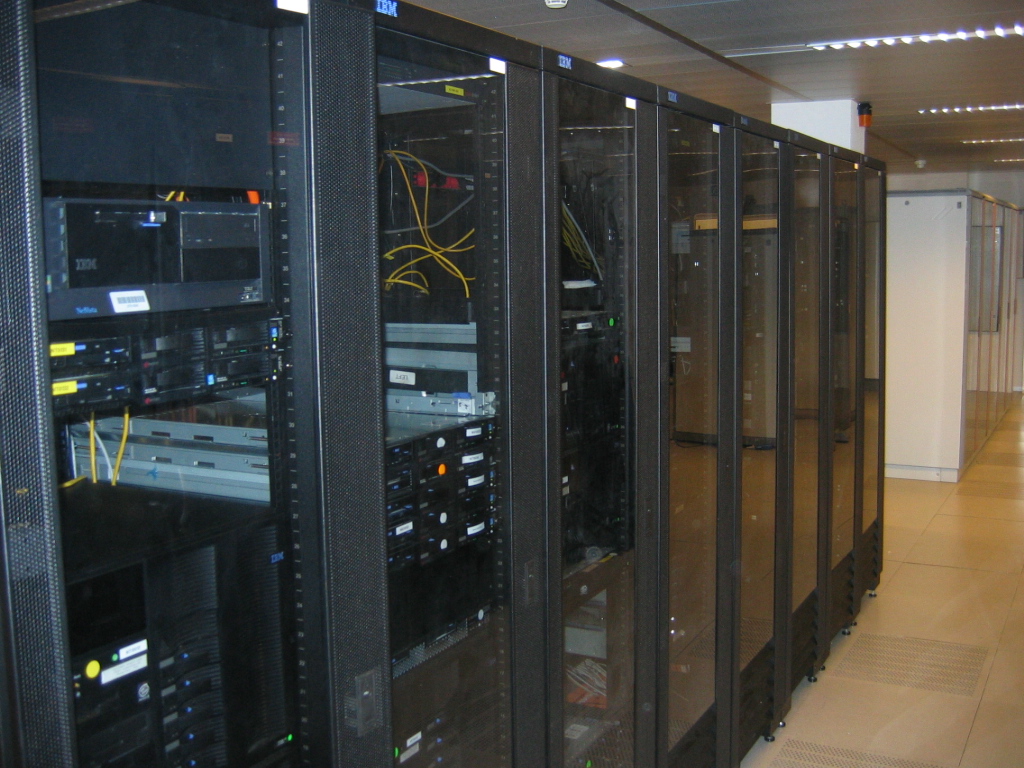
Photo: Server racks inside a data centre — exactly the kind of load FERC says must now bring its own new power supply to the PJM grid. (Photo: Wil Weterings, via Wikimedia Commons, public domain.)
The demand numbers explain the panic. PJM has estimated that data-centre demand on its system could roughly triple by 2030 to about 29 GW — a figure reported by The Inference, citing tradingview.com, and worth treating as a single-sourced estimate rather than gospel. Even discounted, it describes a grid region — 13 states plus Washington D.C., serving some 67 million people — being asked to absorb an entirely new industrial sector in half a decade. Britain is having the same argument about its own grid, as Ofgem's alarm over hundreds of new British data centres shows. PJM chief executive David Mills put it plainly: "demand for electricity continues to grow faster than electricity supply." US Energy Secretary Chris Wright has said the Department of Energy "supports having large electricity users pay for reliable new power generation." Nobody, it seems, disagrees with the goal. They disagree about who writes the cheque — and households are already absorbing the cost of the gas-fired generation keeping the lights on.
What comes next: October 22 and the refiling clock
PJM is not sitting still. The grid operator has called a special Members Committee meeting for October 22, 9 a.m. to noon Eastern, to digest the order. The Large Load Registry survives, and PJM owes FERC a compliance filing on it within 30 days — roughly November 9. Note carefully what is not on the calendar: FERC set no date for an IRAS refiling, and the refiling expected around October 29 is a separate backstop procurement filing, not a second attempt at the shortcut. Conflating the two is the easiest mistake in this story, and several early takes have already made it.
The consumer advocates, meanwhile, are furious at the form of the decision even as they cheer its substance. Claire Lang-Ree, an advocate with the Sustainable FERC Project in NRDC's Climate & Energy programme, said in a statement that "FERC's decision leaves the public exposed to rolling blackouts and higher bills," and accused the Commission of having "disregarded the White House's Ratepayer Protection Pledge." Her prescription was blunt: PJM's rules "must require data centers to bring their own supply," and the grid operator should "fix the technicalities FERC used to reject it and resubmit as soon as possible."
The pledge she invoked is real and worth knowing. The White House's Ratepayer Protection Pledge — five commitments covering building or buying new power supply, paying for delivery infrastructure, paying for the power whether or not they use it, investing in the local workforce and contributing to grid resilience — was signed on March 4, 2026 by Amazon, Google, Meta, Microsoft, OpenAI, Oracle and xAI, and now counts more than 300 signatories. We covered the White House's shift away from AI self-regulation earlier this month; the pledge is the voluntary answer to the question FERC just answered the hard way. Voluntary pledges, meet mandatory jurisdiction.
Our take: the binding constraint on AI just moved
For two years, the story of the AI buildout has been a procurement story: who can buy the chips, sign the power deals and get the electrons. This order moves the binding constraint somewhere new — into law. The electrons exist, or can be built. The question is who is legally allowed to decide the terms on which a data centre connects, who pays, and — in the nightmare scenario — whose lights go out first. FERC just ruled that the last two questions belong, in large part, to the states.
That is a defensible reading of the Federal Power Act, and it is also a punt. Fifty-odd state commissions will now have to write curtailment hierarchies for loads that did not exist five years ago, on timelines measured in months, while the most valuable companies on earth lobby every one of them. The capacity auctions are at the cap, the data centres are still coming, and the bill for the gap between those two facts will land, as it always does, on somebody's electricity bill. The only question FERC actually answered is whose desk it won't be decided at.
Sources: Utility Dive; The Inference; NRDC press release; Energy News Beat; The Duck Curve; Headwaters Wire; whitehouse.gov.
Daniel Rao covers AI infrastructure and the politics of compute for TechPulse USA — the data centres, power deals and regulations deciding where the AI boom actually gets built.


Comments
Post a Comment