
Google Cracked the 20-Year Quantum Bottleneck on Willow
By the TechPulse USA Science Desk | 16 October 2026
For twenty years, the rule of quantum computing was simple and brutal. If you wanted a universal quantum computer — one that could run real programs instead of party tricks — you had to burn almost the entire machine just manufacturing a single finicky resource: the magic state. Some estimates put the tax at up to 95% of the whole computer's capacity, spent on making the magic, leaving 5% for actual computing. This week, Google showed that rule might finally be negotiable. On its Willow superconducting processor, the company's Quantum AI team demonstrated "magic state cultivation" on real hardware for the first time, cutting errors about 40-fold and producing T-states at a record 99.99% logical fidelity. The paper landed in Science on 15 October.
This is one of those stories where the headline numbers are the least interesting part. What matters is that a theoretical fix cooked up in 2024 survived contact with actual physics. In quantum computing, paper ideas die in labs every week. This one lived.
The 20-year tax nobody could dodge
To understand why Google is excited, you need about ninety seconds of quantum theory. A quantum computer becomes "universal" — able to run any program worth running — only if it can perform non-Clifford gates. The practical way to get those gates is to prepare special starting states, dubbed "magic states," and burn them during the computation. The catch is in the burning: use a magic state once and it's gone. A machine running a serious algorithm needs a conveyor belt of fresh ones.
And making them clean is ruinously expensive. Since 2004 — "long before quantum computing was a practical engineering pursuit," as Google Quantum AI wrote on its blog — researchers have known that generating clean magic states the standard way — distillation — eats a colossal share of the machine. Google's own figures put the worst case at 95% of its entire capacity.
What "cultivation" actually means
The idea was developed theoretically in 2024 by three Google Quantum AI researchers — Craig Gidney, Noah Shutty and Cody Jones — who took a concept from the literature, refined it, and gave it a name that sounds like gardening advice. In practice, cultivation works like a high-precision filter, in four stages:
Inject. A noisy, imperfect quantum state is introduced into a small region of the chip.
Filter. The system runs a barrage of tightly coordinated measurements, hunting for errors in real time and throwing out every flawed attempt.
Cultivate. The survivors are grown into exceptionally pure, low-error T-states — the particular magic states needed for universal computation.
Graft. The purified state is transferred across error-correction architectures, from the code used during cultivation to the code that protects the broader computation.
We checked the paper's arXiv listing against Google's announcement and the 2024 theory paper, and the chain holds together cleanly: lead author Emma Rosenfeld, Gidney as a co-author, and a total author list running to roughly 270 names. This was not a three-person garage project; it took a small army.
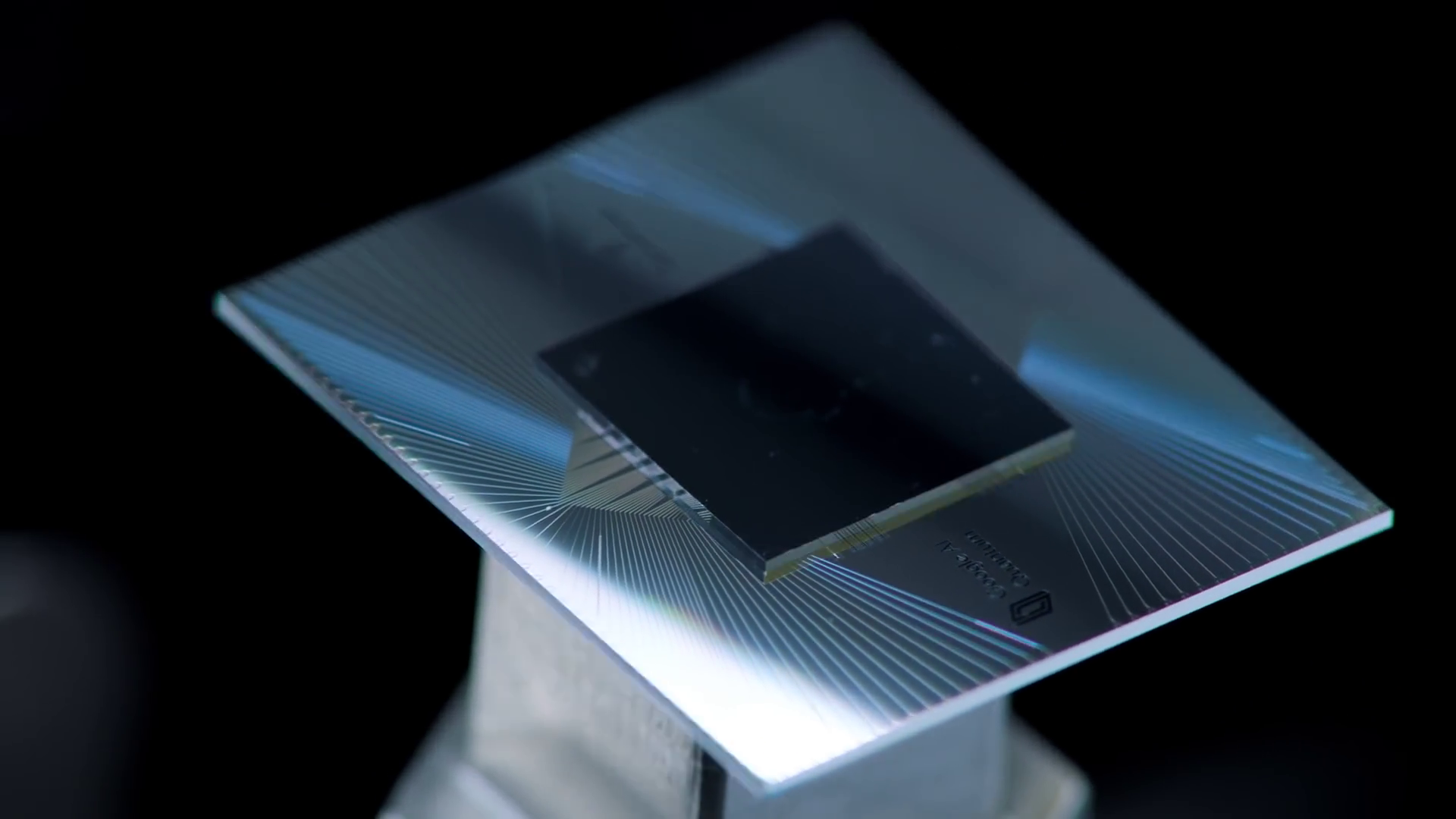
File photo: Google's earlier Sycamore quantum processor. The new "magic state cultivation" result was demonstrated on Willow, Google's newer chip — shown here is Sycamore, its predecessor. Photo: Google / Wikimedia Commons (CC BY 3.0)
The numbers: 40x and 99.99%
Run on Willow, the cultivation protocol achieved about a 40-fold reduction in errors relative to uncultivated states, and produced T-states with a record logical fidelity of 99.99% — with Quantum Computing Report reporting the figure as 99.99(1)%, an error rate of 0.0001 or better. It is, by every independent account, the first physical hardware implementation of the technique. What those numbers don't mean: 40x fewer errors is not 40x faster computing, and 99.99% fidelity does not mean a commercially useful universal quantum computer exists. It means the team can now manufacture, on real hardware, the single most expensive ingredient of fault-tolerant quantum computing at a quality nobody has touched before — with trade-press breakdowns putting the attempt-retention rate at roughly 8%.
Sundar Pichai summed it up on X: the team demonstrated the technique "on physical hardware for the first time," achieving "a 40x error reduction on our Willow processor" and "a state-of-the-art 99.99% logical fidelity."
The nightmare behind the numbers
The part Google's blog tells with unusual candour is how close this came to never working. When the team first tested the cultivation protocol, research scientist Emma Rosenfeld was staring at data that seemed to defy the laws of physics. What followed was months of confusion: simulations, long discussions with colleagues, consistency check after consistency check — the kind of lab weeks where the whiteboards fill up faster than the cryostat cools down. The answer, when it surfaced, was almost insulting in its ordinariness.
The team's go-to measurement technique carried a bad assumption. A particular kind of lab noise — drift in the electrical equipment, micro-variations in room temperature — was quietly invalidating the benchmark. The fix came in two parts: extra hardware controls to suppress the environmental drift, and, more fundamentally, a new benchmarking technique that uses cultivation as a tool to measure itself — establishing what Google calls a new state-of-the-art in quantum metrology.
This is the detail worth underlining. The fidelity record gets the headlines, but the metrology — the ability to measure states this pure on real hardware — is arguably the deeper achievement. You cannot improve what you cannot measure, and for months Google couldn't measure it either.
Why the code-switch is the real story
Buried in the announcement is the technical result that specialists are actually arguing about. Cultivation happens inside one type of quantum error correction — a "color code," a newer scheme the team calls ideal for the job. But much of the field runs on "surface codes," the more established method. A magic state is useless if it can't survive the move between the two.
Google demonstrated exactly that: grafting purified states from a distance-3 color code to a distance-5 surface code, with the states surviving the transfer inside the hardware. The grafting protocol came from the 2024 theory paper; this week was the first proof it works in a real processor — the new engine fitting the existing chassis.

A dilution refrigerator of the type used to cool superconducting quantum processors to near absolute zero. File image for illustration. Photo: OJB Quantum / Wikimedia Commons (CC BY 4.0)
Our verdict: a genuine milestone — with an honest caveat
Here's our position, stated plainly: this is real. Quantum computing has a chronic credibility problem — a graveyard of "breakthroughs" that were simulations, extrapolations, or press-release physics. What separates this one is that it happened on hardware, was published in Science, and comes with the authors' own warning label attached. Google says it plainly: "we still need to demonstrate magic state cultivation at a larger scale to make it realistic for practical quantum computing, and plenty of technical challenges remain."
That caveat is not boilerplate; it's the whole ballgame. A distance-3-to-5 demonstration is a proof of principle, not a factory. Scaling cultivation to the code distances a useful machine needs is a separate mountain, and nobody has climbed it yet. But dismissing this as incremental misses what changed: for two decades, the field's best minds treated the magic-state tax as a law of nature. Google just showed it's an engineering problem. Engineering problems get solved; laws of nature don't.
The timing is telling. Quantum is having a funding moment: the £17M Siemens–Bosch UK–Germany quantum corridor we covered this week is one bet among many. And it's been a busy week for Google generally — the same company that just rewired AI Search to give publishers their links back is now trying to rewire quantum computing's economics.
No, this does not break Bitcoin
One paragraph of cold water, because it needs saying: quantum milestones now feed directly into the "Q-day" debate — the hypothetical day a quantum computer breaks Bitcoin's cryptography. The facts, as reported by cryptonews.net: in a separate March analysis, Google researchers estimated that breaking the elliptic-curve cryptography behind Bitcoin signatures could require fewer than 500,000 physical qubits, about 20 times fewer than some earlier estimates, with around 6.9 million BTC potentially exposed through publicly revealed keys.
Now the part the hype merchants will skip: no quantum computer in existence can carry out such attacks, and Google's magic-state work does not demonstrate any ability to break Bitcoin's cryptography. It removes one obstacle on a very long road to machines that might eventually do so. Coinbase published its own quantum-migration assessment just this week — it safeguards roughly 15% of Bitcoin's supply — and Google has separately targeted 2029 for migrating its own systems to post-quantum cryptography. The honest summary: the clock is real, but Willow is not the alarm.
FAQ
What is magic state cultivation?
A technique for manufacturing the special quantum states needed for universal quantum computation: inject a noisy state into a small chip region, filter errors through coordinated measurements, and grow survivors into ultra-pure T-states. Theorised by Google in 2024, demonstrated on Willow in October 2026.
What is a T-state?
A T-state is a specific type of magic state that enables "T gates," the non-Clifford operations a quantum computer needs to run arbitrary programs. Without a steady supply of high-quality T-states, a fault-tolerant quantum computer can't do useful work.
Does this mean quantum computers can hack Bitcoin now?
No. It improves how magic states are made; it gives no existing machine the ability to break Bitcoin's elliptic-curve cryptography. Researchers estimate that would need hundreds of thousands of physical qubits — far beyond anything built today.
Why did the magic-state problem take 20 years to crack?
Because distillation was so resource-hungry — up to 95% of a machine's capacity — that improving it meant rethinking the approach entirely. Cultivation replaces brute force with a filter-and-grow strategy, and proving it works took both the 2024 theory and this week's hardware demo.
What does Google need to do next?
Demonstrate cultivation at a larger scale — bigger code distances, inside a full fault-tolerant architecture. Google says plainly that this step, plus "plenty of technical challenges," still stands between this result and practical quantum computing.
Sources
Google Quantum AI's official announcement; the Science paper and its arXiv listing; Quantum Computing Report; BusinessToday; cryptonews.net. The 95% tax and 40-fold reduction are Google's own figures; the 99.99(1)% figure and grafting details are corroborated by Quantum Computing Report.
About the author: The TechPulse USA Science Desk covers breakthroughs in quantum computing, AI and frontier research for a US audience — multi-source reporting, every fact checked, no hype without evidence.


Comments
Post a Comment