
Made-Up Pollster Trolled the New York Times for Four Months
A Made-Up Pollster Trolled the New York Times for Four Months
For four months, one of America's most trusted newsrooms published election polls from a company that was making them up. Not massaging them, not leaning on dodgy samples — inventing them outright. The confession arrived this week, ten days before the November 3 midterms, and it lands with the subtlety of a thrown brick: "most" of Wedgewood Polls' data, the firm admitted, was fabricated.
The admission didn't come from a regulator, an investigative committee, or a whistleblower. It came after a single polling aggregator asked questions. Which raises the uglier question: if Wedgewood could fool the New York Times for a third of a year with numbers it pulled out of thin air, what else is sitting in election trackers right now?
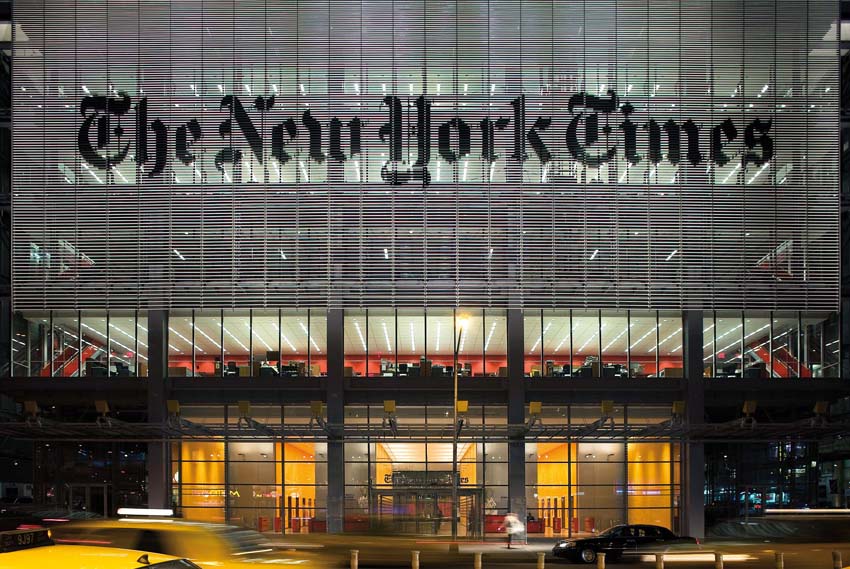
The New York Times Building in Manhattan. The paper removed 15 Wedgewood Polls surveys from its polling tracker this week after the firm admitted fabricating most of its data. Photo: Michel Denancé, via Wikimedia Commons (CC BY 3.0).
How a "polling firm" unraveled in a week
The story broke the way all the best embarrassments do: quietly, then all at once. The polling aggregator FiftyPlusOne contacted Wedgewood Polls as part of an investigation into the firm's surveys. Wedgewood responded with a statement on X admitting that "most" of its data had been made up — and explaining that the whole operation had been, in its telling, an experiment in how easily "an entirely fabricated polling firm" could gain traction and be taken seriously, according to AFP's reporting.
A fuller version of the firm's claim, carried by the Washington Examiner, described the scheme as "an experimental project to demonstrate the vulnerabilities, lack of oversight, and overall low barrier to entry in the modern political polling industry." That is Wedgewood's framing, offered by the people who did the inventing. It deserves exactly the skepticism you'd give a confession note from a confessed forger. But here is the uncomfortable part: the experiment worked.
Wedgewood's data covered high-profile races in several states — Michigan, Georgia, Mississippi, Maine and Kansas, per the Examiner — and was picked up by major polling aggregators and news outlets, including the Times. Then, with the confession out, the firm did what disgraced online entities always do: its X account was taken down, the principals disappeared, and the whole thing became a story told by everyone except the people who ran it.
The campaigns it kneecapped
Fake numbers have real victims. Michigan Senate candidate Mallory McMorrow said that after a Wedgewood "poll" in late June showed her support in single digits — contradicting her campaign's internal polling — "donations dried up," volunteers were "devastated," and the media "hounded" her with calls to drop out of the Democratic Senate primary. "It killed us," she wrote on X.
Read that sentence again. A candidate's fundraising collapsed, her volunteers were gutted, and reporters were calling for her political obituary — because of numbers that never existed. McMorrow's campaign was fighting a ghost.
She wasn't the only one. In Mississippi, Democratic Senate candidate Scott Colom's campaign cited a Wedgewood poll in a news release to support claims of growing momentum, according to New York Times reporting. A campaign built a strategy on quicksand and announced it proudly.

Voters cast ballots in Texas during the 2010 midterms (file photo). Ten days out from the November 3 vote, fabricated polls are distorting real campaigns. Photo: Patrick Feller, via Wikimedia Commons (CC BY 2.0).
The paper of record's shoddy week
The Times' embarrassment is spelled out in its own editors' note: "This page previously included surveys from Wedgewood Polls. On Oct. 20, after being questioned by the polling site FiftyPlusOne, Wedgewood released a statement admitting it had fabricated data for its polls. All of Wedgewood's polls have been removed from our poll tracking project." Fifteen surveys, released between June and October, all gone.
The paper said it had included the surveys after receiving answers to questions about the firm's personnel, methodology and funding. Let that sink in. Somebody at Wedgewood answered a vetting questionnaire — about staff who may not have existed, methods that were fiction, funding that was who-knows-what — and the answers were good enough. This is the part that should make every newsroom queasy: the vetting process didn't fail to happen. It happened, and it was satisfied by a fabrication.
Polls, as it happens, already had a trust problem with the American public — as one recent national survey showed, most Americans are happy to reject even the questions pollsters ask. Wedgewood just gave every skeptic a case study.
Trump pounces: "The New York Times got caught!"
President Donald Trump, who has spent years accusing pollsters of dishonesty, needed no invitation. On Truth Social on Thursday, he wrote: "The New York Times got caught! They used a Company, Wedgewood Polls, that ADMITTED that the Poll Numbers they published were made up and FAKE," in AFP's account of the post.
Trump's broader point — that polling coverage can be wielded as a weapon — is one he has made repeatedly, and the Wedgewood debacle hands it to him on a platter. The irony, if you want it, is that a Democratic primary candidate in Michigan and a Democratic campaign in Mississippi were the ones actually damaged by the fake numbers; the scandal doesn't map neatly onto anyone's partisan script. But precision has never been the point of a victory lap.
The deeper damage is to the institutions standing behind the numbers. Americans' trust in the outfits that measure and model their opinions was already scraping the floor — and every fabrication scandal pours concrete over the cracks.
The FCC chairman turns up the heat
Then the regulators arrived. FCC Chairman Brendan Carr said there had been "a significant surge in entirely fake polls and suppression polls" designed to interfere with the electoral process, and urged the media not to amplify such hoaxes as "news distortions," according to AFP and the Examiner. In the Examiner's fuller account, Carr warned broadcasters against airing fabricated polls "without regard to basic journalistic ethics," and said stations could face regulatory scrutiny if they knowingly mislead viewers through false polling data.
There are real limits to that threat, and Carr's own agency's rules say so. The FCC has maintained its policy against deliberate news distortion on over-the-air television and radio for more than 50 years — but the policy does not extend to cable news, newspapers, online publications, social media or streaming. Enforcement also requires more than a wrong number: the alleged distortion must involve a significant event, and regulators must establish that a broadcaster deliberately distorted factual reporting. Ordinary mistakes don't qualify.
That didn't stop the pushback. FCC Commissioner Anna M. Gomez argued that broadcasters should not face punishment for reporting publicly available polling data in good faith, and media and legal observers questioned whether the agency's rules give it authority to intervene in editorial decisions at all, per Outlook India. A fight about fake polls has now become a fight about who gets to police the press — which is precisely the kind of fight that makes an already polarized election season worse.
The AI accelerant nobody wants to talk about
Here's the part that should worry everyone who works with data for a living: this is getting easier, not harder. Pundits warn that fast-evolving AI tools are making it simpler to fabricate polling results, and the professionals agree. "It's getting easier to conduct low-quality polls — or fake them altogether," FiftyPlusOne warned. The American Association for Public Opinion Research said sophisticated AI tools are making phony pollsters harder to spot. "We are once again experiencing bad actors producing and distributing fabricated data and organisational information that undermines trust in public opinion and election polling," said its president, Mary Losch, adding that fraudulent activity shouldn't be conflated with legitimate election polling.
And it's not just numbers. Fabricated AI imagery has already tested newsrooms' verification instincts this cycle — the forgery toolkit keeps growing while the verification toolkit limps behind.
Wedgewood isn't even the first of the season. In August, a group called Median Strategies admitted to fabricating poll results, saying it had been "created as a short-term social experiment," according to the Los Angeles Times. And on Thursday, FiftyPlusOne said in a blog post — titled, with admirable bluntness, "more pollster funny business" — that it would stop collecting data from a third firm, SoCal Strategies, after an investigation cast doubt on its authenticity. The firm could not be reached; its website, X account and Substack page appeared to have been taken offline.
Three firms. One cycle. Two confessed forgers and one ghost — ten days before a national election.
The real verdict: the gatekeepers botched this, not just the forgers
Let's be blunt about where the failure sits, because the temptation is to blame the forgers and move on. Yes, fabricating data is fraud. But the scandal isn't that a fraud existed — frauds always exist. The scandal is that the gatekeepers waved it through for four months. The Times' vetting was satisfied by answers to a questionnaire. Aggregators scraped the numbers into their models. Campaigns and reporters acted on them. Every layer of the system that was supposed to catch a fabrication performed exactly one function: it passed the numbers along.
That is shoddy, and no amount of editors'-note contrition fixes the structural problem. Fake numbers, real damage, and a regulatory chairman threatening broadcasters over "news distortion" ten days out — that's a cocktail nobody should want. The AI angle matters, but let's not hide behind it: the tools didn't vet the Times' questionnaire. People did, badly. And until newsrooms treat a polling firm's numbers with the same suspicion they'd give an anonymous tip, the next Wedgewood is already out there, filling in spreadsheets.
One housekeeping note, since verification is the whole subject here: we pulled both images for this story straight from Wikimedia Commons and opened the files ourselves before embedding. The licence pages checked out — CC BY 3.0 and CC BY 2.0 — and both photographs depict exactly what our captions say. Wedgewood's big experiment ended the way these things always do: with the account deleted and the architects nowhere to be found, leaving the wreckage for everyone else to clean up.
Update, Oct. 24: how the forgery was actually caught — a metadata mismatch
The post says FiftyPlusOne "asked questions." The fuller account, published by the aggregator's own team and walked through by Columbia's Statistical Modeling blog, is a small piece of data forensics. FiftyPlusOne shared raw survey data with Wedgewood on October 15 — data it has now confirmed was fraudulent — and bought its own comparison survey from Pollfish, the online survey platform Wedgewood claimed to use. Two patterns didn't match. First, in Pollfish data the respondent ID is a roughly even mix of a standard string of numbers and a string prefixed by a hyphen; second, the transaction identifier correlates almost 1:1 with the time a person submitted their survey. Pollfish confirmed both behaviours as expected, and data from another pollster using the platform matched them. Wedgewood's data did not. FiftyPlusOne put the discrepancies to Wedgewood on October 19; one day later, the group confessed on X. VoteHub, meanwhile, says it assigned Wedgewood a D grade after talking to its "head pollster" and included the data anyway — a reminder that a low grade is not the same as exclusion. And one Wedgewood claim survives as a claim only: per Axios, the firm maintained that one crowdfunded Nebraska survey was legitimate. Treat that as Wedgewood's assertion, not as established fact. (Detection method per FiftyPlusOne via Columbia Statistical Modeling and dnyuz; VoteHub D grade per Skeptic Society Magazine's summary; Nebraska claim per Axios via rifnote.)
The afterlife: 869 AI answers are still quoting the fake polls
Pulling 15 surveys from a tracker does not pull them from the machines that already swallowed them. An Innovating for Public Good study of AI answers found 869 answers quoting a Wedgewood poll as a data point, on 83 of the 85 days it collected between July 24 and October 20 — with no change through October 20, the day of the admission. Wedgewood's numbers appear in 15 of the 63 races the study analysed. In the Georgia races, 34 of 122 answers presented the Wedgewood poll as the latest survey, 23 noted its sample size, and none the study reviewed questioned the pollster. The route in was the aggregator tables: the answers cite 270toWin (481 of the 869), Pollsmax (465), RealClearPolling (261), PollingSource (144), Decision Desk HQ (144), Call The Map (135), PoliAgg (127), and FiftyPlusOne itself (97) — counts overlap because one answer can cite several. By platform, Copilot repeated the fake figures most often (298 answers), followed by ChatGPT (258) and Claude (147), then Perplexity (79), plain Google results (41), Google AI Mode (33), and Gemini (13). A chatbot answer carries no "pending review" label, the study notes: once a number enters an aggregator's table, it reaches voters presented as fact until the sites the model learns from tell it differently. Separately, Decision Desk HQ says it removed all 17 Wedgewood polls from its aggregates — its own count, not the Times' 15 — and that the removal "has not changed the projected seat totals or chamber control probabilities in the Senate or House." (AI-answer figures per Innovating for Public Good; DDHQ removal and projections note per zeale.co's summary. Do NOT conflate the Times' 15 with DDHQ's 17 — different aggregators counted differently.)
Wedgewood Polls scandal: FAQ
What is the Wedgewood Polls scandal?
Wedgewood Polls, a self-described polling firm whose surveys appeared in major election trackers, admitted on October 20 that "most" of its data had been made up. The admission came in a statement on X after the polling aggregator FiftyPlusOne confronted the firm as part of an investigation. Wedgewood claimed it had been running an "experiment" to see how easily "an entirely fabricated polling firm" could gain traction; its X account has since been taken down.
How did the New York Times get fooled?
The Times included 15 Wedgewood surveys, released between June and October, in its poll-tracking project. It said it had done so after receiving answers to questions about the firm's personnel, methodology and funding. After Wedgewood's admission, the paper published an editors' note and removed all 15 surveys from its tracker.
Did the fake polls actually affect any campaigns?
Yes. Michigan Senate candidate Mallory McMorrow said a late-June Wedgewood poll showing her support in single digits — contradicting her internal polling — caused donations to dry up, devastated volunteers, and brought media calls for her to drop out of the Democratic Senate primary. "It killed us," she wrote on X. In Mississippi, Democratic Senate candidate Scott Colom's campaign cited a Wedgewood poll in a news release claiming growing momentum, per New York Times reporting.
What has the FCC said about fake polls?
FCC Chairman Brendan Carr said there had been "a significant surge in entirely fake polls and suppression polls" meant to interfere with the electoral process, and urged broadcasters not to air them as "news distortions." He suggested stations could face regulatory scrutiny. FCC Commissioner Anna M. Gomez pushed back, arguing broadcasters shouldn't be punished for reporting publicly available polling data in good faith.
Are AI tools really making fake polling easier?
That's the warning from both pundits and professionals. AFP reports that observers fear fast-evolving AI tools make fabricating results simpler; FiftyPlusOne said it's "getting easier to conduct low-quality polls — or fake them altogether"; and the American Association for Public Opinion Research said sophisticated AI tools are making phony pollsters harder to spot. Wedgewood is the second admitted fabrication this cycle after August's Median Strategies, with a third firm, SoCal Strategies, dropped by FiftyPlusOne over authenticity doubts.
What are poll aggregators changing after Wedgewood?
FiftyPlusOne says it intends to screen pollsters more vigorously, "including meeting them in real life or via a video call, and potentially reviewing firms' microdata — to hopefully avoid problems like this in the future." The New York Times, by contrast, cited its editor's note but did not directly answer a question about what changes it might make to its poll-vetting procedures, per dnyuz's account. Nate Silver's Silver Bulletin makes a related point about its own process: it generally waits a day or two to see whether the NYT and other aggregators have included a poll "lest we add some fake or nonprofessional datapoint," but it has not generally conducted "secondary screening" once a poll passes what Silver calls the equivalent of the TSA security perimeter — the NYT database — "because the NYT usually does a very good job with its vetting." The Wedgewood case is the exception that tests that trust. (FiftyPlusOne plans and NYT non-answer per dnyuz; Silver process per natesilver.net.)
What did the polling profession itself say?
The American Association for Public Opinion Research (AAPOR) condemned the fabrication on October 21, stating that it "strongly condemns fabrication of data in any polling or public opinion research" and that "there is no basis for intentionally fraudulent behavior that misleads the public." AAPOR's statement adds the detail that should worry every newsroom: "the responses in this case were simply made up. No individuals responded to survey questions." It also names the new difficulty — AI tools that generate "not only fabricated data but fabricated organizational documentation," creating "significant challenges to traditional means of confirming legitimacy" — and urges journalists to ask questions about methodologies and the organisations purportedly conducting them, pointing to its Journalist's Guide to Understanding Polls & Surveys. Legitimate firms, AAPOR notes, disclose information about their identities, methods, and data consistent with its Code of Professional Ethics and Practices. (AAPOR statement, October 21, 2026, via aapor.org.)
Sources: AFP reporting carried by Kuwait Times and eNCA (Anuj Chopra, October 23, 2026); Washington Examiner (October 2026); Outlook India (October 23, 2026); WION (October 24, 2026); the Los Angeles Times via wire reporting on Median Strategies. The New York Times editors' note quoted verbatim as carried by AFP and the Washington Examiner. Analysis, framing and the judgment section are the author's own.
By the TechPulse USA News Desk. TechPulse USA is an independent US-first tech and AI news publication covering the stories shaping America's digital future — with every fact verified before it prints.


Comments
Post a Comment