
Maia 300: Microsoft's 'Biggest Bet Yet' to Loosen Nvidia
By the TechPulse USA New York desk
Microsoft still loves Nvidia. It said so last week, when Satya Nadella shared a stage with Jensen Huang to launch a new line of Windows PCs built on Nvidia chips. It said so again in July, when Nadella promised Microsoft would be among the first cloud providers to deploy systems based on Nvidia's next-generation Vera Rubin silicon. And then, this morning, Nadella announced the chip meant to need Nvidia a whole lot less.
"Today we are announcing our biggest bet yet on our own silicon," Nadella wrote on X, unveiling the Maia 300 — the third generation of Microsoft's custom AI chip. "Starting next calendar year, we will scale our Maia family to multi-gigawatt deployments, making it the primary inference system for our own product and services."
That is not the language of a side project. "Primary inference system" means the silicon that will actually answer your Copilot queries, run your Teams summaries, and grind through the long documents and multi-step agent jobs that now dominate enterprise AI — built by Microsoft, for Microsoft, running mostly where Nvidia's GPUs used to run.
The numbers behind the "biggest bet"
Reuters reports Microsoft plans to deploy potentially more than a million Maia 300 chips next year to back its internal AI services. The chip is built from "chiplets" — specialised silicon blocks bonded together — with the key computing functions etched on TSMC's 2-nanometre process and cheaper 3-nanometre silicon handling memory control and data movement. It is a different technical path from Nvidia, whose accelerators fuse one massive computing die to banks of high-bandwidth memory.
The performance claims, all Microsoft's own: the Maia 300 delivers 40 per cent more tokens per watt than "leading GPU-based systems" (Microsoft declined to name which), and a full rack of 96 chips can push up to seven times the rack-scale token throughput of the previous Maia 200 generation. A single rack draws about 167 kilowatts of power — compared with roughly 142 kilowatts for Nvidia's latest GB300 rack, according to Reuters — so Microsoft is asking customers to believe the throughput-per-watt story, because on raw power draw its rack is actually the hungrier of the two.
Still, a million chips is a million chips. Microsoft designs them; TSMC builds them; and every one that ships is a chip Microsoft did not buy from Nvidia. As GeekWire's Todd Bishop put it, this is a shift that "could save the company billions of dollars and reduce its dependence on industry juggernaut Nvidia." In an AI economy where the most valuable commodity is no longer the chip but the electricity to run it — and the capital to buy both — vertical control of your own silicon is the closest thing to a moat the hyperscalers have left.
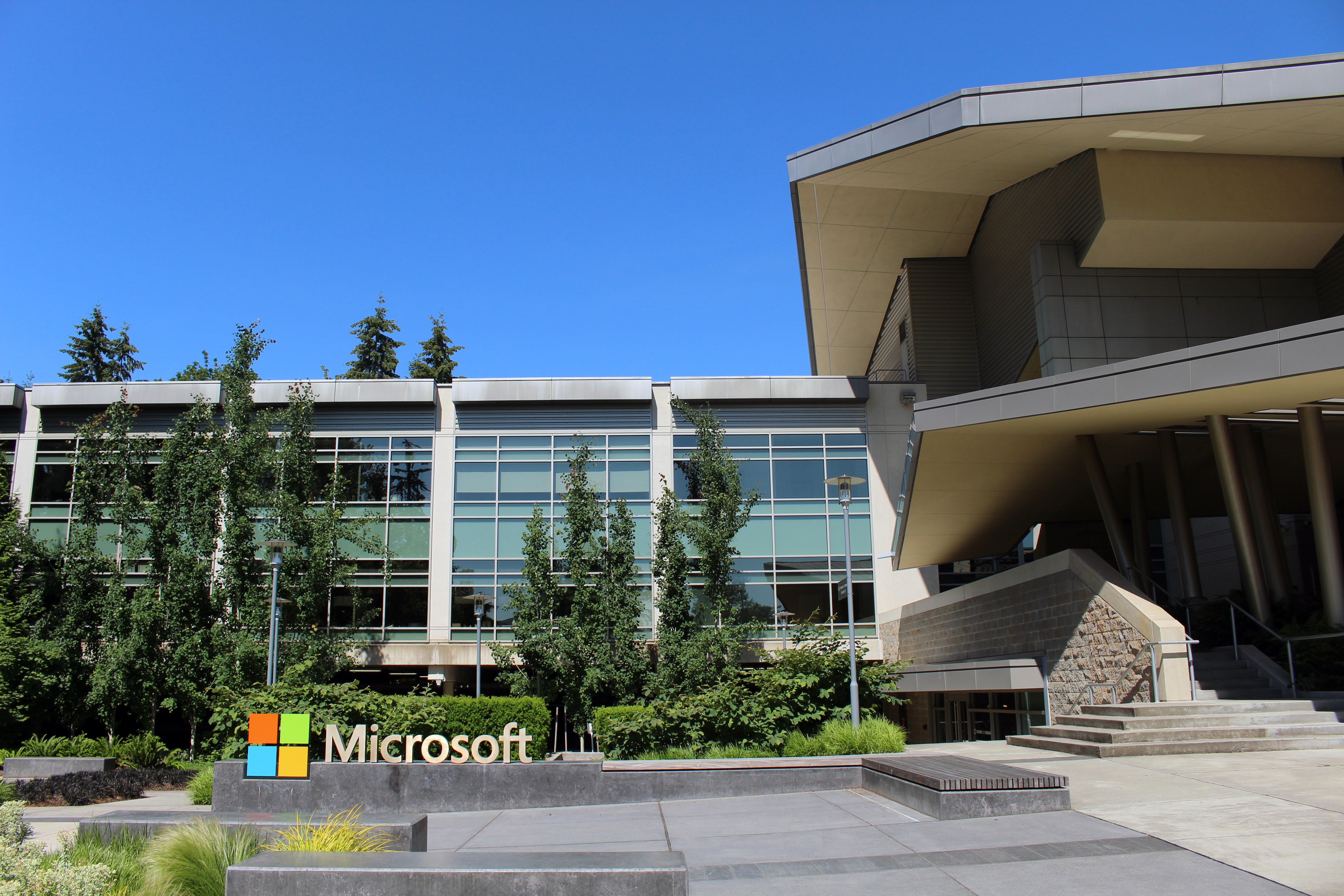
Photo: Microsoft's Building 92 at its Redmond, Washington headquarters. The company says its Maia chips will become "the primary AI inference system for Microsoft products and services." Credit: Coolcaesar, Wikimedia Commons (CC BY-SA 4.0).
Microsoft is late — and it knows it
Credit where it is due: Microsoft is the laggard in the hyperscaler silicon race, and the announcement does not try to hide it. Google has been shipping Tensor Processing Units for years and has begun selling them directly to customers. Amazon's Trainium chips won over Anthropic. Meta rolls its own inference silicon. Even OpenAI — Microsoft's most important partner — unveiled its first custom chip, built with Broadcom, back in June.
Microsoft's record is thinner. The first Maia, announced in 2023, was a false start. The Maia 200 only arrived this January after delays, and The Information reported in August that it was running in just two US data centres. Only now is the current generation getting real scale: Nadella said Microsoft is "already deploying Maia 200 across the US, Europe, and Australia, delivering up to 1.7x more tokens per watt across experiences in Teams and Copilot," with GitHub Copilot and Microsoft Foundry set to move onto it by the end of the year.
The honest read is that Maia 200 was the pilot and Maia 300 is the bet. Evercore ISI analysts estimate Maia will account for only about 10 per cent of Microsoft's AI-chip spending by early 2027, according to CNBC — which means nine dollars in ten still go to Nvidia and AMD. Nadella is not pretending otherwise. But "primary inference system" is a direction of travel, and multi-gigawatt scale is not a hobby.
The Nvidia dance: smile on stage, compete in the lab
Here is the part that would make a good novel. Last week, Nadella stood shoulder-to-shoulder with Jensen Huang, all smiles, launching Windows PCs on Nvidia chips. This week he announced the architecture of Nvidia's gradual displacement inside his own data centres. Both can be true at once — and that is precisely the game every hyperscaler is playing.
Nobody is "dumping" Nvidia. Microsoft remains one of Nvidia's largest customers, and the Maia 300 is aimed squarely at inference — the steady, high-volume grind of answering queries — rather than the frontier training workloads where Nvidia's GPUs still reign. The chip is also not for sale: unlike Google's TPUs, Maia is not available for outside customers to rent, which keeps it an internal cost weapon rather than a revenue line. But the signal to Wall Street is unmistakable: every percentage point of inference that moves to Maia is a percentage point of margin Microsoft keeps for itself, and a dollar of pricing power Nvidia loses.
Our take, bluntly: this is how supplier revolutions actually happen. Not with a dramatic divorce announcement, but with the world's biggest software company quietly deciding that its AI services are too important — and too expensive — to run on somebody else's markup forever. Whether the Maia 300 can deliver its promised 40 per cent efficiency edge in real data centres, against real Nvidia racks, will decide if this bet pays. The physics of 167 kilowatts a rack is not forgiving.
Why this matters beyond Microsoft
Zoom out and the Maia 300 is really a story about the AI boom's central anxiety: cost. As we reported this week, Broadcom CEO Hock Tan told a Singapore panel that capital — not memory chips — is now the biggest constraint on AI growth. Microsoft just offered the clearest possible proof: when your AI inference bill runs into the tens of billions, you stop renting compute and start minting your own.
It also sharpens the power question. Microsoft notes, correctly, that more-efficient chips let it run AI on less electricity "at a time when power supply has become one of the biggest constraints on AI expansion." But multi-gigawatt Maia deployments will still need gigawatts of actual power, delivered through grids already buckling under data-centre demand. Efficiency buys time; it does not conjure megawatts. The chip is a hedge against Nvidia, not a hedge against physics.
Microsoft says it will share more details next month at its Ignite conference in San Francisco. That is when the real questions start: how much of the "40 per cent" survives independent testing, how fast the million-chip ramp actually goes, and whether Azure customers ever get to touch Maia at all. For now, one sentence from Nadella tells you everything about how Redmond sees the next decade: "our biggest bet yet on our own silicon."
Sources: Reuters (Stephen Nellis and Max A. Cherney), GeekWire (Todd Bishop), Microsoft/Azure (Scott Guthrie blog; Satya Nadella on X), The Information, CNBC/Evercore ISI. We ran the rack-power comparison (167kW vs 142kW) from Reuters' figures this morning; Microsoft's efficiency claims are its own and untested independently.
TechPulse USA is an independent tech and AI news publication. Our New York desk covers the companies and capital flows shaping the AI buildout — from hyperscaler silicon to the debt fuelling it.
Maia 300 FAQ: Microsoft's Nvidia exit, explained
What is Maia 300? Microsoft's third-generation custom AI inference chip, unveiled October 12 at the OCP Global Summit in San Jose. It's designed to become "the primary AI inference system for Microsoft products and services," per Azure chief Scott Guthrie.
When does it ship? Production deployments begin in 2027. Until then, Microsoft keeps leaning on Nvidia and AMD for training and much of inference.
How many will Microsoft deploy? Potentially more than one million chips next year, Reuters reported — part of multi-gigawatt plans across the Maia family, per CEO Satya Nadella.
What's the key number? Microsoft claims 40% more tokens per megawatt than leading GPU-based systems, with a full 96-accelerator rack delivering up to seven times the token throughput of the Maia 200. The chips use TSMC 2nm compute chiplets plus cheaper 3nm I/O chiplets.
Does this replace Nvidia? Not entirely. Maia targets inference — serving models — while training still runs on Nvidia and AMD. Evercore ISI forecasts Maia will account for about 10% of Microsoft's AI-chip spend by Q1 2027.
Related: the startup Nvidia and Intel are both backing to replace them · Europe's lone chipmaker just doubled output


Comments
Post a Comment