
Nvidia-Backed Upscale AI Opens Data Centres to Rival Chips
By Daniel Rao
Nvidia just helped bankroll the startup trying to end the single-vendor AI data centre. On Thursday, Upscale AI — a Santa Clara networking outfit in which Nvidia is an investor — launched Token Fabric, a platform that lets customers build data centres mixing AI chips from rival suppliers on one open network. And on that very same day, Nvidia's own shares slid roughly 3% to about $230.48. The sell-off was about OpenAI's revenue figures, not Upscale — but the timing was, let's say, pointed.
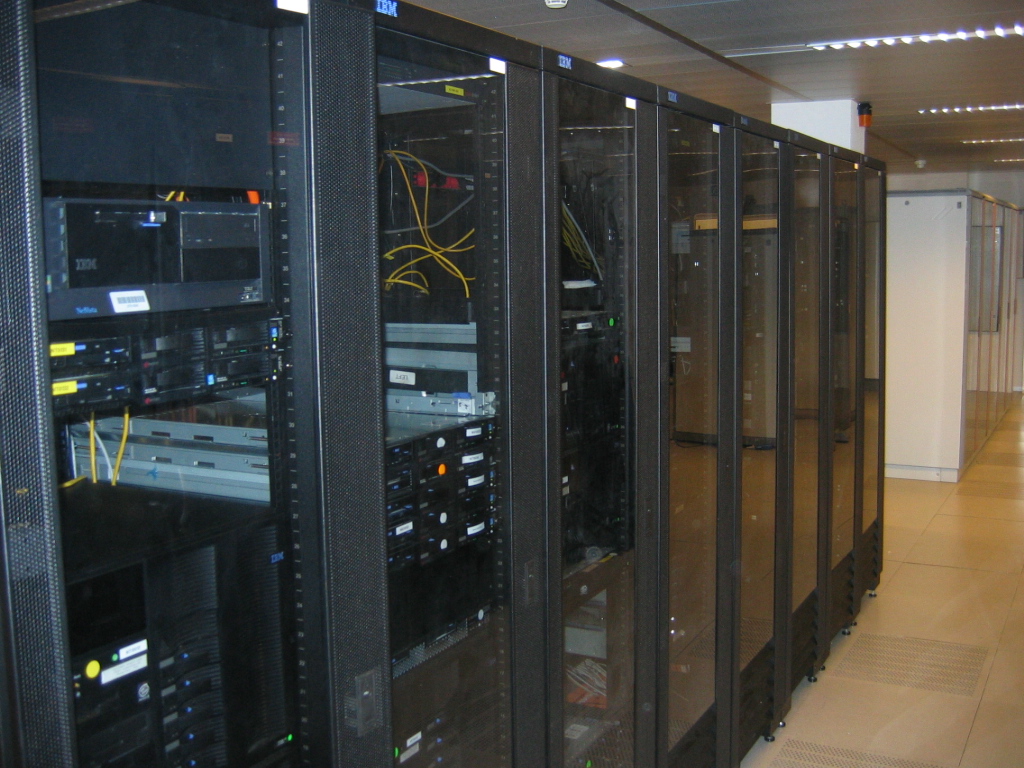
Photo: A data centre server hall — Token Fabric is designed to network racks of AI accelerators from different chip suppliers as one system. Generic image. Credit: Wil Weterings via Wikimedia Commons (public domain).
The strangest launch of the year
Revealed in a Reuters exclusive by Aditya Soni, Token Fabric is hardware and software bundled together: Upscale's own networking chips, equipment built on Nvidia's Spectrum-X technology, and software that spots bottlenecks and flags gear that may need replacing. The pitch is disarmingly simple — no more stitching together separate networking systems for every chip vendor in the building. Buy the platform, plug in whatever accelerators you like, and let the fabric sort it out.
That's a bigger deal than it sounds. For years, the dirty secret of the AI boom has been that the chips were never the hardest part. Getting thousands of them to talk to each other — at speed, without idling — is where fortunes get made or torched. A top-end accelerator sitting idle while it waits for data is the most expensive paperweight in enterprise tech. Token Fabric's whole reason for existing is to make sure that doesn't happen: keep the pricey silicon working instead of waiting around.
Chief executive Barun Kar isn't shy about the ambition, either. He told Reuters he expects Token Fabric to generate revenue next year "in the tens of millions of dollars, potentially reaching the low hundreds of millions." For a company founded last year, that's a bold number to put on the record. Bold, but not insane — the first piece of the platform, which links groups of AI chips across a data centre, ships this quarter, with the full rollout arriving in stages through 2027. General availability is targeted for early 2027, with early-access and joint-validation programmes already running, according to the company's own announcement.
What Token Fabric actually does
Strip away the marketing, and Token Fabric is three things bolted into one architecture. The official announcement — which we checked on upscale.com, where the full release is published, though notably without a single named customer — breaks it down like this.
First, scale-up: Upscale's own SkyFabriX switch silicon and switch trays, designed to pool GPUs and other accelerators inside the rack. Upscale says the silicon delivers 115.2 terabits per second, with a roadmap toward multi-petabits, and speaks open protocols including ESUN, UALoE and the emerging UALink standard. Second, scale-out: systems engineered by Upscale but powered by Nvidia's Spectrum-X Ethernet, running from 400G up to 1.6T. Third, operate as one: SkyOS, an AI-native network operating system, plus SkyCMD, an orchestration layer that watches thousands of network elements and manages them as a single system.
The mantra, repeated everywhere in the launch materials, is "any GPU, any XPU, any NIC." Customers can buy the whole stack, take validated hardware and run their own software on it, or just license the silicon. One consumption tier is explicitly "built for neoclouds and enterprises without hyperscaler-size network teams" — which tells you exactly who Upscale thinks is desperate for this: the AI cloud outfits renting out GPU capacity that can't afford a small army of network engineers, and the enterprises that want in on the AI build-out without becoming networking companies themselves.
"The industry has spent decades connecting computers. AI demands something different: one computer, built at data-center scale," Kar said in the announcement. "Upscale Token Fabric brings heterogeneous accelerators, scale-up, scale-out and software together as one coherent AI system, built on open standards, so the network never gets in the way."
The founders have done this before
Kar is not some first-timer with a slide deck. He co-founded Auradine, a blockchain-infrastructure company, where he was chief operating officer — and before that he was on the founding team at Palo Alto Networks, running engineering as a senior vice president, and earlier still oversaw Juniper's entire Ethernet portfolio. Twenty-five years of building the plumbing the internet runs on. His co-founder and executive chairman, Rajiv Khemani, ran Innovium as CEO before Marvell bought it, and did stints at Intel and Cavium.
There's something almost funny about Kar's career arc: from securing networks, to mining-adjacent blockchain hardware, and now to unpicking the most valuable lock-in in tech. In an interview with SemiWiki last month, he put the mission bluntly: "Upscale AI is providing companies with much more flexibility and interoperability compared to the closed, proprietary solutions that dominate the market today." Closed, proprietary solutions. He means Nvidia's. He just doesn't say so — probably wise, given who's on the cap table.
And what a cap table it is. Upscale was valued at $2 billion in June, when it raised a $190 million extension led by Premji Invest — Azim Premji's investment arm — taking total funding to $500 million. Alongside Nvidia sit Salesforce and Singapore's Temasek. The company launched publicly just over a year ago with a $100 million-plus seed round, then reportedly added a $200 million Series A in January. Half a billion dollars in eighteen months for a company whose first product ships this quarter. That's the AI infrastructure market in 2026: investors aren't buying revenue, they're buying a position.
Why the network is suddenly the whole game
Here's the bit that matters. Inside a single server, Nvidia's NVLink ties GPUs together at blistering speed — that's scale-up, and it's proprietary. Across the data centre, its InfiniBand fabric does the same job at larger distances — also proprietary. For years, if you wanted a serious AI cluster, you bought the whole Nvidia stack or you suffered. The network has become AI's biggest bottleneck, and whoever controls it controls the economics of every data centre on earth.
Upscale's bet is that the industry is done with that arrangement. Its architecture leans on the open standards the big non-Nvidia players have been coalescing around — Ultra Ethernet, UALink, SONiC — while, in a delicious twist, using Nvidia's own Spectrum-X Ethernet gear for the scale-out half. Spectrum-X is Nvidia's Ethernet-based AI fabric: Spectrum-4 switch chips paired with BlueField-3 SuperNICs, with adaptive routing and congestion control that Nvidia claims beats commodity Ethernet by 1.6x. (That's Nvidia's benchmark, not an independent one.) Upscale is a member of the Ultra Ethernet Consortium and the UALink effort — the open-standard insurgency, now armed with Nvidia silicon.
The numbers the industry throws around explain the frenzy. Upscale's announcement cites Dell'Oro forecasting nearly $1 trillion in AI back-end switch spending through 2030, and 650 Group projecting AI networking will top $200 billion by 2030. "As AI infrastructure becomes more complex and expands beyond the hyperscalers, there's a growing need for integrated, full-stack architectures that deliver the required performance and time to market," said Sameh Boujelbene, a vice president at Dell'Oro Group, in the announcement. When the analysts start describing your product as answering an obvious market need, you're either genuinely early or genuinely lucky. Usually it's a bit of both.
Who's supposed to buy it
Reuters says Upscale is targeting neoclouds — the AI-focused cloud providers renting out GPU capacity — and large cloud providers expanding their data centre footprints with chips from multiple suppliers. That tracks. The neoclouds live and die on utilisation: every idle GPU-hour is money set on fire, so a fabric that keeps heterogeneous accelerators busy is worth real money to them. Hyperscalers get a third option: take the silicon and trays, run their own software on top.
Meanwhile the AI funding race keeps minting unicorns at a pace that would have been absurd three years ago, and Upscale's $2 billion valuation now has to be justified with purchase orders, not press releases. Kar's revenue guidance — tens of millions next year, possibly low hundreds of millions — is the first concrete number the company has given the market to hold it to. Watch whether "customer wins and active engagements" turn into named logos by the time general availability lands in early 2027.
The uncomfortable question for Nvidia
Let's be blunt about what's actually happening here, because the press releases won't say it. Nvidia has invested in a company whose entire pitch is that you shouldn't have to buy all your networking from Nvidia. That is either colossally confident or a very expensive hedge — and honestly, it's probably both. Jensen Huang's empire was built on the full stack: buy our GPUs, our NVLink, our InfiniBand, our software, and don't ask questions. Token Fabric says: buy anyone's accelerators, run them on open standards, and — oh, by the way — the scale-out half still runs on Nvidia's Spectrum-X.
See the elegance of it? Nvidia doesn't fight the open-networking insurgency; it funds it, supplies it, and takes a cut. If the industry moves to heterogeneous clusters — and every hyperscaler building its own silicon suggests it will — Nvidia would rather own a piece of the plumbing than watch someone else lay the pipes. The shoddy deal in this story isn't Token Fabric; it's the old single-vendor arrangement where buyers paid the Nvidia tax on every layer and smiled about it. Whether Upscale can actually ship working silicon on schedule — Q4 this year for the first piece — will decide if this is a genuine changing of the guard or just another well-funded science project with great branding.
And then there's Thursday's other Nvidia story. The shares fell about 3% to roughly $230.48 — a bruising day that had nothing to do with Upscale and everything to do with a Financial Times report that OpenAI's annualised revenue was around $50 billion, well below the $68 billion previously signalled. The AI trade wobbled; OpenAI's blockbuster pre-IPO talks suddenly looked a little less inevitable. Nobody on a trading desk was selling Nvidia because of a networking startup's press release. But there's a poetry to it anyway: on the day the market questioned whether AI spending can sustain itself, an Nvidia-backed company launched the product that makes AI infrastructure cheaper to build. Bear markets produce efficiency plays. This one arrived right on cue.

Photo: Nvidia CEO Jensen Huang on stage — the chip giant is both an Upscale AI backer and the incumbent whose single-vendor grip Token Fabric is designed to loosen. Credit: Raysonho via Wikimedia Commons (CC0 1.0).
What to watch next
Three things, in order. First, the OCP 2026 summit, where Upscale is showing Token Fabric publicly at booth Sapphire F5 — the open-compute crowd will be the toughest audience this product ever faces, and their verdict will travel fast. Second, the Q4 ship date for the first scale-up component: networking silicon has a graveyard full of missed quarters, and credibility here is earned in quarters, not keynotes. Third, the customer names. "Active engagements" is what every startup says; signed contracts with neoclouds or XPU makers are what matters.
Nvidia's networking chief, Gilad Shainer, gave the launch his blessing in the announcement: "The network is the backbone of the AI factory, keeping accelerators connected and productive as systems scale. By using NVIDIA Spectrum-X Ethernet for Token Fabric's scale-out systems, Upscale is helping customers build high-performance, open and heterogeneous AI infrastructure." Read that twice. The man in charge of Nvidia's networking business just endorsed the open, heterogeneous future. The lock-in era isn't over — but for the first time, the locksmith is selling keys.
Daniel Rao covers semiconductors and AI infrastructure for TechPulse USA. He has spent a decade writing about the chips, networks and money flows underneath the AI boom.
Sources: Reuters (Aditya Soni, Oct 8, 2026); Upscale, Inc. official Token Fabric announcement (upscale.com, Oct 8, 2026); SemiWiki CEO interview with Barun Kar; ConvergeDigest; SDxCentral; TechFundingNews; Barron's; Forbes via billionaires.africa. Stock figures as of the October 8, 2026 close.


Comments
Post a Comment