
Nvidia Prepays KYEC to Build Chip Testing in America
Nvidia Prepays KYEC to Build Chip Testing in America
By TechPulse USA Staff | October 14, 2026
Nvidia has stopped waiting for America's chip supply chain to catch up. It is now paying in advance to build the missing pieces itself — and this week, the missing piece was testing. On October 13, Taiwanese chip-testing firm King Yuan Electronics, known as KYEC, signed a prepayment agreement with Nvidia under which the chip giant pays upfront to reserve future US testing capacity.
Read that again, because the direction of money is the story. Normally a supplier builds a factory, then hunts for customers. Here the customer is financing the factory before it exists. Nvidia's funds will help KYEC and its wholly owned US subsidiary, AeternZ Semiconductor Testing Corporation, build testing capacity reserved for Nvidia, with the prepayment drawn down gradually once testing services begin.
The headline number attached to the plan — up to $1.4 billion — is not new. KYEC announced that US investment figure back on July 10. What is new is everything around it: the Nvidia prepayment, the named customer, and the shape of a deal that turns a vague expansion promise into a funded project.
The deal: money first, chips later
The mechanics are simple and, for the semiconductor industry, quietly radical. KYEC gets cash now. Nvidia gets guaranteed access later. Once AeternZ's testing lines start running, the prepayment is offset against services until it is fully drawn down. KYEC has not disclosed the prepayment amount, how much capacity is reserved, or the full contract terms — and anyone quoting a figure for this deal is guessing.
That silence is worth stating plainly, because a different number is already circulating in coverage of this story and it belongs to a different company. We will get to it below. For now, the verified core is this: a signed prepayment agreement, dated October 13, between KYEC and Nvidia, backing a US testing build-out of up to $1.4 billion.
There is a second, smaller twist in the paperwork. Dealroom reported that KYEC's board had approved up to $300 million in guarantees to support AeternZ on September 17, and that the guarantee was cancelled on October 13 because the revised contract made it unnecessary. One source, reported rather than independently confirmed — but if accurate, it tells you the prepayment changed the deal's structure, not just its funding.
DIGITIMES independently confirmed the same core facts in its freely visible report: KYEC signed a prepayment agreement with Nvidia to support AeternZ in building local testing capacity, giving Nvidia early access to AI chip testing capacity in the US. When two outlets land on the same facts on the same day, the skeleton of the story is solid, even if the financial flesh is still missing.
Why testing became the bottleneck
For two years, the American chip conversation has been obsessed with the front end: fabs, lithography, wafer supply. Testing was treated as an afterthought, the unglamorous back-end step where finished chips get probed, stressed, and sorted. That hierarchy is now inverted, and Nvidia's chequebook says so.
Imagine the burn-in chamber: rows of chips baking under heat and heavy load for hours, deliberately punished so the weak ones fail here instead of inside a data centre. Burn-in testing runs chips under high temperature or heavy load to flag parts likely to fail, and as AI GPUs draw more power, the testing gear must keep pace on cooling. KYEC's edge, per reporting, rests on three advantages for next-generation AI chips: in-house burn-in equipment, liquid-cooling technology, and mass-production testing management. Building its own equipment lets it tune test conditions to different chips rather than waiting on a vendor's catalogue.
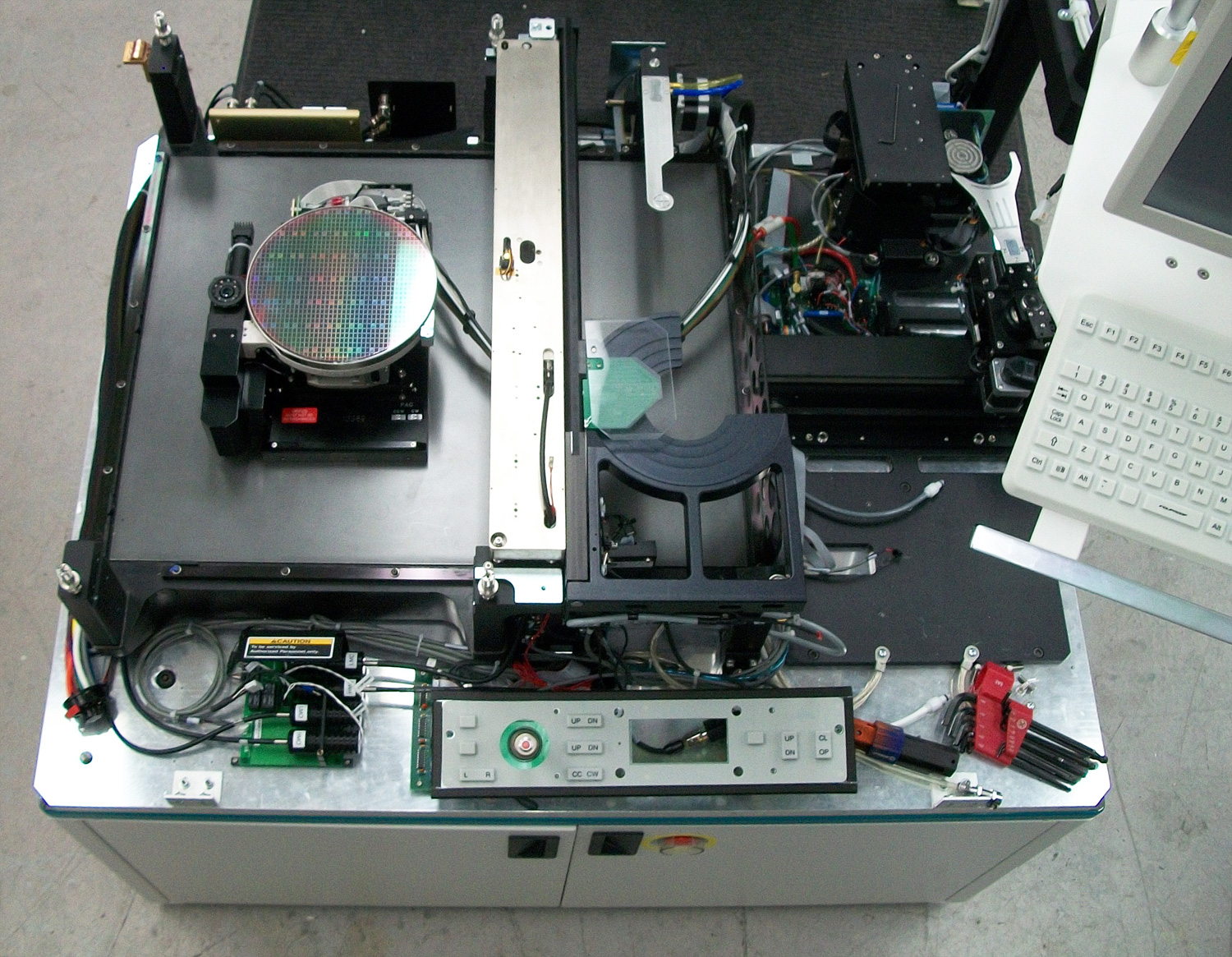
The pressure is rising with each Nvidia generation. As the company moves from Blackwell to Rubin, its successor architecture, rising compute power and power draw raise testing demands for heat dissipation, stability, and equipment. Blackwell's testing load was already heavy — a final packing test, a burn-in test, an additional final test, and a system-level test, with burn-in chamber capacity reportedly rising from 600W to 1kW. Rubin pushes further. Every step up in power is a step up in testing difficulty, and testing is where a chip either proves it can survive real life or gets thrown away.
KYEC's general manager, Chang Kao-hsun, has been blunt about the cost of building in America. In remarks reported by Dealroom and translated from Chinese, he said: "Not everyone wants to go, but not everyone can go." The line captures the bind facing every Taiwanese supplier: the US market demands a local presence, but US construction is slow and expensive. Chang said build times have stretched from under 12 months to at least 24, and that surging demand may require two or three new plants a year rather than one every few years. That is the arithmetic Nvidia's prepayment is trying to solve — cash now, in exchange for capacity that would otherwise take years to justify.
Fort Worth is the frontrunner, not the finish line
So where will the plant go? The honest answer is that nobody has signed anything final — but Fort Worth, Texas, is the clear frontrunner. AeternZ is considering a $1.3 billion manufacturing plant on a 23-acre site in the Fort Worth South Business Park, according to city documents cited by the Fort Worth Report. Those documents put the planned investment at at least $1 billion in real property and $300 million in equipment.
Do not conflate the two billion-dollar figures. The $1.3 billion is the Fort Worth project figure from city tax-abatement documents. The $1.4 billion is the overall US investment cap KYEC announced in July. They describe different things, and sloppy coverage has already started blurring them.
The next milestone is public and dated. We checked the Fort Worth abatement detail against two independent reports this week, and both agree the Fort Worth City Council will consider a tax abatement for the company at its October 27 meeting. Approval would improve the economics of the Texas site, but as Industrial News noted, it "would not itself constitute a final manufacturing commitment" — and there is no basis yet for treating construction or equipment installation as confirmed. Fort Worth is the candidate. It is not yet the decision.

The Texas logic is easy to see. Reuters noted in July that Taiwanese semiconductor and electronics companies have expanded US manufacturing since TSMC's multibillion-dollar investment in Arizona, and that Foxconn and Wistron are building AI server manufacturing capacity in Texas for Nvidia. A testing plant in Fort Worth would sit near the server builders, not far from the Arizona fabs — close to the customers, close to the demand.
The Amkor precedent — and why it matters
Now the number that does not belong to this deal. In July, Nvidia struck a separate $1.5 billion prepayment deal with packaging firm Amkor Technology — a different company, a different deal, covering advanced semiconductor packaging and test technology, including expanded US advanced packaging capacity. That Amkor cash arrives in 2027 and is repaid as US services over five to ten years, per The Inference. Any source presenting $1.5 billion as the KYEC figure has mixed the two deals up. Do not let it into your mental ledger.
The Amkor deal still matters here, because it reveals the pattern. Nvidia is not making one-off bets; it is systematically prepaying its way down the back-end supply chain, removing one bottleneck at a time. First packaging, now testing. The company that once simply bought chips is now underwriting the factories that finish them.
The rationale, in Nvidia's own words, comes from the Amkor announcement — not from the KYEC deal, where no Nvidia quote has surfaced. Debora Shoquist, Nvidia's executive vice president of operations, said in Amkor's July 23 press release: "AI is driving a generational shift in technology, transforming every industry and creating a unique opportunity to reinvigorate American manufacturing and supply chains." Treat that as general onshoring context, which is what it is — but it is also the clearest statement of why Nvidia keeps writing these cheques.
For context, the packaging gap Nvidia is working through remains wide. Advanced packaging capacity — the CoWoS process every major AI accelerator depends on — was expanding toward 120,000 to 140,000 wafer starts per month by the end of 2026, yet remained fully sold out with lead times over a year, according to TrendForce data reported by TechTimes. Amkor's Arizona campus targets production in early 2028; TSMC's own Arizona packaging operation targets 2029. Testing, the step after packaging, was always going to be next in line. This week, it arrived.
What this means for America's chip bet
Here is our position: Washington's original CHIPS bet was colossally front-loaded toward fabs, and it took Nvidia's chequebook to expose what was missing. A fab without packaging is a warehouse. Packaging without testing is a gamble. Each back-end step America lacked has now had to be bought into existence by the one customer rich enough — and desperate enough — to prepay for it. That is not industrial policy as Congress drew it up. It is industrial policy by purchase order, and it is working faster than the subsidy queue ever did.
The first CHIPS for America funding opportunity did cover back-end production — assembly, testing, and packaging — with priority for projects addressing domestic supply-chain gaps. But the KYEC deal shows where the real urgency lives: not in grant applications, but in a customer that cannot afford to wait for its own supply chain to mature. Nvidia's AI accelerators are only as reliable as their weakest test, and the company has decided that weakness is worth paying to eliminate in advance.
What we still don't know
Plenty. The prepayment amount is undisclosed, the reserved capacity is undisclosed, and the full contract terms are undisclosed. The final site is unconfirmed — Fort Worth is the frontrunner, pending the October 27 abatement decision and a formal location decision that has not yet happened. No start-of-production date for KYEC's US plant has been verified; dates floating around for 2028 belong to other projects, including Amkor's Arizona campus, and must not be transferred to KYEC.
KYEC's own US journey is still young. The company approved the US investment on July 10, citing clear demand from American customers and a local supply chain short on testing capacity. According to CryptoBriefing, KYEC's first overseas testing facility — an AI-chip-focused operation in Singapore reported to be worth $78 million — opened in May 2026.
For now, the signal is unmistakable. The bottleneck moved. Nvidia followed it — chequebook open — and testing, the least glamorous step in the chip business, just became the most strategically valuable real estate in the AI supply chain. Readers tracking Nvidia's China share fell to 34% as Huawei surged to 28% will recognise the pattern: Nvidia keeps paying to control what it cannot afford to lose. The same logic explains why TSMC beat its own forecast by $900M and the stock fell — the supply chain, not the demand, is where the story now lives. And as Morgan Stanley: $33.5B can't buy the power AI needs showed, money alone does not remove physical constraints. Testing is the latest proof.
Sources: Dealroom News, "Nvidia prepays for US chip-testing capacity in KYEC's $1.4B expansion," Oct 14, 2026; DIGITIMES, "KYEC, Nvidia eye Texas site for US AI chip testing plant," Oct 14, 2026 (paywalled; lede only); Reuters, "Nvidia supplier King Yuan Electronics to invest up to $1.4 billion in US facility," July 10, 2026; Fort Worth Report, "Fort Worth could be in line for a $1.3 billion chip testing plant," Oct 2, 2026.
TechPulse USA is an independent publication covering the global tech and AI industry, with a US-first lens. We verify every fact we print against primary or reputable secondary sources, and we say so when a claim rests on a single report.
KYEC–Nvidia: your questions answered
How much is Nvidia prepaying KYEC? Undisclosed. KYEC has not revealed the prepayment amount, the reserved capacity, or the full terms of the deal. Anyone quoting a figure for this prepayment is guessing.
What is the $1.4B figure, then? That is KYEC's overall US investment cap, announced July 10 — not the prepayment amount. Keep the two apart.
What is the $1.3B Fort Worth figure? The Fort Worth project figure from city tax-abatement documents: more than $1B in real property plus $300M in equipment. Different from the $1.4B cap.
What about the $1.5B number in some coverage? That belongs to Nvidia's separate July prepayment deal with Amkor, which covers packaging — not KYEC, and not testing. Do not mix them up.
When will the plant open? There is no verified KYEC start date. Asia Daily's timeline calls 2028 a "provisional" start for small-scale operations. Treat it as provisional, not confirmed.
Update, Oct. 14: Fort Worth vote set for Oct. 27, address resolved
Two details have sharpened since publication. First, the Fort Worth City Council will consider a reinvestment zone and an AeternZ tax-abatement agreement at its October 27 meeting, per Asia Daily's timeline of the deal: July 10 board approval, September 17 $300M guarantee, October 13 prepayment plus guarantee cancelled, October 27 council vote. Second, the site-address question is resolved: the Fort Worth Report put the candidate plant at 273 W. Everyman Parkway in the Fort Worth South Business Park. The "Everman/Everyman" spelling discrepancy that kept the address out of the original article now resolves to "Everyman" in two relays of the city documents. Asia Daily also calls 2028 a "provisional" start for small-scale operations — provisional, not confirmed, and it stays that way in our copy. None of this changes the core: the prepayment amount, the reserved capacity, and the final site remain undisclosed.


Comments
Post a Comment