
Nvidia Veterans Just Raised $90M to Give Dumb Robots a Brain
Nvidia Veterans Just Raised $90M to Give Dumb Robots a Brain
By Daniel Rao · 20 October 2026
There are more than five million industrial robots working in factories right now, and here is the industry's dirty little secret: almost every one of them is an idiot savant. Each was programmed — painstakingly, expensively, by a specialist — to do exactly one thing, and nothing it learns can ever be transferred to another machine. Yesterday, two former Nvidia researchers raised $90 million to change that equation. Whether they can is a far harder question than their press release lets on.
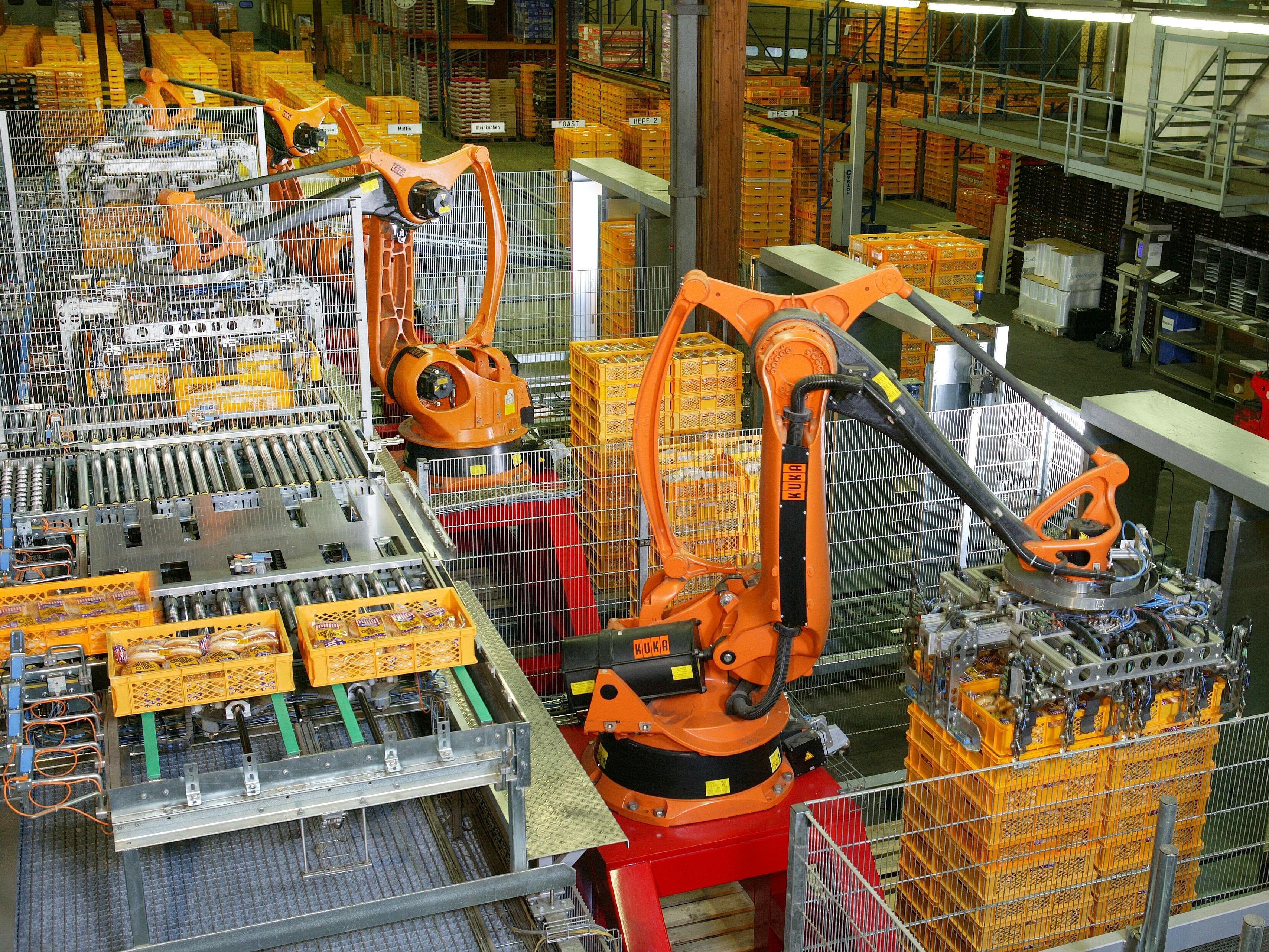
KUKA industrial robots palletising bread crates in a German bakery. Machines like these now number over five million worldwide, yet almost every one is programmed for a single task. Dream Labs says its Dream-1 model can give any gripper-equipped robot general skills, straight from video. Photo: Wikimedia Commons (public domain).
Update, Oct. 20: the price is public — a robot brain costs $3 an hour
Dream Labs' launch day left the price sheet vague; it is now public. Dream-1 costs $3 per hour and a smaller Dream-1-flash costs $2 per hour; each API call returns 1.6 seconds of actions, i.e. 2,250 calls an hour, roughly $0.0013 per action (runtimewire, Oct 19). The launch also added a browser-based Robot Playground — anyone with a browser can issue commands to a physical robot in Dream Labs' San Francisco office and watch it respond live (ventureburn; theaiinsider). The honest line we noted in the original post holds: Dream Labs itself calls Dream-1 a research beta — "it will make mistakes, and it has not been validated for safety-critical use" (medium/@felixsam922). The one benchmark number, Robocurve's 59 vs 48 on RoboDojo-RC Tier 1 at "16x lower cost per task attempt than Gemini 4 Argon," remains a company-cited score, echoed by medium and runtimewire but still not independently verified — keep it flagged as such. The pricing news lands as enterprises are culling their agent fleets — the question is no longer whether agents work, but what an hour of their work is worth.
Two GR00T leads walk out of Nvidia
Dream Labs, a San Francisco startup founded in 2026, announced the $90 million seed round on 19 October, led by B Capital alongside Kindred Ventures, with participation from A.Capital, Unusual Ventures, SV Angel, Wing VC, Scribble VC and the investor Adrian Aoun. The co-founders are Joel Jang and You Liang Tan — former leads of Nvidia's GR00T robotics research programme, the humanoid foundation-model effort that produced the open GR00T N1 model. Their earlier work includes DreamZero, Nvidia's research into models that learn robot control from video, and the "world action model" line of research that treats raw video — not hand-written rules — as the raw material for physical intelligence.
That pedigree is doing a lot of the selling here. GR00T is Nvidia's flagship bet on humanoid robots, and DreamZero's checkpoints are public, so the robotics world has been able to kick the tyres on this team's research. Now the pair want to productise it.
"The hardware is ready. What's been missing is a brain any robot can use," said Joel Jang, co-founder and CEO of Dream Labs, in the Business Wire announcement. "When you get into a rental car, you don't relearn how to drive. You find the controls and your past driving experience does the rest. Dream-1 approaches a new robot the same way, so a new robot can do useful work in minutes, not months. And instead of edited demos, we're giving people a working model they can test themselves, mistakes included."
A brain you rent by the hour
The product is Dream-1, the company's flagship robot foundation model, served through Dream API — which the company bills as the first publicly available API for a robot foundation model. The pitch: point a robot's camera feed at a task, type a plain-English instruction, and the API returns motor commands. Connect any robot with grippers and it carries out the task, even — the company claims — robots the model has never seen before.
Pricing is reportedly around $3 an hour, with a lighter Dream-1-flash tier at $2, according to third-party coverage of the launch — the company itself hasn't published a price card in the announcement. For hardware the zero-shot approach can't handle, there's Fine-tuning as a Service: submit a small batch of demonstration data and get a tailored model within hours. And there's a Robot Playground — anyone with a browser can type commands to a physical robot in Dream Labs' San Francisco office and watch it respond live and unedited, no robot purchase required. That last bit is clever marketing, but it's also the most honest thing in the launch: a live robot you can't edit around.
"A capable robot arm has gone from the price of a luxury car to the price of a high-end laptop. What it needs now is intelligence," said Daisy Cai, General Partner at B Capital, in the announcement. "This team did some of the defining work in robot learning at NVIDIA. Now anyone with an API key can build on it."
The company says it already works with more than 20 hardware partners — though it has named only one publicly, MakerMods, which sells $2,000 bimanual robot arms. "Our customers buy our robots to build things, and the hardest part has always been getting them to do actual work," said Ryan Chan, co-founder and CEO of MakerMods, in the announcement. "With Dream-1, our robot was up and running in a few minutes and attempting tasks we never programmed."

A home-built robotic arm on display at Maker Faire Berlin 2018 — the kind of cheap hardware Dream Labs is targeting. Low-cost arms typically ship with no built-in intelligence; Dream-1 is meant to supply the brain over an API. Photo: Matti Blume / Wikimedia Commons (CC BY-SA 4.0).
For the bigger picture, see what AI agents actually do.
Five million machines, one trick each
The problem Dream Labs is attacking is real, and the numbers are stark. The International Federation of Robotics' World Robotics 2026 report puts the global operational stock of industrial robots at just over five million — more than double seven years ago — after factories installed 603,000 new units in 2025 alone. China took 354,000 of those, 59% of the global total; the United States overtook Japan as the world's second-largest market with 38,400 installations. "The new mark of five million robots operational in factories worldwide is more than double the number seven years ago," IFR president Jane Heffner said when the figures were released. The strongest growth, she noted, is in Asia, followed by the Americas.
But here's the catch the launch announcement states plainly: nearly every one of those five million machines is programmed for a single task, and what it learns can't transfer to another machine. Teaching one robot one task can take specialists months, and a new task or new hardware often means starting from zero. Meanwhile low-cost robots now sell for a few thousand dollars — the announcement says the machines Dream Labs supports today cost between about $2,000 and $10,000 — and ship with no built-in intelligence at all. Cheap arms, expensive teaching. That gap is the entire business case.
It's the same gap the broader industry is racing to close. Professional service robot sales are climbing too — service robot shipments have been one of the few bright spots in the hardware market — but service machines have the same software problem: every new deployment is a fresh integration project.
Ninety million is pocket change in this fight
Let's be blunt about the money. $90 million is a serious seed round — one of the largest in robotics this year — but the "brain layer" of robotics is currently the most expensively contested turf in venture capital, and Dream Labs is walking in with a water pistol.
Physical Intelligence, the San Francisco startup pursuing an almost identical foundation-model strategy, has raised roughly $2.1 billion across four rounds since 2024, according to funding analyses — its backers include Thrive Capital, OpenAI, Jeff Bezos and Alphabet's CapitalG — at a reported valuation around $11 billion. (The latest chunk, a Series C of about $1.05 billion, appears in corporate filings rather than a company announcement, so treat the total as approximate.) Skild AI raised $1.4 billion in January 2026 at a valuation above $14 billion, led by SoftBank with Nvidia participating, and says it has crossed a $100 million annual recurring revenue run rate. FieldAI has reportedly signed a term sheet for $700 million at a $10 billion valuation.
The hardware side is no quieter. Tesla's Optimus programme and Figure's humanoids are pursuing the full stack — brain and body together — and OpenAI is building its own humanoid, which puts a frontier lab directly in this race. Dream Labs' bet is that hardware makers would rather rent intelligence than build it. That's plausible — but it's also what Physical Intelligence and Skild AI are already selling, with billions in the bank and paying customers.
The verdict: exciting launch, shoddy evidence so far
Now the honest part. The zero-shot claims in this launch are doing an enormous amount of heavy lifting, and the evidence on offer is thin. "Out of the box, Dream-1 can control any robot with grippers, zero-shot" is the kind of sentence that should make any robotics engineer reach for their wallet. Third-party coverage cites an independent benchmark — a group called Robocurve scoring Dream-1 59 versus 48 against the next-best alternative — but that figure comes from launch materials, not from any evaluation we can independently verify. Until independent researchers run Dream-1 on hardware the company didn't choose, the zero-shot story is a claim, not a fact.
To its credit, the company isn't pretending otherwise. Dream-1 is explicitly a research beta — "it will make mistakes, and it has not been validated for safety-critical use," in the launch materials' own words. And right now its skill ceiling is gloriously mundane: picking and placing objects, and folding laundry. Wheeled mobile robots and dexterous hands are "to follow" — launch-speak for "not yet."
We ran a sweep of our own archive before writing — no earlier Dream Labs story, so this one stands alone — and we pulled the IFR's World Robotics 2026 figures from multiple independent reports to check the five-million number wasn't launch-copy inflation. It isn't. We also checked the "20+ hardware partners" claim: it rests entirely on the company's word, with only MakerMods named. Worth remembering the next time someone cites the number.
None of this makes Dream Labs a bad bet. The rental-car analogy is genuinely the right mental model, the founders' GR00T and DreamZero credentials are real, and the Robot Playground — a live, uneditable robot anyone can drive from a browser — is the kind of radical transparency this industry desperately needs. (A 78-year-old professor once took on a burrito-making robot in a very different kind of live demo.) But a $90 million seed doesn't buy you a moat; it buys you a ticket to a knife fight with companies holding billions. Dream Labs has the right idea. Whether it has the right runway is the real story — and that won't be settled by a press release.
Sources: Business Wire announcement from Dream Labs (19 Oct 2026); Runtime Wire, The AI Insider, Unite.AI and CityBiz coverage of the raise; IFR World Robotics 2026 figures via IEEE Robotics and Automation Society, Manufacturing Digital and Notebookcheck; Physical Intelligence and Skild AI funding figures via Revenue Memo and Nasdaq Private Market analyses; DreamZero background via Humanoids Daily.
Daniel Rao covers AI infrastructure and robotics for TechPulse USA — the money and machines behind the AI boom.


Comments
Post a Comment