
OpenAI says AI killed a conjecture behind hundreds of papers
Read the headline twice, because it is not the strangest part of this story. OpenAI says one of its own models has proved that the Exponential Time Hypothesis is false — and the people now charged with checking that proof include Russell Impagliazzo and Ramamohan Paturi, two of the researchers who proposed the hypothesis in the first place. The prosecution, in other words, has been handed to the authors of the law.
That is only one of three claims OpenAI published on 26 October 2026 under the title "Working with academic communities to build scientific understanding". The company says its models also proved the local smoothing conjecture in every dimension — a result it says resolves the Kakeya and Stein's restriction conjectures — and produced a rigorous existence proof for four-dimensional quantum field theories including quantum chromodynamics (QCD) and pure Yang-Mills theory. None of the three results has been independently verified. This article reports what OpenAI claims, what its own announcement actually says, and what remains unproved — because in a story like this, the gap between "announced" and "established" is the story.
We checked OpenAI's announcement page directly, cross-read it against ANI's syndicated report carried by The Tribune, PANews, tech-insider.org's line-by-line analysis and AI Weekly's coverage, and curl-checked every internal link in this article against the live blog. Where OpenAI's summary wording and its technical wording differ, we say so. Where outsiders cannot yet see the evidence at all, we say that too.
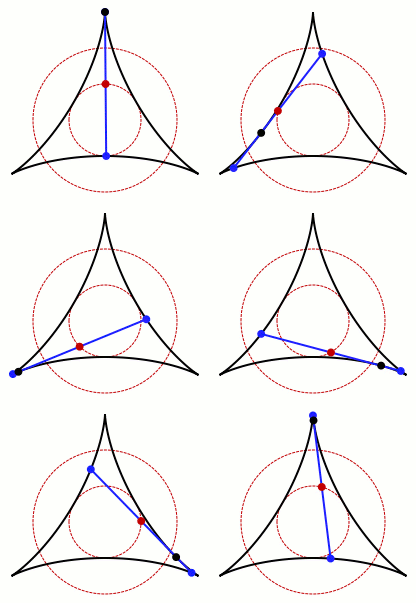
Photo: Animation of the Kakeya needle problem — a unit needle rotating inside a deltoid. Credit: Claudio Rocchini (CC BY-SA 3.0), via Wikimedia Commons. Illustration only — the diagram shows the classical needle problem, not OpenAI's claimed proof.
What OpenAI actually announced
OpenAI frames the release as an experiment in disclosure, not just three theorems. In its own words, the manuscripts are "best understood as a form of raw research data", and the company says it "reached out to external experts and asked them to act as shepherds, organizing groups to understand the new results". The shepherds then advised three different release strategies: release the mathematics output openly, form an external group for the computer science result while publishing the output, and form an external group for the physics result while deferring to it on what gets released.
"We do not yet know which of these three approaches will be most useful, and we welcome feedback on what works and what we can improve," OpenAI wrote. That sentence matters. It is the company conceding, in print, that it does not yet know how to publish machine-made mathematics responsibly — ten days after it helped fund a $15 million verification effort for its last, far messier mathematics dump.
The collaborations, OpenAI says, follow four principles: transparency, no academic credit for OpenAI, recognition for the groups doing the understanding, and independence. Participation is voluntary and unpaid, nobody signs a non-disclosure agreement, and members "do not speak on behalf of OpenAI, and OpenAI does not speak on their behalf". The company also points to its recently announced $5 million contribution to the Simons Foundation, managed by the foundation, for workshops, conferences and special programmes to help researchers understand and build on AI-produced results.
The mathematics claim: waves in every dimension
The mathematics result concerns harmonic analysis — the study of how complicated signals break down into waves. In 1991, Christopher Sogge proposed the local smoothing conjecture, which, as OpenAI explains it, says that the most extreme focusing of a wave must be short-lived: what can happen at the worst-case moment is far more extreme than what a wave typically does when averaged over time. OpenAI says its models proved that conjecture in every dimension, using what it calls a novel auxiliary partial differential equation.
The stakes are high because local smoothing sits upstream of two famous problems. OpenAI's summary sentence is sweeping: its models "produced a proof of the local smoothing conjecture in every dimension and therefore also resolve the Kakeya conjecture and Stein's restriction conjecture in all dimensions". But the narrower technical description quoted by The Verge and tech-insider.org says the proof yields the Kakeya maximal and dimension conjectures and Stein's spherical restriction estimates "throughout the interior of the conjectured range". That qualifier is not decoration. The interior of a range is not the whole range, and the boundary cases may still be open. Until the manuscript itself is digested, the honest version of the claim is: local smoothing in every dimension, with Kakeya and Stein consequences in the interior of the conjectured range — not an unqualified "Kakeya solved".
For scale: humans proved local smoothing in two dimensions in 2019 (Guth, Wang and Zhang), and Hong Wang and Joshua Zahl proved the Kakeya conjecture in three dimensions in 2025 — work that contributed to Wang's Fields Medal in 2026. OpenAI's claim jumps from those hard-won cases to every dimension at once. That is precisely why it needs slow, hostile reading rather than applause.
On dates, OpenAI says it obtained the AI output on 18 October 2026 and formalised it in Lean, the machine-checkable proof assistant, the following day, 19 October. It released both the AI natural-language write-up and the Lean proof in its public GitHub repository, following the same open-release strategy as its 6 October 2026 release. That openness is genuinely helpful: unlike the physics claim below, outsiders can at least start reading.
The computer science claim: the hypothesis hundreds of papers relied on
This is the claim that should make working computer scientists sit up. The Exponential Time Hypothesis (ETH), proposed by Impagliazzo and Paturi with Francis Zane and widely believed to be true, says roughly that 3-SAT — deciding whether a collection of true-or-false conditions can all be satisfied — cannot be solved in subexponential time. Hundreds of papers have used it as a load-bearing assumption, deriving "conditional" hardness results: if ETH holds, then these problems cannot be solved fast.
OpenAI's sentence is blunt. "Surprisingly, our system has recently proved that the ETH is false, a result that was subsequently verified in Lean," the company wrote. The word "surprisingly" is OpenAI's own, and it is doing real work there: even the lab did not expect this one. According to The Verge's description of the paper, quoted in secondary coverage, the argument is a deterministic algorithm that exactly counts satisfying assignments of fixed-width CNF formulas in subexponential time and polynomial space, and the 3-SAT case refutes ETH. AI Weekly's coverage puts the claimed running time at roughly 2^(n/sqrt(log n)) for 3-SAT on n variables — subexponential, emphatically not polynomial, which means P vs. NP is untouched even if the claim holds.
OpenAI says its model found the natural-language disproof on 16 October 2026 and formalised it in Lean on 17 October, and that both the write-up and the Lean proof are on GitHub. The verification group is led by Impagliazzo (UC San Diego), Paturi (UC San Diego) and Ryan Williams (MIT) — and here the announcement's own logic cuts both ways. Having the hypothesis's proposers examine its refutation is the strongest possible panel, and also the panel with the most to lose if the proof is wrong. The group has drawn its line in public. In an open letter reported by AI Weekly and The Next Web, the three wrote: "Our involvement should not be taken as certification of the claim. A result of this significance requires careful, independent scrutiny," adding: "If the claim is correct, it will change an important part of theoretical computer science." Williams is reported as saying the group "signed no non-disclosure agreements and will not be paid". OpenAI says it has agreed to the group's requests that all raw data be made public and that it fund a conference on the implications.
One more caution, and it is colossally important. A Lean check proves that a formal statement follows from Lean's axioms. It does not by itself prove that the formal statement says what the headline says — that the algorithm really counts what it claims to count, in the generality claimed. Bridging that gap is exactly the shepherd group's job, and it has barely begun. OpenAI itself cautions that "finding such algorithms, and turning theoretical advances into practical improvements, will require significant further research". Nobody's code runs faster because of this announcement. Not yet, and maybe not ever.
The physics claim: the one nobody outside can read
The physics claim is the boldest of the three and, by a distance, the least checkable. OpenAI says its models produced a mathematically rigorous existence proof for certain interacting quantum field theories containing gauge fields and fermions in four dimensions, including QCD — the theory of the strong force binding quarks and gluons — and a unified completion of the Standard Model. As a subproblem, it says, the work includes a proof of the existence of pure Yang-Mills theory, part of the Clay Mathematics Institute's Millennium Prize problem on "Quantum Yang-Mills Theory".
Two qualifications must travel with that sentence wherever it goes. First, existence is only half the Millennium Prize problem: the prize also requires a mass gap, and OpenAI does not claim a mass gap. Nobody has won a million dollars here. Second, and more damning for verification, the physics materials were not released in full. The group led by Nobel laureate David Gross — with Michael Douglas, Arthur Jaffe, Igor Klebanov and Nikita Nekrasov — "has decided to hold off on releasing the AI-produced artifacts and instead work on writing it up themselves", in OpenAI's words. Outsiders therefore cannot audit the physics argument end to end. They can verify only that OpenAI made the claim.
The dates, per OpenAI: a natural-language proof for Yang-Mills existence on 9 September 2026, a proof for QCD on 18 September 2026, and completion of the Lean formalisation of Yang-Mills existence on 16 October 2026 — the formalisation wait being the stated reason for the delayed release. The physics is built, OpenAI says, on Balaban's approach in constructive quantum field theory. Gross's credentials for the role are not in doubt — his 1973 work on asymptotic freedom helped establish QCD and earned him a share of the 2004 Nobel Prize in Physics — but credentials are not verification, and shepherding is not endorsement. Nothing in OpenAI's announcement says any member of the group has vouched for the result, and readers should not infer endorsement from participation.
There is one gloriously human detail buried in the announcement. The physics group asks that all communications about the effort be directed to a public Gmail address: YANGMILLS4D@gmail.com. A problem that may touch a Millennium Prize is, for now, being run partly out of a free email inbox. That is either charmingly open or a sign of how improvised this whole process is. Probably both.
Separately — and this must not be conflated with OpenAI's claim — mathematician Levent Alpöge and Ethan Sussman have publicly documented a separate attempt, using Anthropic's Claude, to finish Balaban's programme for constructing Yang-Mills theory, with a GitHub repository titled "Yang–Mills-LLM-experiment" marked under construction. That effort was noted in public discussion of OpenAI's announcement, including by Alpöge himself. It is a parallel thread in the same mathematical territory, not evidence for or against OpenAI's result, and it underlines the point that the Balaban route to Yang-Mills is now crowded with machine-assisted attempts. None of them has yet produced a publicly audited proof.
Why the shepherd model matters more than any one theorem
Step back from the three claims and the announcement's real subject comes into focus: who gets to say a machine-made proof is true? The old pipeline — submit to a journal, wait months, get two referees — collapses when a lab can emit hundreds of manuscripts in a day, as OpenAI did on 6 October. The shepherd model is OpenAI's answer: recruit famous experts before publication, give them different release rules per field, and let them organise the reading. It is clever, and it is shoddy in one obvious respect: the shepherds are chosen by the company whose work they examine. OpenAI admits the tension itself, noting that "choosing initial shepherds necessarily shapes who gets involved first and creates asymmetry of information". A negative finding from these groups would carry enormous weight — but so would a positive one, and the world will be watching which kind arrives first, and how loudly.
There is also the context OpenAI would rather you forget. Its 6 October release of 722 manuscripts was followed within a day by withdrawals and repairs, and by mathematicians describing the dump in terms ranging from unprintable to "a denial of service". The $15 million verification commitment from OpenAI, Anthropic and the Simons Foundation, covered by TechPulse USA on 16 October, was the clean-up. This 26 October announcement is the same lab returning, ten days later, with bigger claims and a better process. Better is not the same as good enough.
Our take: believe the announcement, not the theorems — yet
Here is our position, stated plainly. We believe OpenAI made this announcement, on 26 October, in the terms quoted above — that is verified from OpenAI's own page and multiple independent reports. We do not believe, and no reader should believe, that the Exponential Time Hypothesis is false, that local smoothing holds in every dimension, or that Yang-Mills theory exists, until the shepherd groups and the wider community have done their work and said so in public. A Lean file on GitHub is a strong artefact, not a verdict. A Nobel laureate's willingness to read a proof is not agreement with it. And a physics proof that nobody outside the room can see is, for now, a press release with equations attached.
If the ETH claim survives, it will be one of the most consequential results in theoretical computer science in decades — hundreds of conditional results will need re-examination, and the search for faster algorithms will reopen across graph theory, databases and computational biology. If the local smoothing claim survives in full, harmonic analysis gains a unifying result decades ahead of schedule. If the physics claim survives, quantum field theory takes its first real step toward becoming a rigorous mathematical subject. Those are enormous "ifs", and enormous claims have a habit of shrinking under their first serious reading. The history of claimed proofs of famous conjectures is a graveyard of beautiful, wrong arguments.
What to watch next: the ETH group's open examination and its promised conference; whether the mathematics write-up survives contact with harmonic analysts outside OpenAI's orbit; and, above all, when — not if — the Gross group releases something the rest of physics can actually read. Until then, treat every headline about this story, including ours, as a claim awaiting its evidence. We will update this article when a shepherd group publishes a verdict, in either direction.
Further reading on TechPulse USA: our report on OpenAI and Anthropic's $15 million commitment to verify AI's 722 mathematics proofs; our earlier account of the 722-paper mathematics dump that triggered a mathematician backlash; and our report on Claude redesigning quantum circuits with far fewer gates, another case of an AI system doing original technical work that still awaited independent reproduction.
Sources: OpenAI, "Working with academic communities to build scientific understanding" (26 October 2026); ANI via The Tribune (27 October 2026); PANews (27 October 2026); tech-insider.org analysis (27 October 2026); AI Weekly (26–27 October 2026); The Verge and The Next Web as quoted in secondary coverage; Wikipedia, "Kakeya set", for the classical needle-problem background. All three results are reported here as OpenAI's claims pending independent verification.
About TechPulse USA: TechPulse USA covers global technology and AI news for readers in the USA, Europe, Canada and Australia, with an emphasis on verified facts, named sources and clear separation between what is claimed and what is established.


Comments
Post a Comment