
Oxide's $445M Raise: a Profitable Startup That Can't Keep Up
A hardware startup just raised $445 million — not to survive, not to pivot, but because its factory cannot keep up with its order book. Oxide Computer Company announced a Series D led by Eclipse on October 9, and the most interesting word in the announcement isn't the number. It's the one the company keeps repeating: profitable.
Read that again. A seven-year-old company that builds refrigerator-sized cloud computers for other companies' basements says it turned profitable earlier this year, scaled manufacturing twentyfold in twelve months, and still can't make enough. In a funding market that spent the last three years asking software startups to show a path to profitability, a hardware company just showed up with the receipts and a backlog. That is the story here — and it says more about where enterprise computing is going than any GPU keynote this month.
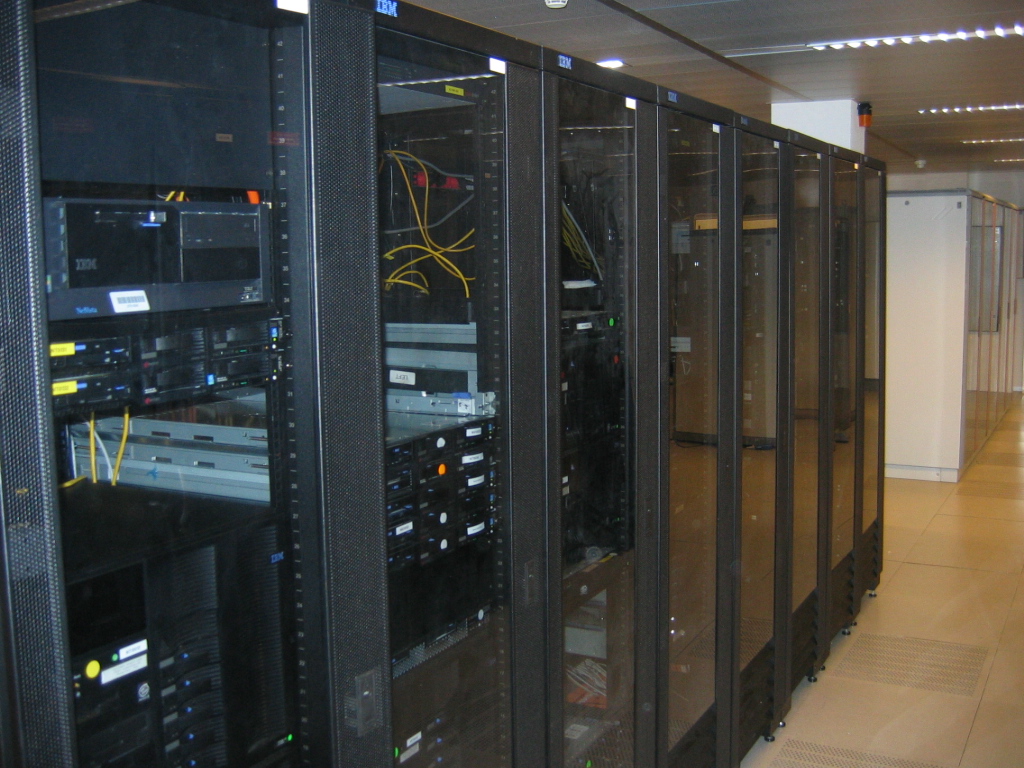
Photo: Server racks in a datacenter. Oxide's bet is that enterprises want the cloud's automation in a box they own themselves — and right now, it can't build the boxes fast enough. Public domain photo by Wil Weterings via Wikimedia Commons.
The numbers, with the footnotes
The headline facts are straightforward. The $445 million Series D was led by Eclipse, which has backed Oxide since the seed round. Existing investors US Innovative Technology Fund, Riot Ventures and Jane Street returned; Atreides Management and AMD Ventures joined as new money. The proceeds are earmarked for the unglamorous stuff: component procurement, manufacturing expansion, and the working capital to keep fulfilling orders.
Now the footnotes, because this is a funding announcement and footnotes are where the truth lives. An SEC Form D filing for the round records $444,999,052 sold — one dollar shy of the headline, close enough — with the first sale dated July 20. The round took roughly two and a half months to assemble, which suggests syndicate-building rather than a single anchor cheque. Fifteen investors are listed; their identities are not.
And "profitable" deserves scrutiny. The release says Oxide "reached profitability" earlier this year, full stop — no period, no figures. Secondary reporting adds the only texture available: the founders said ordinary operations generated taxable income in the spring, which points at roughly the second quarter. Taxable income is not a stated annual GAAP profit, and nobody has disclosed revenue, the size of the profit, the backlog's value, how many systems have shipped, or what share of the $445 million goes to inventory versus factory expansion. A hardware company that won't name a customer or a number beyond the round size has earned itself a sceptical paragraph, and that was it.
The funding history, though, checks out cleanly: $100 million Series B in July 2025 led by Thomas Tull's US Innovative Technology Fund, $200 million Series C in February led by the same fund, and now $445 million. Disclosed rounds alone — $30 million and $44 million in 2022–23, plus the three big ones — put the company's known venture haul north of $800 million, with an undisclosed seed round on top. (We added that up ourselves; Oxide has never published a total, and one outlet's "$6 billion valuation" claim traces to a dead link, so we are not repeating it.)
The founders: Sun, Joyent, and the people who built the cloud
Oxide's founding story reads like a résumé of the last forty years of infrastructure. CEO Steve Tuck spent nine years at Dell and then roughly a decade at cloud provider Joyent, rising to president and chief operating officer. CTO Bryan Cantrill spent fourteen years at Sun Microsystems — the company that coined "the network is the computer" — and nine more at Joyent as a systems engineer. Co-founder Jessie Frazelle, formerly of Docker, Mesosphere, Google, Microsoft and GitHub, left in 2022 to start a CAD company. Founded in 2019, headquartered in Emeryville, California.
"We felt strongly that organizations should be able to control their infrastructure without having to forfeit the modernity of cloud computing," Cantrill said in the announcement. It is a founding thesis in one sentence: the cloud was right about the automation, wrong about who owns the building.
That thesis is the product. Oxide's "Cloud Computer" is a rack-scale system — purpose-built hardware fused with open-source software (its Helios OS, Propolis hypervisor, Crucible storage and OPTE networking fabric) — that brings hyperscale-style architecture into a company's own data centre. Per SiliconANGLE's reporting on the current generation, each rack holds 24 modular "sleds," each sled carrying up to a 144-core AMD CPU with around 1.64 terabytes of memory and up to 300 terabytes of flash, plus a custom Oxide Server Processor managing thermals, power and firmware. The pitch: cloud-level automation and APIs, with the customer keeping direct control of security, performance, data and economics.
Why now: the great cloud repatriation
Oxide's timing is the real story. Enterprises are bringing workloads home from the public cloud at a pace that would have been unthinkable five years ago. Cloudian's 2026 survey found 75% of 212 senior IT decision-makers had moved workloads from cloud to on-premises in the previous 24 months. An enterprise AI infrastructure survey of 203 IT leaders earlier this year found 93% have repatriated some AI workloads, are doing so, or are evaluating it. The drivers are always the same three: data sovereignty, cloud bills that refuse to behave, and latency.
The AI chapter of that story is agentic workloads — systems that don't just answer questions but execute work, hammering compute, memory and networking in patterns the old request-response cloud wasn't priced for. Eclipse partner Seth Winterroth, in the announcement, framed it as a CPU bet: "The next infrastructure bottleneck is already taking shape. As AI shifts from generating answers to executing work, demand for CPU-based systems is accelerating dramatically." In a market drunk on GPUs, Oxide sells AMD EPYC CPU sleds. It is a contrarian position, and right now it is a contrarian position with a backlog.
"The accelerating pace of on-prem cloud computing projects has required us to scale manufacturing capacity by 20x over the past 12 months, and yet demand still exceeds supply," Tuck said. "We're well-capitalized, and hit an important profitability milestone earlier this year. This funding will allow us to aggressively invest in the materials and manufacturing scale our customers need for years to come." Translation: we could meet the current backlog from existing cash, but we'd have to start saying no to new orders — and saying no is how you lose a land-grab.
The AMD tell
The most strategically interesting name on the cap table isn't Eclipse — it led the seed, the A rounds, and now the D, so its conviction is old news. It's AMD Ventures. Oxide's sleds already run AMD EPYC processors, and the release notes an existing technical relationship across the hardware and software stack. Now AMD's venture arm is a shareholder.
Read it as a hedge. Nvidia owns the full-stack GPU narrative end to end — its own racks, its own networking, sold through hyperscalers — while AMD has been the brilliant chipmaker renting space in other people's systems. Backing an independent vendor that puts AMD silicon inside a private-cloud appliance gives AMD a route into enterprise data centres without building a rack company of its own. It also quietly keeps Oxide's hardware AMD-flavoured at a moment when Intel parts still appear in some of its configurations. Sagi Paz, head of AMD Ventures, put it in corporate verse: "Oxide's systems-level approach to enterprise infrastructure is expanding the choices available to customers as their computing needs become more complex." Strip the verse and it's a chipmaker buying shelf space in the on-prem revival.
Our verdict: hardware's revenge, with the receipts still sealed
There are two ways to read this raise, and both are partly true. The generous reading: a company that spent seven years building the hardest kind of product — integrated hardware plus software, sold to conservative buyers — reached profitability, outgrew its factory by 20x, and raised $445 million as working-capital insurance so it never has to turn a customer away. In an era when "AI startup raises giant round" usually means "burn rate seeks revenue," Oxide's round means "revenue seeks factory." That is genuinely rare air.
The ungenerous reading: every hard number in that story except the round size is undisclosed. No valuation, no revenue, no backlog value, no units shipped, no named customers beyond sector labels — financial services, government, national laboratories, aerospace. "Profitable" means taxable income in the spring, which is a quarter, not a year. The 20x is a company-reported capacity metric with an undisclosed denominator. None of this means the numbers are wrong; it means we're asked to take the company's word for all of them, which is exactly what a $445 million press release wants.
Our judgment: the undisclosed numbers are a flag, not a verdict. What we can verify — the round, the lead, the Form D, the prior rounds, the founders' backgrounds, the repatriation surveys — all points the same direction. Enterprise computing is moving back on-premises, agentic AI is accelerating the move, and the company best positioned to sell the picks and shovels just got $445 million to build more shovels. The cloud was supposed to kill the server room. The server room just raised a Series D.
Related coverage: Nvidia's defence of its open AI alliance — the other side of the full-stack fight; Mistral's trillion-parameter 'Le Chonk' and the open-weights infrastructure wave; and AMD's $82B bet on AI that sees the physical world.
Sources: PR Newswire/Oxide company release (October 9, 2026); SEC Form D filing (via RuntimeWire); SiliconANGLE (October 9, 2026); RuntimeWire (October 9, 2026); Unite.AI; TechDefused; citybiz; WOWTALE; Blocks & Files (founder backgrounds, October 2023); VCA Online; Pulse2 (Series C, February 2026); IT Brew/Cloudian survey (April 2026); Enterprise AI Infrastructure Survey (via EINPresswire, March 2026). All executive quotes are from the October 9 company release. Funding totals beyond disclosed rounds are our own arithmetic, not company figures.
Daniel Rao is a technology journalist covering AI, privacy and regulation at TechPulse USA. He writes about the collision between new technology and old norms.


Comments
Post a Comment