
Pichai Said No: Google Killed Trump's Atlantic Ocean Rename
Update, Oct. 23: the mockup, the Brin praise and the 'American Ocean' joke
Update, Oct. 23 — Since the rally, two details have filled in. First, Trump says he didn't just pitch the idea on the phone — Firstpost and LiveMint report he told the crowd he sent Google an image mockup showing the proposed 'Trump Ocean' label; Google never acknowledged it. Second, the ocean jokes didn't stop at the Atlantic: the Hindustan Times reports Trump also floated renaming the Pacific the 'American Ocean' and riffed on how European leaders would react. He kept praising the men who shot him down, too — 'Sergey and Sundar, totally brilliant guys,' he said (NY Post, USA Today), adding they were 'still rattled from the Gulf.' The walkback from the day before still stands as the last word: asked if he was serious, Trump said he wasn't — it just wasn't 'among the worst ideas' he'd proposed.
By the TechPulse USA desk — Oct. 23, 2026
There is, somewhere in the middle of the Atlantic Ocean, an invisible line where one man's branding ambitions end and the rest of the world's sovereignty begins. Donald Trump found that line this week. He picked up the phone, called Sundar Pichai — the chief executive of Google — and asked whether Google Maps could start showing a different name for the Atlantic Ocean. The president's preferred label: the Trump Ocean. Pichai's answer, by Trump's own telling, was the first real no Google has ever given him: "No, no, no. This time I'm not doing it."
The story came spilling out on Wednesday night, Oct. 22, at a campaign rally in Clemson, South Carolina, where Trump was mid-riff about the growing list of places he has renamed since returning to the White House. It was supposed to be a boast. It landed as something stranger: the president of the United States, on stage, narrating a failed pitch to a tech executive — and conceding, in front of thousands, that the ocean had beaten him.

Photo: President Donald Trump boards Air Force One in Myrtle Beach, South Carolina, after a rally in August 2026. The "Trump Ocean" pitch surfaced at another South Carolina rally two months later. (Official White House Photo by Molly Riley — public domain)
"Sundar, I'm thinking of the Atlantic Ocean. Can you handle it?"
According to Trump's recounting, the call went something like this. "I only like two oceans — the Atlantic Ocean and the Pacific Ocean," the president told the crowd, laying out his criteria with the precision of a man picking wallpaper. "I'm not going to put either Trump or America on any other ocean but these two. So, we seriously looked at the Atlantic Ocean and I called Google Maps, who were really great with the Lake [America], and I spoke to a brilliant guy, Sundar [Pichai]. He heads all of Google. He's a brilliant guy."
He described Google as still "rattled from the Gulf [of America]" — delivered as a quip, with the crowd laughing — and then, he said, he made his pitch. "I said, Sundar, I'm thinking of the Atlantic Ocean. Can you handle it?"
And then, in Trump's version, the Google boss drew a line that two years of executive orders never managed to cross. "No, no, no, this time I'm not doing it," Trump quoted Pichai as saying. "He said, 'Oceans are different, sir. They cover a lot of countries. Please don't ask us to do that.'"
A quick but important note on sourcing: every word of that exchange comes from Trump himself. Google did not immediately respond to requests for comment from the outlets that covered the rally, and neither Pichai nor the company has confirmed that the call happened at all. We cross-checked three separate transcriptions of the rally remarks — from USA Today, the New York Post and the Hindustan Times — and the "no, no, no" quotes match word for word, which means the president's story is at least internally consistent. Whether Pichai actually said it is something only two men know.
Trump, for his part, took the refusal in good humour. "So, I'll probably pass," he told the crowd, pausing with a grin to take a poll: "Should I pass it? I think let's keep it the Atlantic Ocean, right?" The crowd, which had cheered the idea of a Trump Ocean seconds earlier, cheered that too. It is the president's gift — every punchline lands, even when the joke is on him.
Why an ocean is different from a gulf
Here is where Pichai's alleged reasoning is worth taking seriously, because it happens to be correct. Google's stated policy — restated in a statement the company gave USA Today earlier — is that Maps follows official government names: "We have a longstanding practice of applying name changes when they have been updated in official government sources." That is why, after Trump's January 2025 executive order, American users started seeing the Gulf of America and, later, Lake America where the Gulf of Mexico and Lake Ontario used to be.
But the crucial fine print: Google applies those names only where they are official. Users in Mexico still see the Gulf of Mexico. Canadians still see Lake Ontario. Everyone else sees both names. And an ocean is, as the supposed Pichai put it, different — the Atlantic touches dozens of countries, and there is no US government source on earth whose paperwork could make the rest of the planet relabel it.
Not every mapmaker even played along on the easier ones. MapQuest publicly refused to adopt Lake America, declaring in a social media post in August: "We're not changing it." That was a gulf and a lake with presidential orders behind them. An ocean with no order and forty-odd coastal nations was never going to happen.
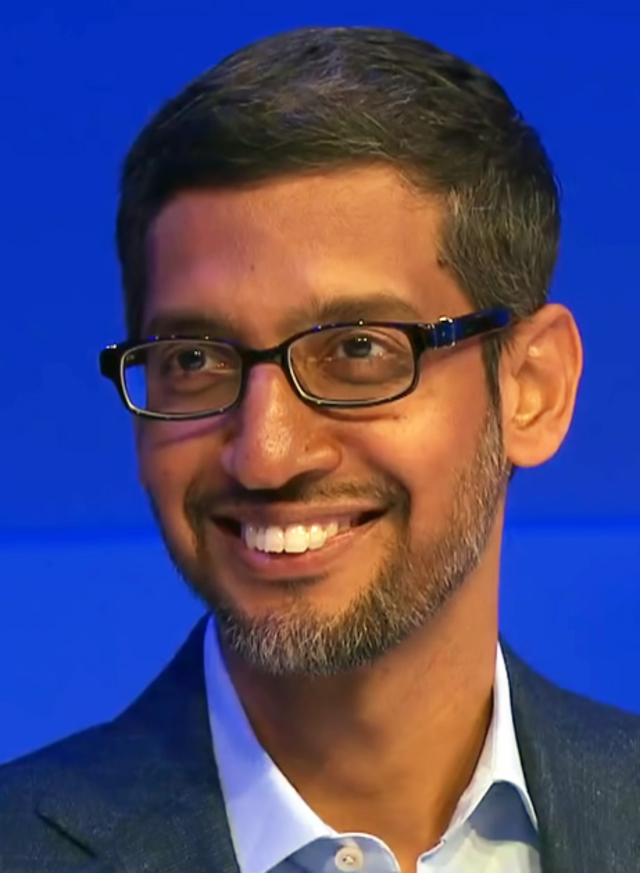
Photo: Sundar Pichai, chief executive of Google. Trump described him as a "brilliant guy" while recounting the refused renaming request; Google has not confirmed the call. (Wikimedia Commons — CC BY 3.0)
The renaming spree, from gulf to strait
The Atlantic episode did not come out of nowhere. It is the latest entry in what has become one of the defining hobby-horses of this presidency: renaming the map. The greatest hits so far, per the administration's own telling: the Gulf of Mexico became the Gulf of America for US users; Lake Ontario became Lake America after a collapsed trade deal with Canada; Fort Liberty reverted to Fort Bragg; Denali became Mount McKinley again.
And the list keeps growing. Just three days before the Clemson rally, Trump posted on Truth Social that "New Mexico should immediately change its name to New America," arguing — in full caps-adjacent energy — that "We are not Mexico, we are the United States of America!" (A president cannot rename a state by executive order; New Mexico's name is in its constitution. But that has never been the point.)
The ocean idea itself has been simmering since Oct. 10, when Trump floated it at a rally in Clarksville, Tennessee: "We've got the gulf. We've got a beautiful lake. Now, somebody said, 'You need a river. We need a river.' We need an ocean." Back then the options were "Trump Ocean" or "Ocean of the Americas," and he added: "No, we have to. We should have, before I get out, we should have an ocean and we need a great river."
He has also mused about the Strait of Hormuz — currently a chokepoint of global oil politics — becoming the "Trump Strait." And when a reporter asked this week why he was so keen on oceans, he offered the kind of answer that explains everything and nothing: "I'm very, I was always high-end. My father said that kid has the greatest eye for location."
It would be easy to file all of this under rally theatre — and plenty of it is. But there is a serious undercurrent. Trump's courtship of Big Tech has been one of the stories of his second term, from the White House dinners to the onstage boasts, including the night he joked that Google "kisses my ass". The Clemson anecdote is the first time the public has heard Google — or at least, Trump describing Google — saying no to the president. That is a data point about the real balance of power between Washington and Mountain View, whether or not the call happened exactly as described.
Could he actually rename an ocean?
Technically, a president can direct US government agencies to use a different name for a geographic feature through executive action. But the keyword is federal government usage. It would not bind anyone else — not other countries, not private companies, and certainly not Google Maps users in Lisbon or Lagos.
That is especially true for the Atlantic and the Pacific, which border multiple countries and carry names recognised around the world for centuries. As USA Today noted, there is no international authority that could require other nations to adopt a US-designated name. His executive-order machine has already rewritten federal maps before — but an ocean is not a federal building. It is 106 million square kilometres of water that does not answer to Washington.
Google's own system, for what it is worth, is built for exactly this kind of dispute. When official names vary between countries, Maps shows each user their local official name — the Sea of Japan versus the East Sea being the classic example, displayed as "Sea of Japan (East Sea)" in the United States. A unilateral American "Trump Ocean" would, at best, have appeared as a parenthetical next to the Atlantic for US users only. Which may be the shoddiest part of the whole episode: even if Pichai had said yes, the victory would have been a bracket.
Our read: the telling part isn't the ocean, it's the phone call
Strip away the comedy and the Clemson crowd noise, and one detail deserves more attention than it is getting. Per Trump's account, he called Google first — before any executive order, before any announcement — to check whether the company would play along. The Gulf of America order went out and the maps followed; this time, he apparently wanted the cart hitched before the horse. That is a remarkable admission about how the last two years of map-renaming actually worked: not decree-then-compliance, but a quiet phone call to Mountain View to make sure the pixels would cooperate.
And whether Pichai's "no, no, no" happened verbatim or is rally-stage embroidery, the political function is the same. Trump gets to tell his base he tried to put their president's name on an ocean — and Google gets cast, by implication, as the one institution in America the president can't quite bend. Both men come out looking like winners to their respective audiences. The only loser is the Atlantic Ocean, which will now spend the next news cycle being discussed as if it needed a rebrand. It did not. It was doing fine.
What happens next
Probably nothing. Trump said he would "probably pass," and the White House has shown no sign of drafting an ocean-renaming order. Google, meanwhile, has bigger things on its plate — an AI empire to run, antitrust cases to fight, and a CEO who, if Trump's story is true, has just learned how to say no to the most powerful man in the world.
But the episode will linger as a small, perfect parable of the second Trump term: the president treating the planet's geography like a branding exercise, Silicon Valley treating the president like a particularly demanding enterprise client, and the rest of us watching the negotiation play out in real time on a rally stage in South Carolina. The Atlantic Ocean, for its part, remains the Atlantic Ocean. Some things are still bigger than politics.
Frequently asked questions
Did Trump really ask Google to rename the Atlantic Ocean?
According to Trump himself, yes. At a rally in Clemson, South Carolina, on Oct. 22, 2026, he said he phoned Google CEO Sundar Pichai and asked whether Google Maps could label the Atlantic Ocean the "Trump Ocean." Google has not confirmed the call, and the quotes come entirely from Trump's recounting.
What did Sundar Pichai supposedly say?
Trump quoted Pichai as saying: "No, no, no. This time I'm not doing it. Oceans are different, sir. They cover a lot of countries. Please don't ask us to do that." The quotes were reported verbatim by USA Today, the New York Post and the Hindustan Times from rally transcripts.
Why did Google agree to "Gulf of America" but not "Trump Ocean"?
Google's policy is to follow official government names in each country. The Gulf of Mexico and Lake Ontario changes followed US executive orders, and Google shows those new names only to US users. An ocean touches dozens of countries with no single official name change, so there is nothing for Google to follow.
Could Trump rename the Atlantic Ocean by executive order?
Only for US federal government usage. An executive order cannot bind other countries or private companies, and there is no international body that could force the world to adopt a US-designated ocean name.
Was Trump joking about the whole thing?
He delivered much of the anecdote as comedy — the "still rattled from the Gulf" line was a clear quip — but he described the phone call itself as real and said he had "seriously looked at" the idea. No verified statement from Trump has walked back the claim that the call happened.
What other places has Trump tried to rename?
Beyond the Gulf of America and Lake America, he has floated renaming New Mexico to "New America," the Strait of Hormuz to the "Trump Strait," and floated "Ocean of the Americas" as an alternative ocean name at an Oct. 10 rally in Tennessee.
Did Trump send Google a mockup of 'Trump Ocean'?
He says he did — Firstpost and LiveMint both report Trump claimed he sent the company an image showing the proposed name 'Trump Ocean.' Google, which did not respond to requests for comment at the time, never acknowledged receiving it.
Sources: USA Today (Saman Shafiq, Oct. 22, 2026); New York Post (Oct. 22, 2026); Business Today (Oct. 22, 2026); Hindustan Times (Oct. 22, 2026); NDTV Profit/PTI (Oct. 22, 2026). Rally quotes are Trump's own recounting; Google did not respond to requests for comment.
— The TechPulse USA desk. TechPulse USA is an independent tech newsroom covering the collision of technology, business and power. We verify every quote against multiple transcripts and check every claim before we print it.


Comments
Post a Comment