
SWI Compute Bets $1B on NVIDIA Before Naming a Customer
By Daniel Rao
SWI Compute has ordered about $1 billion of NVIDIA hardware, signed its first customers and promised Europe 2.3 gigawatts of AI factories by 2029. It has not named a single customer. That gap — between the scale of the promise and the thinness of the proof — is the whole story of Europe's AI infrastructure boom right now.
The company emerged from stealth on Monday, October 26, as the new AI infrastructure arm of Euronext Amsterdam-listed SWI Group. Its pitch is simple and, on its face, compelling: SWI Group spent six years securing power — 3.6 gigawatts of it across Europe and the United States — and SWI Compute is the vehicle that turns that power into NVIDIA AI factories, starting in Europe.
It became a Preferred NVIDIA Cloud Partner in August. Two months later, it says, it had placed roughly $1 billion in NVIDIA systems orders and finalised contracts with its first customers. The speed is the selling point. Whether it is also the risk is the question this article keeps coming back to.
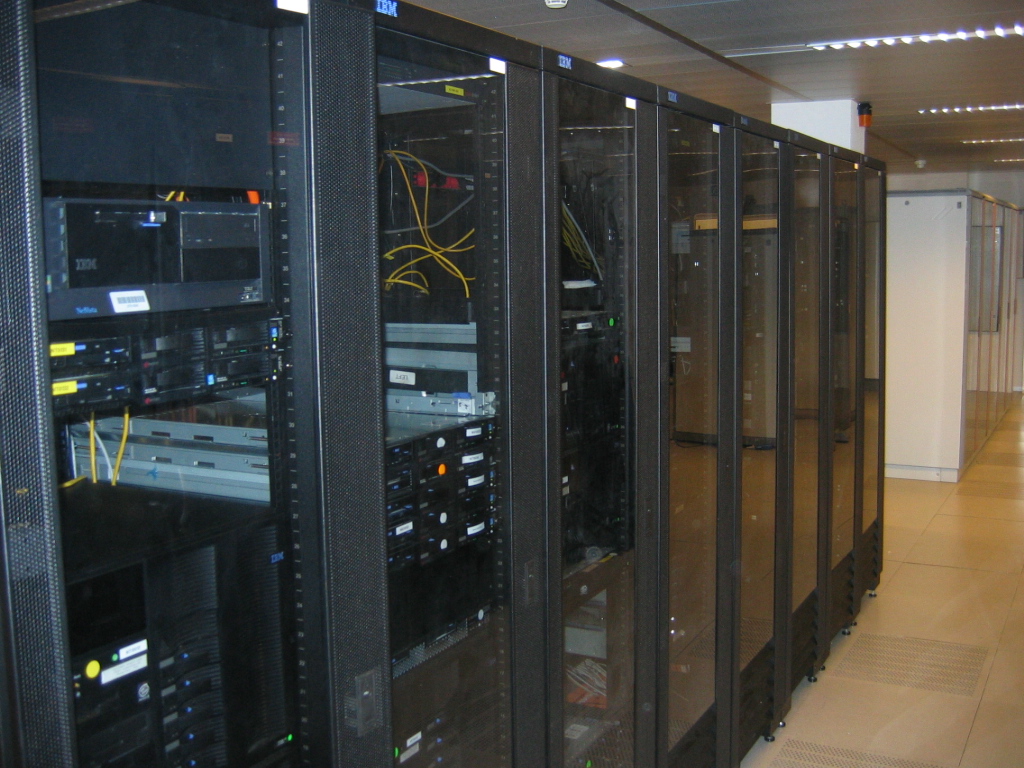
Photo: File photo of racks inside a data centre. SWI Compute's first factory starts at 30 MW — the gigawatt numbers are targets, not operating capacity. Credit: Wil Weterings, Wikimedia Commons, public domain.
The announcement: stealth, $1 billion, and no names
SWI Compute will build and operate NVIDIA AI factories, deploying globally with its strongest presence in Europe. That is the announcement, and it is deliberately framed as a power story rather than a chip story. "Energy availability represents the primary bottleneck facing European AI infrastructure," said Halil Mirakhmedov, CEO of SWI Compute. "Having spent six years acquiring grid access, SWI Group is now deploying these power resources into dedicated NVIDIA AI factories through SWI Compute. Just two months after joining the NVIDIA Cloud Partner program, our team secured approximately $1 billion in advanced hardware orders and executed initial client contracts. The market continues to surpass available capacity, and we are rapidly expanding our footprint to fulfill this requirement."
The framing is not wrong. Grid connections are the scarcest input in the AI buildout — harder to get than GPUs, slower to build than data-centre shells, and the thing every hyperscaler and neocloud is currently fighting over. A company that genuinely controls 3.6 gigawatts of contracted power starts the race several years ahead of anyone still queueing for a connection.
But note what the announcement does not do. It does not name one customer. It says its first customer is "a US-based AI inference platform" that "has contracted capacity" — no name, no size, no duration. It says contracts with first customers are finalised — plural, unnamed. For a company asking the market to believe a $1 billion order book, that is a thin evidence base, and it matters more than the headline number.
Cambridge first: 30 MW, close to 7,000 Rubin GPUs
The concrete part of the plan is a first large-scale AI factory in the UK, at Cambridge Innovation Campus. It starts at 30 megawatts, housing close to 7,000 Rubin GPUs and 3,500 Vera CPUs in NVIDIA Vera Rubin NVL72 racks, and is expected to come online by the end of 2027. The racks are connected by NVIDIA Quantum-X800 InfiniBand and NVIDIA Spectrum-X Ethernet networking.
That 30 MW is the initial phase of a UK campus planned to grow to 530 MW, according to the announcement — and the first step toward 2.3 gigawatts of NVIDIA AI factory capacity by 2029. Starting in the fourth quarter of 2027, the company says, its next generation of AI campuses across Europe is scheduled to come online, with thousands of GPUs planned for deployment.

Photo: Canary Wharf, London — not the Cambridge site, but a reminder of where the UK's AI buildout is concentrated: the south-east. SWI's first factory lands in Cambridge. Credit: Robin Stott, Wikimedia Commons, CC BY-SA 2.0.
The technology stack is pure NVIDIA reference architecture. Every SWI Compute site is built to NVIDIA reference architectures, and from 2027 every new site — starting with the UK campus — will follow the NVIDIA Vera Rubin DSX AI Factory reference design, which co-designs compute, networking, power and cooling as one system. On Vera Rubin NVL72, the company says, DSX can enable up to 40% more GPU capacity within the same power budget.
The first deployment runs NVIDIA Blackwell Ultra systems, with NVIDIA Vera CPU racks to follow. From NVIDIA's OEM and ODM ecosystem, SWI Compute has selected its systems partners, with Delta Computers as systems integrator alongside storage partners, to deliver more than 8,000 GPUs. That "more than 8,000" figure sits oddly next to "close to 7,000 Rubin GPUs" for the Cambridge first phase — the two numbers describe different scopes, the first phase versus the wider systems order, but the announcement does not spell that out, and a careful reader should not merge them.
The power behind the pitch
SWI Group began investing in land, power and shell in 2020. Today it holds 3.6 gigawatts of power capacity across Europe and the US, with its deepest presence in Europe, where its five campuses are in Ireland, the UK, Denmark, Spain and Italy — one of them already leased to a major hyperscaler, unnamed. The group develops its own sites, from grid connection to commissioning. "The power is contracted and the systems are on order," the announcement says.
"We started investing in land, power and shell in 2020. SWI Compute is the final piece, providing fully integrated infrastructure for NVIDIA AI factories. SWI Group is now a transatlantic, vertically integrated digital infrastructure company, from the grid connection to the GPU, and SWI Compute puts that capacity directly in the hands of the customers who need it most," said Max-Hervé George, Founder and CEO of SWI Group.
Vertical integration is the right word and the right strategy. The companies winning the AI infrastructure race are the ones that control the whole chain — land, grid, shell, cooling, chips, networking — because every handoff between vendors is a delay and a margin lost. SWI's claim is that it already owns the hardest link. If the 3.6 gigawatts are real, contracted and deliverable on the timetable implied, that is a genuine moat.
NVIDIA, for its part, is lending its brand without quite lending its balance sheet. "AI factories are essential infrastructure that turn regional energy into intelligence and economic opportunity," said Nico Caprez, Vice President, Global AI Infrastructure Growth at NVIDIA. "SWI Compute is putting Europe's energy to work for the ecosystem of AI natives, labs, universities and enterprises. Built on NVIDIA reference architectures and adopting NVIDIA DSX for its next generation of AI factories, SWI Compute is building infrastructure that is productive, durable and fungible — able to serve new customers and workloads and keep generating value for years to come."
What we checked — and what does not add up yet
SWI Compute's own website does not match its own announcement. The website lists the Cambridge campus as a first phase "growing to 500 MW" — not the 530 MW in the announcement, a discrepancy also flagged by EconoTimes and RuntimeWire. That is a 30 megawatt discrepancy, roughly the size of the entire first phase, sitting in plain sight between two pages published by the same company on the same day. It may be a rounding difference, a stale web page, or a genuine scope change. Either way, a company selling precision infrastructure should not have two different answers to the size of its flagship campus.
We also checked TechPulse USA's own archive before writing this: the blog covered SWI Group's €800 million raise, but it has never covered SWI Compute itself — this launch is new to our readers as well as to the market.
The second check concerns NVIDIA itself. NVIDIA's October 21 post listed SWI Compute among companies developing or expanding regional AI infrastructure in Europe — but, as EconoTimes noted, that post did not confirm SWI's order total or its UK timetable. Inclusion in an ecosystem roundup is not an endorsement of a $1 billion order, and it should not be read as one.
The third check is the simplest: 3.6 gigawatts is power capacity SWI can access across 24 sites. It is not operating AI factory capacity. The 2.3 gigawatts is a goal for 2029. Between today's 30 MW first phase and that 2029 goal lies roughly a 75-fold scale-up in three years — through planning permissions, grid buildouts, hardware deliveries and customer signings that have not happened yet. None of that is impossible. All of it is unproven.
Then there are the unnamed parties. One site is leased to an unnamed hyperscaler. The first customer is an unnamed US inference platform, with no size or duration disclosed. Anonymity is normal in early data-centre deals — tenants often insist on it — but stacked together, the unnamed hyperscaler, the unnamed first customer and the unnamed contract sizes mean the market is being asked to trust the structure of the story without being able to inspect any of its load-bearing parts.
How SWI got here: Polarise, then €800 million
The launch follows a shift in SWI's approach to the compute market. After a proposed majority investment in AI cloud operator Polarise did not proceed, SWI said in August it would develop its own computing platform while providing financing to Polarise, EconoTimes reported. Building rather than buying is slower and harder — but it also means SWI keeps the whole margin and the whole strategy.
The money followed two months later. On October 12, SWI Group announced an €800 million capital increase to support power infrastructure, computing deployments and other projects — a raise TechPulse USA covered at the time, when SWI was converting former FTX-linked bitcoin mining assets into AI data centres. SWI's €800M capital raise was the war chest; SWI Compute is what the war chest is for.
The timing is not accidental. AI infrastructure took $15.7B of Europe's funding in the first nine months of 2026, the biggest segment of a $61.9 billion European total. Capital is flooding into exactly what SWI is building. The question is whether it is flooding in faster than the returns justify — and that question now hangs over every company in the sector.
The neocloud question
SWI Compute is, in substance, a neocloud: an AI-specialised cloud company building data centres that exist for one purpose, training and running AI models. And the neocloud business model is under live interrogation by the market. Nebius borrowed $3.5B for a year despite $40B in contracts — a reminder that even a contract book stuffed with investment-grade customers does not pay for GPUs today. Contracts are future revenue; chips and buildings are present-tense bills.
SWI's answer to that problem is that it owns the power rather than renting it, and that its customers are Europe's AI natives, labs and enterprises — buyers who, the announcement argues, have been shut out because existing capacity "has been committed first to global hyperscalers and frontier labs, the buyers able to sign multi-year contracts at scale." That is a real gap in the market. Europe has the researchers, the founders and the enterprises to build frontier AI, and much of that building has happened on capacity outside Europe. A sovereign, European-jurisdiction alternative has genuine appeal — for startups, for labs, and for governments that would rather not see their AI future hosted elsewhere.
But the gap is also the reason to be cautious. The buyers SWI is targeting — AI natives with frontier ambitions and startup balance sheets — are, by the announcement's own admission, the buyers who have the hardest time paying. Serving the customers the hyperscalers passed over is a mission, not a business model, until someone demonstrates it can be done profitably at scale.
The same arithmetic now hangs over every neocloud: Anthropic's buildout is the extreme case — the $530B lease sprint behind its 15 GW of capacity — and the question it raises is the one SWI has to answer too: who pays if the contracts slip? That is Hock Tan's warning that cash, not chips, is the constraint, applied to a company that owns its power but still has to pay for its GPUs.
Update, Oct. 26: what the company's own page adds
SWI Compute's own launch page, published with the announcement, adds three details the announcement coverage skipped. First, its next-generation factories will adopt NVIDIA DSX, which the company says ‘can enable up to 40% more GPU capacity within the same power budget’ on Vera Rubin NVL72 — the efficiency claim behind the whole pitch. Second, Delta Computers is named as systems integrator, and the page puts the GPU count at ‘more than 8,000’ — a differently-counted total from the ~7,000 Rubin GPUs in the announcement, so treat it as the company's own tally, not a correction. Third, the next wave is dated: ‘Starting in Q4 2027, its next generation of AI campuses across Europe is scheduled to come online.’ That date, not the 2.3 GW target, is the milestone to hold SWI to.
Our take: power is real, proof is pending
Here is our honest read. SWI Compute is not another press-release data centre. The power position behind it — six years of grid acquisition, five European campuses, 3.6 gigawatts under some form of control — is the kind of asset that cannot be faked quickly, and the NVIDIA partnership, the $1 billion order and the Cambridge timetable are all concrete enough to be checked as they land. If the Cambridge factory switches on at the end of 2027 with close to 7,000 Rubin GPUs inside it, the scepticism in this article will look misplaced, and SWI will have earned the right to talk about gigawatts.
But today, the ratio of promise to proof is badly out of balance. A 30 MW first phase is being used to sell a 2.3 gigawatt story. A $1 billion order is announced without a named customer to anchor it. The company's own website disagrees with its own press release about the size of its flagship campus by a full first phase. None of this means the story is false — it means it is unfinished, and unfinished stories in the AI infrastructure market have a habit of repricing violently when the first delivery date arrives. SWI has bought itself the benefit of the doubt with real power assets and real capital. What it has not bought yet is the right to be believed about 2029. That has to be earned one switched-on megawatt at a time.
Sources: SWI Compute / PR Newswire launch announcement, October 26, 2026; SWI Compute company website (swi-compute.com); EconoTimes, "SWI Compute Orders About $1 Billion in NVIDIA Systems, Plans UK Factory," October 26, 2026; Data Center Dynamics, "SWI launches AI cloud unit SWI Compute"; Unite.AI, "SWI Compute Debuts With Plans for NVIDIA AI Factories Across Europe"; NVIDIA's October 21, 2026 post on European AI infrastructure, as reported by EconoTimes. Quotes from Halil Mirakhmedov, Max-Hervé George and Nico Caprez are verbatim from the launch announcement.
By Daniel Rao — Daniel Rao covers AI infrastructure and the business of compute for TechPulse USA — the debt, the data centres, and the deals holding the AI boom together.


Comments
Post a Comment