
Watchdog Weighs Probe Into Home Office AI Asylum Decisions
Britain's borders watchdog is circling a question the Home Office would plainly rather it did not ask: what exactly is its AI doing to asylum claims? The Independent Chief Inspector of Borders and Immigration has asked the Open Rights Group for more detail on two generative AI tools used in asylum casework, as it draws up the topics it will inspect next year. No inspection has been announced. No inspection has been confirmed. But the request itself is the news — because it means a watchdog that rarely moves fast is now, at minimum, taking the question seriously.
That distinction matters, and this article will keep it sharp throughout. The inspector has not opened an investigation. It has asked a campaign group for information while it decides what to inspect. The Home Office, for its part, insists no machine decides anything. And yet the numbers behind that reassurance are, on the campaigners' evidence, shaky enough that "trust us" no longer quite covers it.
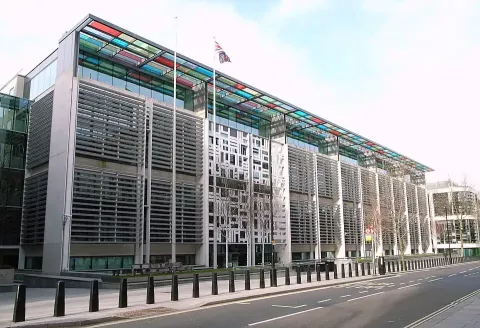
Photo: The Home Office headquarters at 2 Marsham Street, Westminster, London, photographed in February 2008. This is a file photograph of the department's building, not of the AI tools described. Credit: Steve Cadman, via Wikimedia Commons, CC BY-SA 2.0.
By Daniel Rao, TechPulse USA's AI correspondent
What the two tools actually do
The tools at the centre of this are Asylum Case Summarisation, known as ACS, and Asylum Policy Search, or APS. According to documents obtained by the Open Rights Group (ORG), both are built on OpenAI technology — WIRED's account names OpenAI's 2023 GPT-4 model, used through Microsoft Foundry — and both do work that sounds clerical until you think about what is at stake. ACS turns long asylum interview transcripts into summaries for caseworkers. APS helps caseworkers find and summarise country policy information: the material used to judge whether an applicant faces a genuine risk of harm back home.
The department began piloting the pair in late 2024, as the Labour government tried to clear a backlog of around 100,000 asylum cases while tens of thousands of new applications kept arriving each year. Government estimates from the pilot suggested that using the two tools together could save around an hour per case. An hour, multiplied across a backlog like that, is an enormous prize. It is also, campaigners argue, exactly the kind of prize that makes an organisation stop asking awkward questions about accuracy.
Here is the detail that should stop any reader cold. These tools do not merely retrieve text. ORG's report stresses that both generate new text of their own — and a system that generates can also filter, or quietly omit, facts relevant to a decision. A summary that drops the one sentence in which an applicant described a threat is not a clerical error. It is a different case.
The numbers that worry campaigners
ORG's case rests on a six-month investigation: 11 parliamentary questions, two ministerial letters and 10 public records requests, assembled into a report titled "Automated Discrimination: Unpacking the Digital Hostile Environment". Its headline finding is a gap between the Home Office's published pilot figure and what happened after wider rollout. A 2025 Home Office pilot evaluation found that 9% of ACS summaries were inaccurate or omitted information and had to be removed from the trial. But sampling by subject-matter experts after rollout told a worse story: 45 of 203 summaries — about 22% — failed an initial assessment, and 30 of 56 summaries examined at a second stage also failed.
The sampling itself is part of the scandal, on ORG's telling. Only 203 summaries were checked by Home Office experts between April and July 2026, roughly 0.3% of the estimated 70,000 cases processed in that period. And there is a quieter sting in the detail: ORG found that a summary could pass its checks despite leaving out important details, provided the information it retained was accurate. In other words, the test can miss exactly the failure mode — omission — that matters most in an asylum interview.
For APS, the picture is thinner still. ORG found no equivalent ongoing quality-control process for its summaries, and Anna Turley, the Minister of State for Border Security and Asylum, confirmed in August that testing of the APS tool had ceased. The inspectorate's own earlier finding points the same way: it told WIRED it was aware of concerns about AI use and pointed to findings from the previous year that one tool's "effectiveness and reliability were varied". "Varied" is doing a lot of heavy lifting in that sentence. In Whitehall, it is about as close as an inspector gets to saying "not good enough".
The human cost is not hypothetical. In July, WIRED reported, a UK judge accused the Home Office of relying on an "AI hallucinated" document when refusing an asylum claim by a Moroccan woman and her child, on the grounds that it would be safe for her to return. One case, one judge, one furious phrase — but it is the nightmare scenario in miniature: a machine invents something, a human files it, and a family pays.
"They do not make decisions" — the Home Office defence
The department's answer, given to WIRED by email, is worth quoting in full because it is the sentence the whole debate turns on: "Asylum decisions are made by trained caseworkers, with AI tools used only to assist in navigating interview records and policy information. They cannot be used in isolation and do not make decisions on claims," a Home Office spokesperson said. "We regularly monitor the performance of these tools alongside our established quality-assurance processes, and have already committed to publishing updated evaluations on their roll out."
Take that at face value and the story softens considerably. Nobody's claim is decided by a chatbot. A trained human signs off. The problem — and it is a problem the Home Office has not really answered — is that a human who reads a flawed summary is not quite the independent check the sentence implies. An inaccurate interview summary or country assessment can shape a caseworker's judgment long before any formal decision is taken, and researchers have warned that cultural bias and lost linguistic nuance in the models could feed discriminatory outcomes. The signature at the bottom of the decision does not disinfect the evidence above it.
The secrecy problem: a register with blank lines
The second half of ORG's complaint is not about accuracy at all. It is about darkness. The UK government's AI Playbook requires departments to be transparent about algorithmic tools used in decision-making, including listing them in a public repository. Neither ACS nor APS appears on that register. Applicants are not told when the tools are used in their cases. And when ORG asked, officials routinely invoked national security to refuse or redact — the report's phrase is "near-total secrecy".
That secrecy has a legal edge. An independent legal opinion from lawyers at Cloisters, commissioned by ORG, concluded that preventing people from challenging an incorrect AI summary of their personal information may breach UK data rights law. The Home Office's response is that its privacy notice explains that parts of processing may involve automation. Note the asymmetry there: a privacy notice that says automation "may" be involved is not the same as telling an applicant that a machine summarised their interview.
The campaigners are not alone in noticing the blank lines. Public Law Project senior research fellow Caroline Selman told WIRED that ACS and APS are two of 11 high-risk government AI systems her team has found in use but missing from the public repository. "Other tools are being used but not being publicized at all," Selman said, "and you can't even begin to ask questions about things if you don't know that they're being used."
There is also a separate inquiry that must not be confused with the possible inspection: the UK's data regulator is investigating the Home Office's refusal to disclose information about staff use of, and training on, the two tools. That is about access to information; the inspectorate question is about whether the tools themselves belong under formal scrutiny.
Our verdict: inspect, and inspect in public
Here is where reporting ends and judgment begins. The Home Office's position — humans decide, machines merely assist — is true in the narrowest sense and misleading in every sense that matters. A summary is not a neutral object. It is an argument about what mattered in an interview, and when a machine makes that argument badly, one time in five by the department's own experts' checks, the human signature at the end is not a safeguard.
Labour backbench MP Bell Ribeiro-Addy put the moral case more plainly than any report could. "We're dealing with people's lives. We're talking about people that have faced some of the worst circumstances, and we're meant to be making decisions based on facts and on understanding harm," she told WIRED. "I just don't think it's appropriate that machines are doing that." Sara Alsherif, who leads ORG's migrant digital justice programme, made the practical case: "Migrant organizations, legal practitioners, not many of them know about the actual use of this tool," she told WIRED. "So we need to let them know about this, let them know how it works, so they can challenge it."
ORG has asked for the tools to be suspended pending an independent evaluation and audit. Suspension may be a step further than the evidence alone compels today. But an inspection is not. When a system that can quietly drop a sentence from a survivor's testimony is operating at national scale, in secret, off the public register, "we are monitoring it" is a botched answer.
We checked TechPulse USA's own archive before writing this story: the two internal posts linked in this article — our account of Claude slipping past a paywall to grab vote counts it was never told to fetch and our guide to what AI agents actually do — both still resolve live, and neither covers this Home Office story. The pattern, though, is the same one this blog keeps finding: the machine does something unasked, the human finds out later, and the audit trail was never built.
Sources: WIRED (original report, 27 October 2026, via PYMNTS and other carriers); PYMNTS, "UK Home Office Scrutinized For AI Use in Asylum Cases", 27 October 2026; Open Rights Group, "Automated Discrimination: Unpacking the Digital Hostile Environment" (via Electronic Immigration Network summary); The Guardian's coverage of the ORG report, 27 October 2026. No comment beyond the WIRED/PYMNTS reports was found from the Home Office, the ICIBI or ORG in this run's checks — the Home Office and ICIBI positions quoted above are those given to WIRED.
About the author: Daniel Rao is TechPulse USA's AI correspondent, covering artificial intelligence, technology and the internet for a global English-speaking audience, with a focus on the US tech industry.


Comments
Post a Comment