
ASML Cannot Build Machines Fast Enough for AI Demand
By the TechPulse USA Newsroom | Veldhoven, Netherlands | 14 October 2026
Here is a sentence you do not hear often from a company that has just posted the best quarter in its history: we cannot keep up. ASML said exactly that on Wednesday. The Dutch company that makes the machines every advanced chip depends on reported record third-quarter sales of €11.7 billion, raised the floor of its full-year forecast, handed shareholders billions — and then told its customers, in so many words, that it will not have enough machines for them in 2027 or 2028.
Read that again, because it is the whole story. The bottleneck in the artificial intelligence boom is no longer money, or power, or even memory. It is the factory floor in Veldhoven. The company with a near-monopoly on the most advanced chipmaking equipment on Earth cannot build its machines fast enough, and it knows it.
This is the payoff to our preview earlier this week, when we set out what to watch in ASML’s third quarter and in TSMC’s numbers due on Thursday. The preview asked whether the AI boom could survive its own sceptics. ASML’s answer arrived in euros, and it was emphatic.

Photo: ASML’s corporate headquarters in Veldhoven, Netherlands. Credit: A ansems via Wikimedia Commons, public domain.
A record quarter, in plain euros
Start with the scoreboard, because it is genuinely remarkable. ASML reported total net sales of €11.662 billion for the three months to the end of September, which it rounds to €11.7 billion. That is up from €9.326 billion in the second quarter and from about €7.5 billion a year earlier — roughly 55% growth year on year — and it landed towards the high end of the €11–12 billion guidance the company had given.
| Measure | Q2 2026 | Q3 2026 |
| Total net sales | €9,326m | €11,662m |
| Of which Installed Base Management | €2,762m | €3,289m |
| New lithography systems sold | 86 | 113 |
| Gross profit / margin | €5,035m / 54.0% | €6,700m / 57.5% |
| Net income | €2,918m | €4,960m |
| Basic earnings per share | €7.59 | €12.95 |
| Cash and short-term investments | €7,582m | €12,735m |
Net income came in at €4.960 billion — the €5.0 billion of the headline — more than double the roughly €2.1 billion of a year earlier, and well up on the second quarter’s €2.918 billion. Gross margin hit 57.5%, beating guidance, helped by a mix tilted towards the most advanced systems and by a strikingly strong services business. Installed Base Management sales — servicing machines already in the field and selling productivity upgrades for them — reached €3.3 billion, above guidance, as customers paid to squeeze more wafers out of the tools they already own. We checked ASML’s release against Reuters’ and CNA’s same-day reporting, and the headline figures matched line for line.
ASML shipped 113 new lithography systems in the quarter, up from 86 in the second quarter, plus eight used ones. Then it gave the money back, in the best possible sense: about €4.1 billion of shares repurchased in the quarter under its 2026–2028 buyback programme, and an interim dividend of €1.88 per ordinary share payable on 4 November 2026.
And the company expects the fourth quarter to be bigger still: total net sales between €14.2 billion and €15.2 billion, with a gross margin of around 57%, research and development costs of around €1.2 billion, and selling, general and administrative costs of around €0.4 billion. That fourth-quarter guide came in above the €14.19 billion analysts polled by LSEG had expected, according to Reuters. Full-year 2026 sales are now expected between €44 billion and €45 billion, with a gross margin of around 56% — the bottom of the range lifted from €43 billion.
The sentence that matters more than the numbers
Big numbers, though, were not the news. The news was one sentence in chief executive Christophe Fouquet’s statement. ASML’s president and chief executive officer said in a statement that “our supply as currently planned for both 2027 and 2028 will not fully meet the demand of our customers.” Fouquet’s phrasing — “not fully meet” — is Dutch understatement for a queue that now stretches past the end of the decade.
Behind that sentence sits a shift in how customers are behaving. “Our customers continue to increase their short- and medium-term equipment demand forecasts with us,” Fouquet said in the same statement, “driven primarily by their views on the size and duration of AI-related investments.” Some customers, he added, are already expressing interest in placing orders for 2029 and even 2030. Reuters’ account of the results put it more bluntly: discussions with customers are shifting beyond 2027, with strong interest in orders for 2029 and sometimes even 2030.
That is a different kind of demand signal from a single hot quarter. Chipmakers do not talk about orders four years out unless their own customers — the hyperscalers, the AI labs, the memory buyers — have given them reason to believe the spending lasts. A foundry does not reserve a lithography slot for 2030 on a hunch.
One thing the release did not contain is worth noting, because readers will look for it. There was no quarterly bookings figure in euros. ASML no longer publishes quarterly bookings, having moved to reporting its total systems backlog once a year; the demand story in this release is told through guidance, customer commitments and management’s own words instead. Do not mistake the absence of a bookings number for an absence of orders. Fouquet’s language about an order book whose momentum keeps increasing quarter on quarter is the company telling you, in the only terms it now uses, that the queue is growing.
Why ASML cannot simply build more machines
The obvious question is why a company selling every machine it can make does not just make more of them, faster. The answer is that an EUV lithography system is not a product you scale by adding a shift. It is a bus-sized machine that prints chip patterns with 13.5-nanometre light, built from components — precision optics, a tin-plasma light source, vacuum chambers — that only a handful of suppliers on Earth can produce to tolerance. ASML’s own description of its business is that it supplies chipmakers with the hardware, software and services to mass-produce the patterns of integrated circuits, working with partners across the supply chain. When the chain is the constraint, money alone does not unblock it.
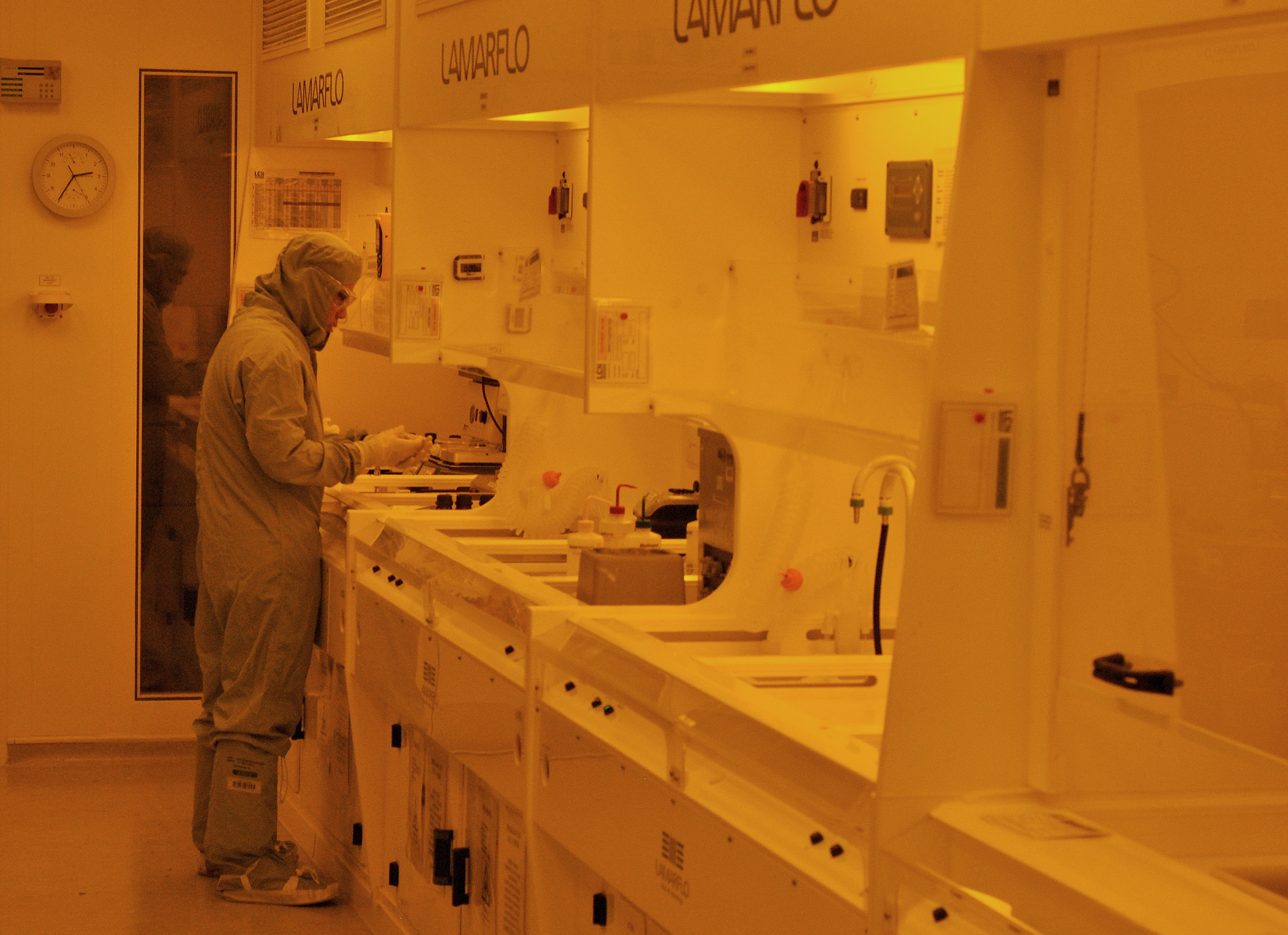
Photo: A photolithography cleanroom (illustrative image, not an ASML facility). Credit: London Centre for Nanotechnology / UCL, via Wikimedia Commons, CC BY 3.0.
ASML is trying. In July it set out a plan to lift its 2026 low-NA EUV capacity of around 65 systems by 30% in 2027, and said it was investigating a further 30% increase for 2028; the same 30%-and-then-maybe-30% shape applied to DUV immersion capacity of around 130 units. Wednesday’s release says, in effect, that even that will not be enough: the company is now investigating ways to increase capacity for 2028 beyond the 30% increase it previously communicated. Its footnote to the release confirms the July figures are the baseline being beaten.
The longer-term fix is concrete, but it is not quick. On 8 September, ASML broke ground on Brainport Industries Campus North in Eindhoven, about 7 kilometres from its Veldhoven headquarters, near Eindhoven Airport. The multi-phase development will eventually span roughly 350,000 square metres with potential capacity for up to 20,000 workplaces; its first phase, due for completion in 2029, will house at least 3,000 employees and bring production, logistics and offices together around a new “flow factory” for building its giant tools more efficiently. As Reuters noted on Wednesday, ASML will need other answers before that first phase is finished in 2029 — which is precisely why the productivity-upgrade business did €3.3 billion in the quarter.
That services line is the quiet hero of this story. Where ASML cannot sell a customer a new machine, it can sell them more output from the machines they have: upgrades that raise throughput, better overlay metrology, faster servicing. Chief financial officer Roger Dassen said in a company Q&A published with the results that upgrades and higher-throughput versions of its machines would provide a significant enhancement to customers’ capacity. It is the closest thing the industry has to printing capacity without pouring concrete.
The casino across the street
ASML’s numbers landed in a market that had spent the previous two days talking itself into a panic. On Monday, at an event in Singapore, Broadcom chief executive Hock Tan warned that many AI investors “have no clue what they are investing in” and said their extreme expectations were “almost like they are in a casino.” You can read our full account of Hock Tan’s warning here; the short version is that he argued financing the AI buildout could become a bigger problem than chip shortages, and questioned whether the spending would ever pay.
The market reaction was violent. South Korea’s Kospi index slid sharply on Tuesday, with Samsung down 7.4% and SK Hynix down 10%, according to Barron’s, and the PHLX Semiconductor Index had already dropped 2.7% on Monday. Some of that was Tan. Some of it was a report that Chinese memory maker CXMT had advanced a denser DRAM design, threatening the incumbents. Some of it was simply a market looking for a reason to sell a trade that had run very hot.
And then ASML reported. Put the two events side by side and the contrast is the story of this week in tech. On one side, a celebrated chief executive warning that the AI trade looks like a casino. On the other, the house that sells the tables reporting record sales and admitting it cannot meet demand for two years. Both men can be right, in their own way: Tan is talking about investors and returns; ASML is talking about orders and machines. But when the company at the very top of the supply chain says its customers are booking into 2030, the casino metaphor starts to look like a description of the stock market, not of the factories.
Our take: scarcity is the story now
Here is where we plant our flag. The AI boom’s binding constraint has moved, and it is not going back. For two years the question was whether enough GPUs could be built. Then it was whether enough power could be found. Now it is whether enough lithography capacity exists to make the chips at all — and the answer, from the one company that would know, is no, not in 2027, not in 2028, not at currently planned supply.
That scarcity rearranges power in the industry. It gives ASML pricing leverage it has rarely enjoyed — the Wall Street Journal reported that Dassen said price-increase conversations with key customers are complete, with the effect becoming visible partly in 2027 and in full from 2028 onwards. It makes ASML’s customers’ factory plans hostage to Veldhoven’s production schedule, and it makes every alternative — throughput upgrades, second-hand tools, squeezing more from installed machines — worth real money. It also raises the stakes on the geopolitical front: a world in which the most important machines on Earth are rationed is a world in which export controls, rare-earth restrictions and factory locations become sharper arguments than they already are.
None of this means the bubble warnings are wrong. Scarcity at the top of the chain can coexist with waste at the bottom of it. Plenty of AI spending will never earn a return, and plenty of investors will lose money on it — Tan is not wrong about that. But a bubble in AI equities and a shortage of lithography machines are two different claims, and Wednesday’s numbers are evidence for the second, not the first. The honest way to hold both ideas is this: the buildout is real, the capacity to feed it is not, and the companies that control the capacity will be paid first, whatever happens to the share prices of the companies further down the queue.
The risk to ASML’s story is not that demand is fake. It is that demand is concentrated: a small number of giant customers — TSMC, Samsung, SK Hynix, Micron, Intel, and, per Reuters, newcomer Terrafab — expanding at the same time, for the same reason, on the same bet about AI. If that bet ever pauses, the queue that looks so reassuring today would shorten fast, and a company that has just told the world it cannot keep up would face the opposite problem. That is the sentence to remember the next time someone calls this trade a one-way bet.
What to watch next
First, TSMC on Thursday. The world’s biggest contract chipmaker reports the day after ASML, and its capital spending plans will either confirm or complicate the picture Fouquet painted. If TSMC talks about its own capacity the way ASML just did, the 2027–2028 shortage story hardens into the defining fact of the cycle.
Second, the fourth quarter itself. ASML has guided to €14.2–15.2 billion of sales, which would make it by far the biggest quarter the company has ever reported. Hitting the top of that range requires the ramp-up Fouquet praised — “the strong execution of our ramp-up,” in his words — to keep running without a stumble. The market will forgive a lot; it rarely forgives a missed ramp.
Third, the 2028 capacity decision. “Investigating ways to increase capacity” is a promise to try, not a plan with a number. Watch for a concrete figure — how many extra systems, which product lines, which suppliers are being qualified — in the next two quarters. That number, when it comes, is the real sequel to this release.
Fourth, pricing. If Dassen’s timetable holds, higher prices start to show in 2027 and land in full from 2028. In a shortage, that is the market working. It is also the detail that will decide whether ASML’s margin story keeps climbing from an already remarkable 57.5%.
And finally, the building site in Eindhoven. The first phase completes in 2029, which means the shortage ASML has just admitted will not be solved by a new campus. It will be solved — if it is solved — by the unglamorous work of upgrades, throughput and supply-chain grinding, in the years before the concrete dries. Nvidia is already prepaying suppliers to lock in chip capacity; expect more of that behaviour, from more companies, as the queue lengthens.
The chip industry has spent its history cycling between glut and shortage. ASML has just told us which one we are in, for how long, and who gets paid first. Believe it. The numbers, for once, are not the complicated part.
Sources
ASML Holding N.V. third-quarter 2026 results press release, via GlobeNewswire (14 October 2026), including the CEO statement and outlook, share buyback and dividend update, and the Q2 capacity footnote; Reuters reporting on the results, via CNA and Euronext, including analyst expectations and the ING analyst reaction; AFP reporting via The Economic Times, including CFO Roger Dassen’s remarks and the year-earlier comparisons; The Wall Street Journal’s earnings-call reporting on pricing; and ASML’s September 2026 Brainport Industries Campus North groundbreaking release, via Reuters and GlobeNewswire.
TechPulse USA is an independent technology news publication. This article is based on public company releases and reputable news reporting; it is not investment advice.
By the TechPulse USA Newsroom. TechPulse USA covers the global technology and AI industries — chips, infrastructure, policy and the companies building them — with reporting grounded in primary sources and verified figures. Our earlier coverage includes ASML Reports Wednesday, TSMC Thursday: Auditing the AI Boom, Hock Tan’s warning on the AI trade, and Nvidia prepaying suppliers to lock in chip capacity.
Update, Oct. 14: the market verdict — record quarter, falling shares
The market heard the same numbers you just read and sold the stock anyway. ASML’s US-listed shares fell about 3% in overnight trading after the results, and around 3.85% on some platforms, with Micron, SanDisk and Intel falling 1% to 2.6% in tandem and Nvidia sliding too. The reason is the gap between a great quarter and a perfect one: in dollar terms, revenue of $13.07 billion narrowly missed the $13.12 billion analysts expected (Koyfin), even as earnings per share of $14.51 smashed the $12.05 consensus. A record that misses is still a miss, and traders priced it that way.
Three details from the earnings call fill out the picture. ASML sold 17 extreme ultraviolet (EUV) systems in the quarter, part of the 113 new machines shipped. Net income included a €500 million revaluation of the first tranche ASML bought from Mistral AI. And chief financial officer Roger Dassen said the installed-base business came in €400 million above guidance, driven by customers paying for productivity upgrades on machines they already own — the shortage business, in other words, is already paying.
The hardware answer to the shortage is also now dated: ASML confirmed it will introduce the NXE:3800F EUV scanner in 2027, lifting wafer throughput from 230 wafers per hour to 260, while upgraded DUV immersion tools due in 2027 will reach a record 330 wafers per hour. None of that arrives in time for the 2027–2028 gap — which is exactly why the queue, not the quarter, is the story. The money side of that queue is Morgan Stanley’s warning that $335 billion cannot buy the power AI needs, and the $113 billion debt machine that just hit a wall.


Comments
Post a Comment