
Tencent Leased 100,000 Chips It Can't Legally Buy
Tencent Leased 100,000 Chips It Can't Legally Buy
Update, Oct. 2
The market has reacted: Oracle shares rose more than 2.5% in overnight trading after the FT report, per Finance.yahoo and Stocktwits coverage. Reuters still cannot independently verify the report and neither Tencent nor Oracle has commented (TheEdge, Oct. 2). ChosunBiz (Oct. 2) reports Tencent will more than double AI spending this year to fold its Hunyuan model and AI agents into games and social apps, including WeChat's 1.4 billion users.
By Daniel Rao

File photo: Nvidia's Santa Clara headquarters. The advanced AI chips at the heart of the reported Oracle–Tencent lease are Nvidia-class hardware that Tencent is barred from buying in China. Photo: Coolcaesar, CC BY-SA 4.0, via Wikimedia Commons.
Tencent cannot legally buy the chips it needs. So it rented 100,000 of them instead — for a reported $7 billion. And if the Financial Times' sources are right, the whole manoeuvre is perfectly legal, which may be the most damning detail of all.
The FT reported on 30 September that Tencent signed a five-year lease with Oracle earlier this year, covering multiple Oracle data centres across Southeast Asia. The contract gives the Chinese tech giant access to roughly 100,000 advanced AI chips that are effectively unavailable inside China, at an estimated value of $7 billion, with about 30 per cent — roughly $2.1 billion — paid upfront. If accurate, it is the largest overseas lease Tencent has ever signed.
Read that again: not bought. Leased. The chips never touch Chinese soil, and that single distinction is the entire story.
The deal, as the FT reported it
The numbers are stark. Five years. Multiple Oracle data centres in Southeast Asia. About 100,000 high-performance AI chips. Roughly $7 billion, with nearly a third paid before the lease even gets going. Tencent's largest-ever overseas leasing agreement, according to people familiar with the matter cited by the FT.
Reuters carried the FT's report on 30 September — filed from Bengaluru, for what it's worth — but was candid about its limits. It could not independently verify the figures. Oracle and Tencent did not answer when Reuters rang for comment. As the Financial News' Martin Holloway noted in his analysis of the numbers, no SEC filing, no 8-K, and no HKEX announcement references the transaction anywhere in either company's public record.
That matters. The $7 billion price tag, the 30 per cent upfront payment, the five-year term and the Southeast Asian locations all trace back to a single FT report built on anonymous sourcing. The story has since ricocheted around financial media — syndicated by Reuters, picked up by outlets from the Korea Herald to TrendForce — without a denial from either side. A denial would have been easy. None has come.
The money trail: a cash deficit for the first time in a decade
Whether or not the Oracle lease is real, Tencent's books already show the burn. In the second quarter, capital expenditure surged 176 per cent year-on-year to 52.8 billion yuan — a quarter of the company's entire quarterly revenue. Free cash flow swung to a deficit of 13.8 billion yuan, the company's first quarterly cash deficit in more than a decade.
The mechanics are plain in Tencent's own results release. Capex payments of 59.3 billion yuan outran operating cash flow of 52.7 billion yuan, with media content and lease liabilities adding to the outflow. Buried in the release is the line that matters: operating cash flow included "large AI-related prepayments to provide infrastructure to support our Hy model enhancements, WorkBuddy and CodeBuddy inference needs, Weixin AI initiatives, and development of AI capabilities across our products and services."
Strip out the compute prepayments and free cash flow would have been a healthy 37.6 billion yuan. The deficit is not a business in trouble; it is a business paying for compute before it has finished counting what the compute will earn.
Ma Huateng, chairman and chief executive of Tencent, said in the company's second-quarter results announcement: "At the infrastructure level, we substantially stepped up our procurement of compute, which will enable us to convert usage of our applications and models into revenue going forward."
We read the full Q2 results announcement this morning — the PR Newswire release of 12 August. The word "Oracle" does not appear in it once. The entire $7 billion lease, if real, is hiding inside a single euphemism: "large AI-related prepayments." That is either remarkable discretion or remarkable coincidence, and investors are entitled to wonder which.
Ma also said in the same announcement: "we are making substantial progress towards building a new, AI-empowered Tencent in terms of intelligence, applications, and infrastructure." The ambition is unmistakable. So is the invoice.
Why renting is legal and buying isn't
Here is the legal logic the whole deal turns on, and it is worth stating precisely because the distinction is the story. US export controls bar Chinese firms from buying advanced Nvidia chips. They do not, at present, bar those firms from leasing computing capacity in data centres outside China. Ownership is restricted; rental is not. The chips stay in Southeast Asia. Tencent's workloads travel to them.
This is not a novel interpretation of the rules. A Reuters legal analysis of almost exactly this scenario found that a Chinese company could become an infrastructure-as-a-service customer at a Malaysian data centre and remotely use advanced computing hardware it could not receive on the mainland — and that US rules "currently do not comprehensively prohibit this kind of ordinary remote access."
Even Nvidia has effectively acknowledged the shape of the loophole. "By design, the export rules allow clouds to be built and operated outside controlled countries," an Nvidia spokesperson said, as reported by Engadget, adding that the company's cloud partners go through review before being approved to receive its products.
Washington's counter-argument is that China's AI giants are simply stealing what they can't buy.
So the fence exists, and there is a gate in it, and the gate is wide enough to drive 100,000 chips through. Beijing knows it. Washington knows it. And now, apparently, so does Tencent's treasury department.
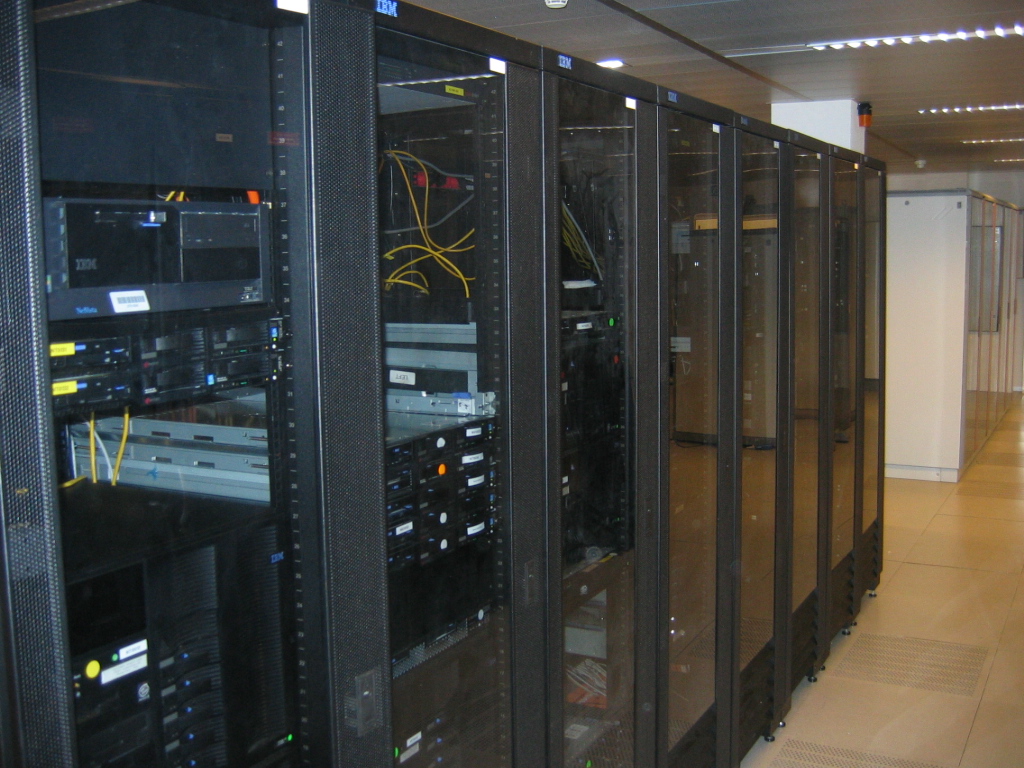
File photo: rows of server racks inside a data centre. This image dates from 2005 and is illustrative — the capacity Tencent is reported to be leasing sits in Oracle data centres across Southeast Asia. Photo: Wil Weterings, released to the public domain, via Wikimedia Commons.
Tencent is not first in the queue
The striking thing about this deal is how unoriginal the playbook has become. ByteDance is already one of Oracle's largest GPU customers in the Asia-Pacific region, and OpenAI leases Oracle capacity too — including the five-year, $300 billion arrangement the Wall Street Journal reported last year. Oracle has separately disclosed roughly $40 billion in Nvidia GB200 chip purchases to power an OpenAI data centre under the Stargate project, according to Reuters.
Put bluntly, Oracle has become the AI boom's most important landlord, and its tenant list now runs from Sam Altman's lab to TikTok's parent company to — reportedly — Tencent. ByteDance and Alibaba are already counted among the biggest users of Southeast Asian data-centre capacity, according to Anadolu Agency's reporting on the deal.
The pattern extends beyond any single vendor. Chinese firms are reserving large amounts of capacity in Malaysia, Singapore, Indonesia and Thailand as domestic access to advanced GPUs tightens — a quiet, region-wide migration of compute demand to wherever the export rules end. Amazon, for its part, is running a parallel experiment in chip-financing engineering: it reportedly wants investors to buy its $8 billion Nvidia chip bill through a special-purpose vehicle. The whole industry is improvising around the same constraint.
What the chips are for
Tencent's target is no mystery. The company plans to use the leased capacity to sharpen its Hunyuan family of models — which, by several accounts, have improved substantially in recent months, narrowing the gap with domestic rivals from DeepSeek and Alibaba — and to accelerate development of AI agents capable of performing complex tasks autonomously.
The spending commitment behind it is enormous. Management told investors it expects to "more than double" its new-AI-product investments in 2026, after spending about 18 billion yuan on the Hunyuan model, the Yuanbao chatbot and related products in 2025. And the distribution prize is obvious: Tencent's WeChat superapp reaches more than 1.4 billion users, and the company is pushing AI agents directly into that ecosystem. This is not research for its own sake. It is compute bought — or rather, rented — to defend the most valuable user base in Chinese tech.
Meanwhile the AI buildout is becoming a credit story as well as a compute story. KKR reckons AI debt has swallowed 6% of America's bond market — the same data-centre boom, financed on the other side of the ledger. And on the US side of the arms race, SoftBank's $64.6 billion grip on OpenAI shows just how much capital is chasing the same scarce resource: GPUs, wherever they can be found.
Our take: the fence with a gate in it
Let's be blunt about what this deal says. Washington spent years tightening export controls to slow China's AI progress, building what officials described as a "small yard, high fence." Tencent has now reportedly responded by simply renting the yard next door. If a $7 billion, five-year lease of 100,000 advanced chips can be signed in the open, reported in the FT, syndicated globally — and still be entirely lawful — then the fence has a colossal design flaw, not a small one.
None of this is to say the controls did nothing. They forced Tencent to pay a premium, to route around its own country, and to hand $2.1 billion upfront to an American cloud giant — an almost comical outcome for a policy meant to starve Chinese firms of compute. Oracle, an American company, gets the cash. Nvidia, an American company, sells the chips. The only thing the controls clearly achieved was making the transaction more expensive and more convoluted, while the compute flowed anyway.
The shoddy part is the pretence. As long as "remote access" sits outside the rules, every major Chinese lab will do exactly what ByteDance did first and Tencent is doing now: lease abroad, train abroad, deploy at home. Regulators can close the loophole — but doing so means telling American cloud companies they may not rent servers to Chinese customers, a fight with Silicon Valley that Washington has so far declined to pick. Until Washington picks that fight, the playbook will keep running: more leases, bigger numbers, anonymous sources, corporate silence.
Tencent's 100,000-chip lease: your questions answered
What exactly is the deal? A five-year lease across multiple Oracle data centres in Southeast Asia — about 100,000 advanced AI chips, an estimated $7B headline figure, roughly 30% (~$2.1B) paid upfront — reportedly Tencent's largest overseas deal.
Why is Tencent's cash position suddenly weak? Second-quarter capex jumped 176% to ¥52.8B while free cash flow turned negative for the first time in more than a decade (a ¥13.8B deficit).
Why is renting legal but buying isn't? The chips stay in Oracle's Southeast-Asia data centres — US export controls restrict shipping advanced chips into China, not foreign firms leasing overseas compute. Ownership is restricted; rental is not.
What are the chips for? Tencent's Hunyuan model and AI agents/assistant tools that work autonomously.
Sources
This article is based on the Financial Times' 30 September 2026 report as carried by Reuters (syndicated via the LA Post, the Korea Herald and others); Tencent's official second-quarter 2026 results announcement (PR Newswire, 12 August 2026); CHOSUNBIZ's 2 October analysis of the deal's financial impact; TrendForce and Financial News coverage of the FT report; Analytics India Magazine's account of the Reuters legal analysis on remote compute access; Startup Fortune and Anadolu Agency on ByteDance, Alibaba and OpenAI's Oracle usage; Engadget's reporting on Nvidia's export-rule comments; and KR-Asia on Tencent's AI spending guidance. A check of our own archive backs the freshness claim: the only Tencent item in our publication log is a rejected, unverified compute story from a previous cycle. This lease story has not run on TechPulse USA before.
Daniel Rao covers AI infrastructure, the frontier labs and technology policy for TechPulse USA. His beat is the people and institutions deciding what artificial intelligence gets to do — and who pays for it.


Comments
Post a Comment